

On this page
A common JEE electrostatics question gives you three or four metal plates, each with its own charge, and asks for the charge on every face and the field in every gap. Two rules and one check settle every version of this problem.
How does charge distribute on the surfaces of parallel plates?
Take large, identical conducting plates of area A, placed parallel and close together, so each charged face behaves like an infinite sheet. Then:
Each outermost surface (the far left face and the far right face) carries half the total charge: q_out = (Q1 + Q2 + ... + Qn)/2.
The two faces looking at each other across any gap carry equal and opposite charges.
Allen Miller of the Syracuse University physics department put the two-plate case plainly in a 1999 PHYS-L discussion, writing that "the two outer charges are the same, and are each equal to the arithmetic average of Q(1) and Q(2)." The same reasoning works for any number of plates.
Why do the outer surfaces get half the total charge?
You need two results you already know. A uniformly charged infinite sheet makes a field of magnitude σ/2ε₀ on both sides, according to the NCERT Class 12 Physics chapter on electric charges and fields. The field inside a conductor in electrostatic equilibrium is zero, and just outside its surface the field is σ/ε₀, as OpenStax University Physics explains.
Now treat every face as a sheet. At a point to the left of the whole stack, every face is on the same side of you, so their fields simply add: E = (Q1 + ... + Qn)/(2Aε₀). Just outside the leftmost face, the conductor result says the same field equals q_out/(Aε₀). Set the two equal and you get q_out = (total charge)/2. The right side works the same way.
For the inner faces, draw a Gaussian pillbox that crosses a gap with both ends buried inside the metal. The field is zero at both ends and there is no flux through the sides, so the enclosed charge is zero: the facing faces must cancel. Our guide to choosing the Gaussian surface in Gauss's law problems walks through it.
Worked example: how do you split charge across three plates?
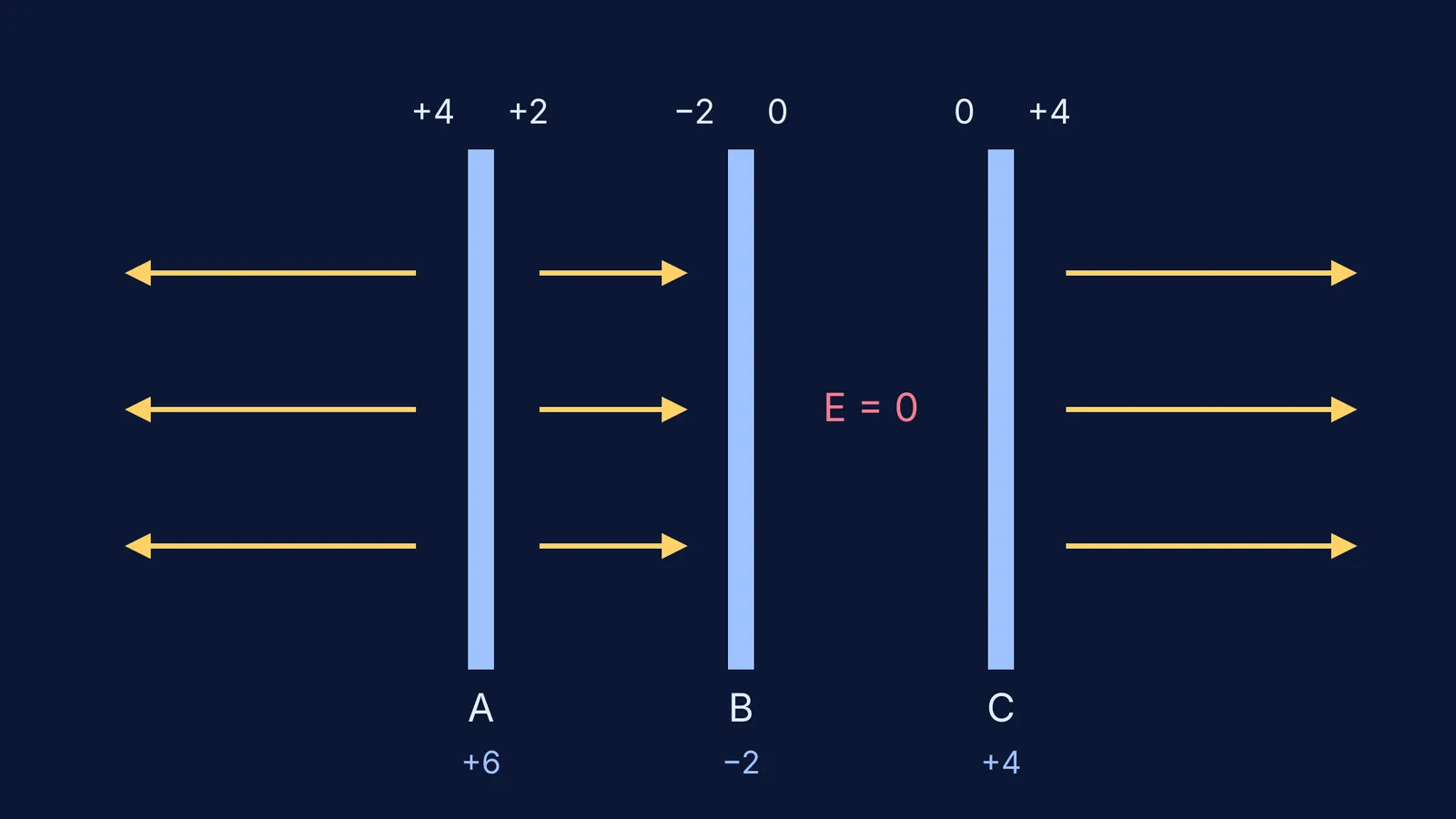
Plates A, B and C, left to right, carry +6 µC, −2 µC and +4 µC. Each has area 0.1 m².
Total charge = +8 µC, so the left face of A and the right face of C each carry +4 µC.
A's right face: 6 − 4 = +2 µC.
B's left face faces A's right face, so it is −2 µC. B's right face: −2 − (−2) = 0.
C's left face faces B's right face, so it is 0. C's right face: 4 − 0 = +4 µC.
What is the electric field between and outside the plates?
In each gap, the field is the charge on the inner face divided by Aε₀, pointing from the positive face to the negative one. Outside, it is q_out/(Aε₀), pointing away from the stack if the total is positive. Using ε₀ = 8.854 × 10⁻¹² C² N⁻¹ m⁻² from the NCERT chapter summary, for our example:
Left of A: (4 × 10⁻⁶)/(0.1 × 8.854 × 10⁻¹²) ≈ 4.5 × 10⁶ N/C, pointing left.
Between A and B: ≈ 2.3 × 10⁶ N/C, pointing from A to B.
Between B and C: zero, because the facing faces carry no charge.
Right of C: ≈ 4.5 × 10⁶ N/C, pointing right.
The zero gap means B and C sit at the same potential.
A capacitor with +Q and −Q has zero total charge, so both outer faces are bare and all the charge sits on the inner faces, giving a field of σ/ε₀ between them, as in OpenStax's two-plate example. Our post on series, parallel and energy stored in capacitors builds on this. If a plate is earthed, rule 1 no longer applies, because charge can flow to or from the earth and the total is not fixed.
A 60-second plan for the exam hall
Add every plate's charge, halve it, and write that on both outer faces.
Move left to right: inner face = plate charge minus the face you already filled.
Put the opposite charge on the face across the gap.
Check that the last face equals half the total.
Fields: face charge over Aε₀, from + to −.
This works because charge in a conductor moves until the field inside is zero, the same idea behind surface charge and shielding in conductors. If you want that idea in its own lesson, the Fermi Concept Library gives every physics concept its own lesson and its place in the map.
For more multi-plate and capacitor questions, the Fermi Problem Library has worked problems with a step-by-step solver that explains the reasoning rather than printing an answer.


