

On this page
Many students first try to find the speed of a chain sliding off a smooth table by looking at the forces. But as the chain slides, the amount of mass hanging off the edge keeps changing. That means the pulling force changes, the acceleration changes, and you have to set up an integral to solve the problem.
There is a faster way. Instead of tracking the force at every instant, you can compare the energy at the start and the end.
Why use the centre of mass?
The centre of mass is a hypothetical point where the entire mass of an object may be assumed to be concentrated to visualise its motion (Wikipedia).
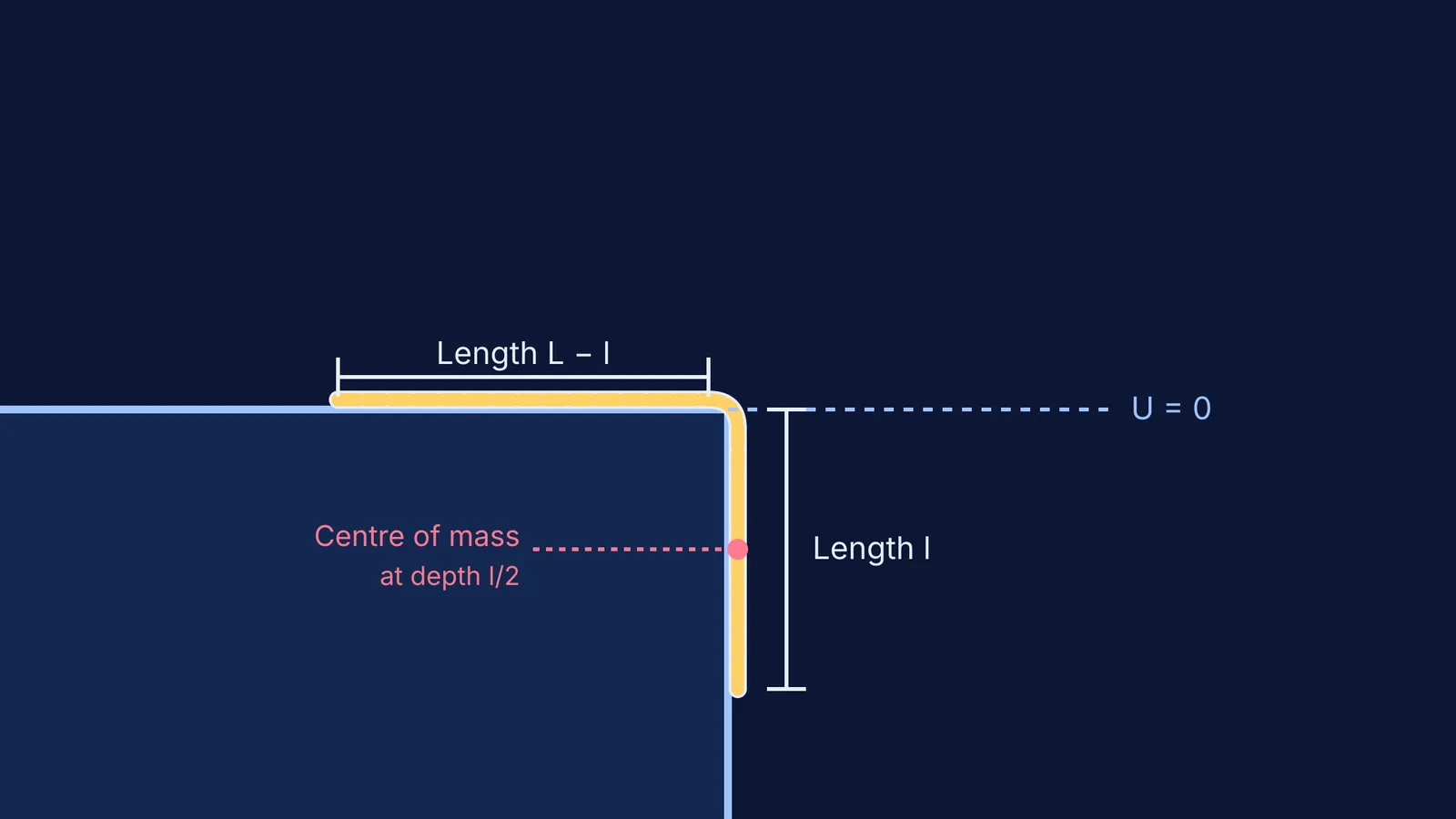
When dealing with a uniform chain, we treat the hanging part as a single mass located at its exact middle. The part of the chain still resting on the table has no gravitational potential energy (if we take the table surface as height zero).
If a length l is hanging down, its centre of mass is at a depth of l/2 below the table. If the chain's mass per unit length is λ, the mass of this hanging part is λl.
This means its initial potential energy is the mass (λl) times g times the height (−l/2).
Initial potential energy = −λgl²/2
What is the speed of a chain sliding off a smooth table?
To find the speed, we write down the energy at the start and the energy when the chain just leaves the table. Let the total length of the chain be L.
Initial state (at rest):
Kinetic energy = 0
Potential energy = −λgl²/2 (only length l is hanging)
Final state (just sliding off):
Kinetic energy = ½(λL)v² (the whole mass λL is moving at speed v)
Potential energy = −λgL²/2 (the whole length L is hanging, so its centre of mass is at −L/2)
By conservation of energy, the total initial energy equals the total final energy:
0 − λgl²/2 = ½(λL)v² − λgL²/2
Notice that the mass density λ cancels out entirely. This tells us a fascinating fact: the speed at which the chain leaves the table does not depend on how heavy or thick the chain is, but only on the proportions of its length and the strength of gravity. Rearranging to solve for v gives:
½Lv² = gL²/2 − gl²/2
v² = g(L² − l²) / L
v = √(g(L² − l²) / L)
How does a worked example look?
Suppose a uniform chain of length 2 m is held on a smooth table with 0.5 m hanging over the edge. What is its speed as it leaves the table? (Take g = 10 m/s²)
Here, L = 2 m and l = 0.5 m.
L² = 4
l² = 0.25
L² − l² = 3.75
Put these into the formula: v = √(10 × 3.75 / 2) v = √(18.75) v ≈ 4.33 m/s.
Problems involving continuous mass appear often in mechanics. Just as you use the centre of mass here, you will need similar integration ideas when finding the extension of a rod stretching under its own weight or the elastic potential energy in a stretched wire.
If you struggle to know when to use energy and when to use forces, the Fermi Problem Library has worked problems with a step-by-step solver that explains the reasoning rather than printing an answer. Fermi's AI tutor works out what you already know and builds a plan for the session, so you sit down to a clear next step.


