

On this page
When you look at a living cell under a microscope, you see a complex, highly organised machine full of distinct organelles. But what is it actually made of? If you break a cell down into its basic chemicals, you might be surprised to find that the vast majority of its weight is just water, with a small but critical fraction of organic molecules doing all the heavy lifting.
What is the average chemical composition of a cell?
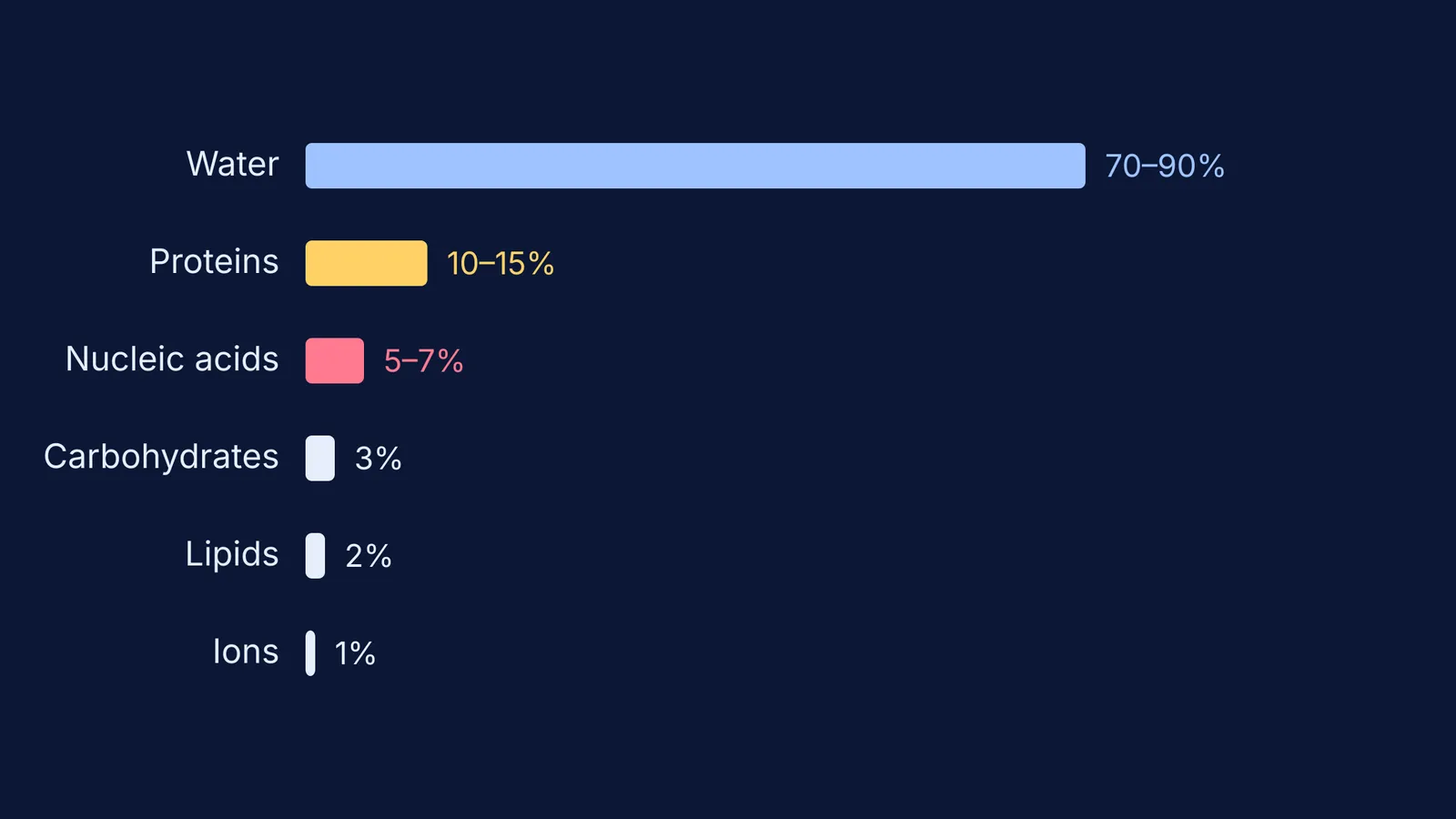
According to Chapter 9 (Biomolecules) of the Class 11 NCERT Biology syllabus, the average chemical composition of a typical cell is dominated by water and proteins [[1]](https://byjus.com/biology/biomolecules/). Here is the exact breakdown of the total cellular mass:
Water: 70–90%
Proteins: 10–15%
Nucleic acids: 5–7%
Carbohydrates: 3%
Lipids: 2%
Ions: 1%
Water is the most abundant component, accounting for 70–90% of the total cellular mass [[1]](https://byjus.com/biology/biomolecules/). This incredibly high water content is essential for life. Water acts as the universal solvent for the cell, creating an aqueous environment where all chemical reactions can take place. It also helps to regulate temperature, transport substances across the cell membrane, and maintain the cell's shape through turgor pressure.
Which biomolecule is the most abundant in a cell?
While water makes up the bulk of the total mass, proteins are the most abundant organic molecules in a cell. They make up 10% to 15% of the total cellular mass [[1]](https://byjus.com/biology/biomolecules/). Because water is so heavy, if you were to remove it all and measure the cell's dry weight, proteins would account for approximately 50% of that dry mass [[1]](https://byjus.com/biology/biomolecules/).
Proteins do almost everything in the biological world. They act as structural support in the cytoskeleton, form transport channels in the plasma membrane, and function as biological catalysts. For instance, the six enzyme classes that drive metabolic reactions are almost entirely made of folded proteins. They are polymers of amino acids arranged in polypeptide chains, and they take on complex primary, secondary, tertiary, and quaternary structures. Certain proteins like myosin even allow movement through the contraction of muscles [[1]](https://byjus.com/biology/biomolecules/).
Following proteins, the next most common biomolecules are nucleic acids (DNA and RNA), which make up 5% to 7% of the mass. The building blocks of these molecules, nucleosides and nucleotides, carry the genetic instructions required to build the proteins and govern cell division. The main function of these nucleic acids is the transfer of genetic information and the synthesis of proteins by translation and transcription [[1]](https://byjus.com/biology/biomolecules/).
Carbohydrates account for 3% of the cell's mass. They serve as the most abundant dietary source of energy and are structurally very important for many living organisms. For example, cellulose forms a major structural component in plant cell walls [[1]](https://byjus.com/biology/biomolecules/).
Lipids, making up 2%, are crucial for forming the cellular structure and serve as a chief source of energy. They include fats, waxes, sterols, fat-soluble vitamins, and phospholipids [[1]](https://byjus.com/biology/biomolecules/). Unlike carbohydrates, proteins, and nucleic acids, lipids are not polymeric molecules. They are insoluble in water but soluble in organic solvents.
A tiny 1% fraction consists of inorganic ions like potassium, sodium, and calcium, which are vital for transmitting nerve impulses and balancing cellular fluids [[1]](https://byjus.com/biology/biomolecules/). Together, these essential molecules form the primary metabolites involved in normal growth, unlike the primary and secondary metabolites found in certain plants that serve specific ecological roles.
How do you arrange the chemical composition in descending order?
A very common multiple-choice question in competitive exams like NEET asks students to arrange the chemical components of a cell in descending order of their abundance. Students often mistakenly assume lipids make up a larger percentage because they form the entire cell membrane, but lipids are actually much lighter than the bulky proteins packed inside the cell.
The correct descending order is: Water > Proteins > Nucleic acids > Carbohydrates > Lipids > Ions [[1]](https://byjus.com/biology/biomolecules/).
To easily remember this exact sequence during an exam, you can use a simple mnemonic checklist: Water Pours Naturally, Creating Life Inside.
Water (70–90%)
Proteins (10–15%)
Nucleic acids (5–7%)
Carbohydrates (3%)
Lipids (2%)
Ions (1%)
If you are revising these biomolecule structures and their cellular percentages, the Fermi Concept Library has every concept in physics, chemistry, biology, mathematics and computing, each with its own lesson and its place in the map. If you find yourself stuck on exam questions about cell mass or struggling to apply these facts to complex problems, Fermi's AI tutor works out what you already know, builds a plan for the session, and teaches through it—holding a line of reasoning rather than just printing an answer.


