

On this page
Organic chemistry relies on a dual naming system. While the International Union of Pure and Applied Chemistry (IUPAC) provides a systematic way to name every compound, common names stubbornly persist. In competitive exams and industrial chemistry, you are far more likely to see a question asking about "resorcinol" than "benzene-1,3-diol".
When you first encounter phenol derivatives, the sheer number of common names can feel overwhelming. However, matching the dihydric phenols (benzene rings with two hydroxyl groups) and the cresols (benzene rings with one hydroxyl and one methyl group) to their IUPAC names follows a strict positional logic.
What are the common names of dihydric phenols?
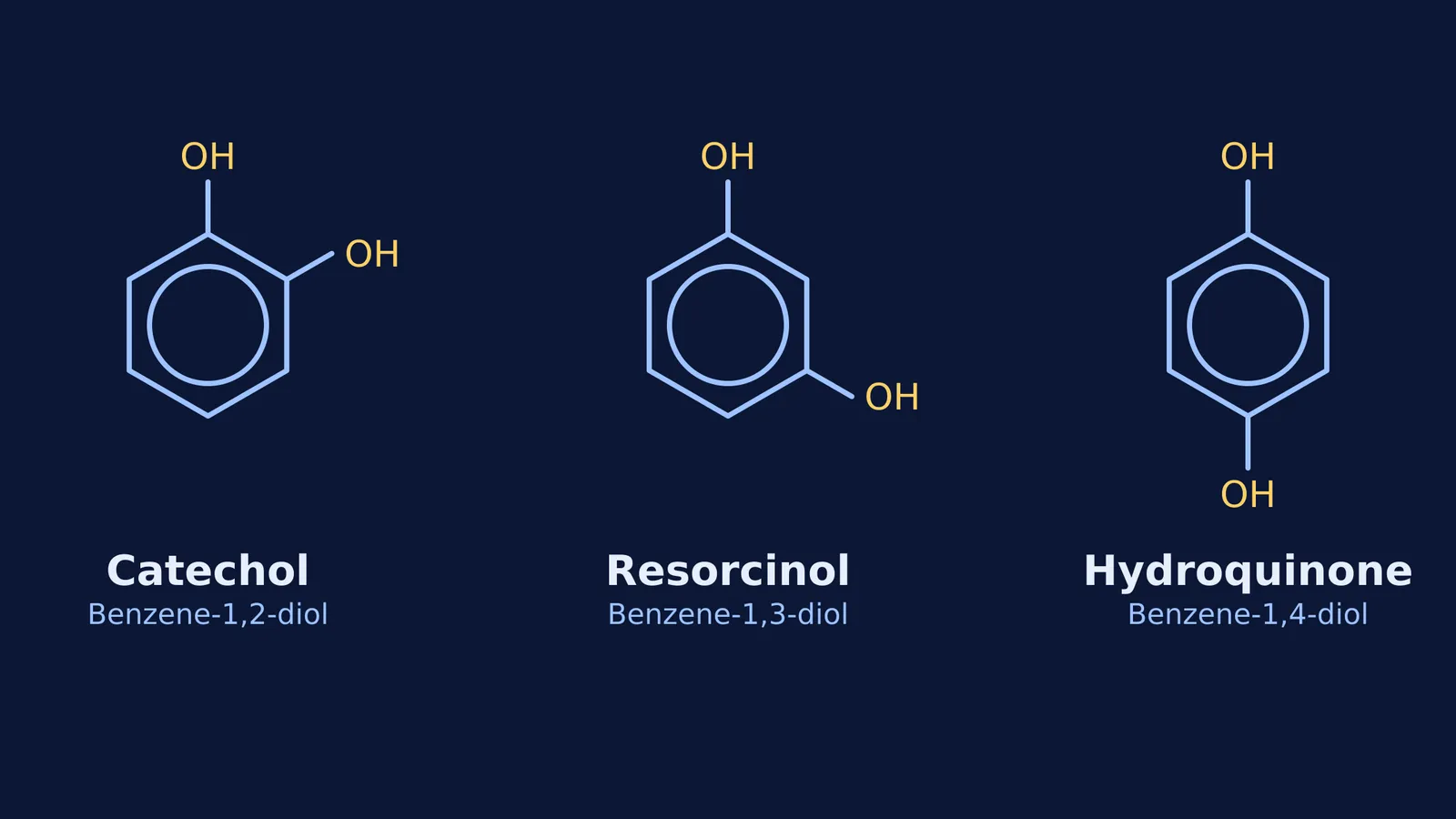
A dihydric phenol is a benzene ring bonded to exactly two hydroxyl (–OH) groups. Because a benzene ring is a regular, flat hexagon, there are only three possible unique ways to arrange these two groups relative to each other: at the 1,2, 1,3, or 1,4 positions. All three dihydric phenols share a molecular formula of C₆H₆O₂ and a molecular weight of 110.11 g/mol (PubChem).
Catechol is benzene-1,2-diol. The two hydroxyl groups sit on adjacent carbon atoms, giving it the *ortho* arrangement. It is a vital industrial chemical; approximately 20,000 tonnes of catechol are produced annually for use in pesticides, flavours, and fragrances (PubChem). In biology, the catechol structure forms the basis of catecholamines, a crucial class of neurotransmitters that includes dopamine and adrenaline.
Resorcinol is benzene-1,3-diol. The hydroxyl groups are separated by one bare carbon atom, placing them in the *meta* position. It frequently appears in medical treatments for skin conditions and in the manufacturing of adhesives for rubber tyres.
Hydroquinone (often called quinol) is benzene-1,4-diol. The hydroxyl groups sit exactly opposite each other on the aromatic ring, making it the *para* isomer. Because it easily oxidises to form benzoquinone, it is historically famous as a reducing agent in black-and-white photographic developers.
What are the IUPAC names of the cresols?
Cresols are structurally distinct from dihydric phenols, though they are often taught together. Instead of two hydroxyl groups, they feature one hydroxyl group and one methyl group (–CH₃) attached to a benzene ring. This makes their IUPAC parent name "phenol", with the methyl group treated as a substituent.
Just like the dihydric phenols, there are three positional isomers for the cresols:
o-Cresol (ortho-cresol) is 2-methylphenol. The methyl group sits right next to the hydroxyl group.
m-Cresol (meta-cresol) is 3-methylphenol. The methyl group is separated from the hydroxyl group by one bare carbon atom.
p-Cresol (para-cresol) is 4-methylphenol. The methyl group is located directly opposite the hydroxyl group on the ring.
In exams, cresols frequently appear as reactants in electrophilic aromatic substitution problems. This is because both the –OH group and the –CH₃ group are activating groups that push electron density into the benzene ring, making it highly reactive towards incoming electrophiles.
How do you solve nomenclature questions?
The challenge with common names is that test papers use them to obscure the structure of the starting material. If an examiner writes "hydroquinone is oxidised", they are actively testing whether you know it is benzene-1,4-diol before testing your knowledge of the oxidation reaction itself.
When you learn these compounds, always draw the structure rather than just reading the name. Connect the letters *o*, *m*, and *p* explicitly to the numbers 2, 3, and 4. A good habit is to mentally translate every common name into its IUPAC equivalent the moment you read the question.
If you forget a structure while working through a complex organic conversion, you can look up the nomenclature rules and structural diagrams directly in the Fermi Concept Library. Furthermore, when you are stuck on a reaction involving these phenols, the step-by-step solver in the Fermi Problem Library explains the reasoning rather than printing an answer. It will walk you through drawing the correct starting structure before tackling the underlying mechanism, ensuring you build the fundamental recognition skills required for organic chemistry.


