

On this page
The carbonyl group (>C=O) is the cornerstone of organic chemistry, found in aldehydes, ketones, carboxylic acids, and their derivatives. If you understand how this group is built and where its electrons lie, you can predict how thousands of different molecules will react.
What is the structure of the carbonyl group?
The carbonyl carbon is bonded to three other atoms: an oxygen atom and two other substituents (such as carbon or hydrogen). It uses sp² hybridization, meaning its three sigma (σ) bonds arrange themselves in a flat, trigonal planar shape.
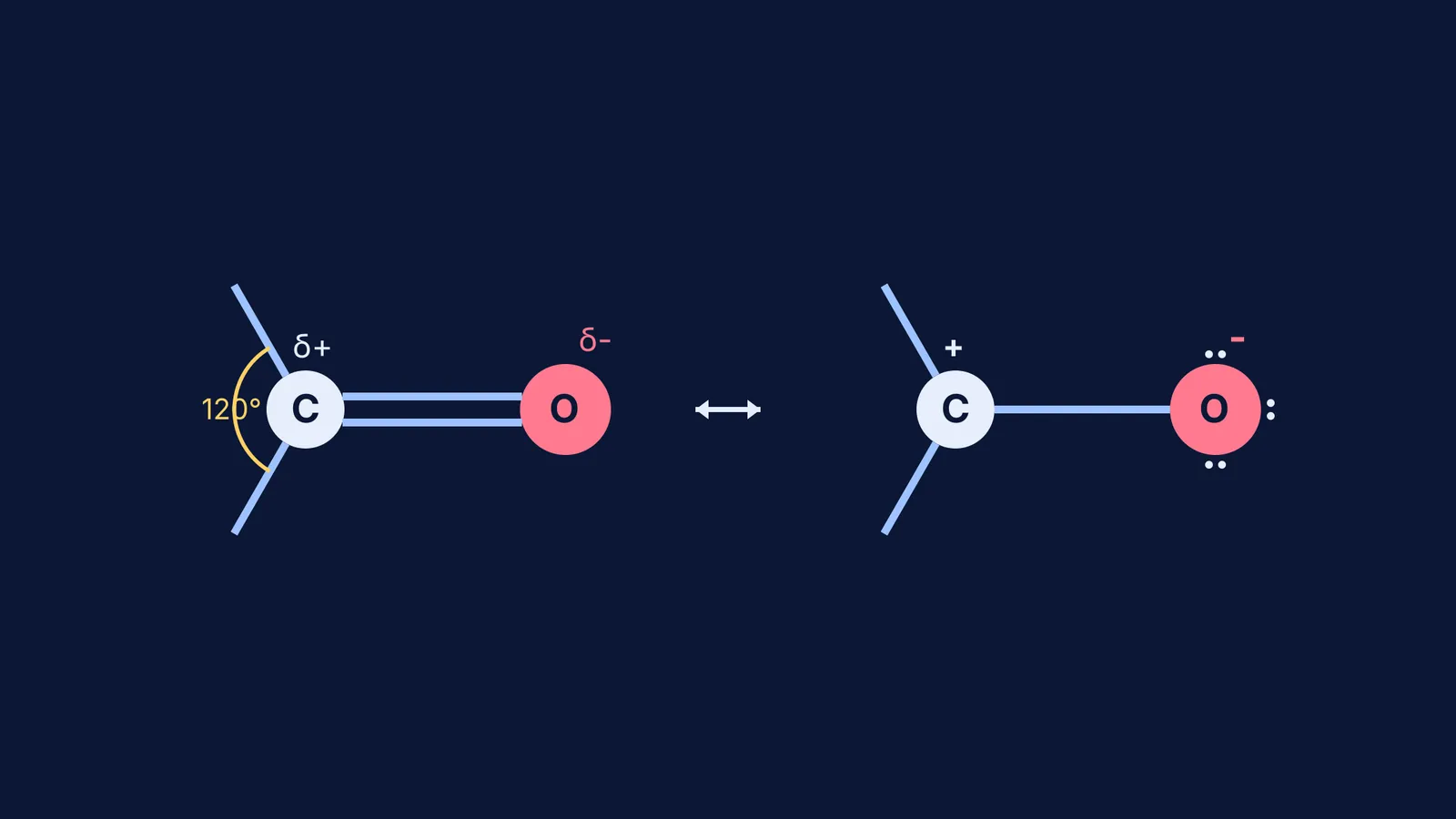
Because the atoms push away from each other as far as possible, the bond angles around the carbonyl carbon are approximately 120°. The remaining unhybridized p orbital on the carbon overlaps sideways with a p orbital on the oxygen, forming a pi (π) bond. Together, the σ and π bonds create the carbon-oxygen double bond, which typically has a length of about 120 picometres in organic molecules.
The double bond itself consists of two different types of connections. The first is a strong sigma (σ) bond, formed by the head-on overlap of sp² hybridized orbitals from both the carbon and the oxygen. The second is a pi (π) bond, created by the sideways overlap of the unhybridized p orbitals that sit above and below the flat plane of the atoms. Because sideways overlap is less efficient than head-on overlap, the π bond is weaker and more easily broken during chemical reactions. This combination of a strong σ framework and a vulnerable π electron cloud is exactly what makes the double bond so chemically active.
Why is the carbonyl group polar?
A bond's polarity comes from a tug-of-war for electrons. On the Pauling scale, carbon has an electronegativity of 2.55, while oxygen sits at a much higher 3.44. Because oxygen is significantly more electronegative, it pulls the shared electrons in the double bond strongly toward itself.
Electronegativity measures how strongly an atom attracts shared electrons in a chemical bond. Because oxygen's nucleus has more protons than carbon's nucleus for the same electron shell, it exerts a stronger pull. The π electrons are particularly mobile and easily drawn toward the oxygen atom, leaving the carbon atom partially stripped of its electron shield.
This unequal sharing creates a permanent dipole. The oxygen atom takes on a partial negative charge (δ−), leaving the carbon atom with a partial positive charge (δ+).
Chemists often represent this reality using resonance. The true structure is a hybrid of two extremes: one with a neutral double bond, and a dipolar contributor where the oxygen holds a full negative charge and the carbon holds a full positive charge. This resonance places a pronounced positive character on the carbon atom.
How does polarity explain its reactivity?
The partial positive charge turns the carbonyl carbon into an electrophile (an electron-seeker or Lewis acid). It acts as a magnet for nucleophiles—electron-rich species like hydroxide ions, cyanide ions, or amines.
When a nucleophile approaches, it aims for the carbon atom because opposite charges attract. The nucleophile brings its own pair of electrons to form a new sigma bond with the carbon. However, carbon can only maintain four bonds at a time. To make room for the incoming nucleophile, the weak π bond of the carbonyl group breaks. The two electrons that once formed the π bond shift entirely onto the oxygen atom, giving it a full negative charge. The carbon atom, which was originally flat and sp² hybridized, rehybridizes to sp³ and takes on a tetrahedral shape. This fundamental step—nucleophilic addition—is the opening move in almost every reaction involving a carbonyl compound.
Because the carbonyl carbon sits flat in its sp² plane, nucleophiles have a clear, unblocked path to attack from either directly above or below the plane. Conversely, the oxygen’s partial negative charge makes it a nucleophile (a Lewis base) that readily accepts protons from acids.
To map out how this functional group governs these chemical reactions, explore the Concept Library. If you find it hard to picture the 3D orbital overlap or the geometry of a nucleophile's approach, Fermi's AI tutor can draw the figure and run the simulation right alongside your notes.
How do you predict carbonyl reactions?
When you look at a new carbonyl reaction, ask yourself three questions:
Find the electrophile: The carbonyl carbon is electron-deficient.
Find the nucleophile: Look for the molecule with a lone pair or a negative charge.
Check the substituents: Bulky groups attached to the carbonyl carbon will block the nucleophile's approach, making the reaction slower—a key reason why aldehydes (like those in the Cannizzaro reaction) generally react faster than ketones.
By spotting the δ+ and δ− charges, you never have to memorise organic reactions blindly; you just follow the electrons. To see how these principles apply to reduction, read our guide on the Clemmensen and Wolff-Kishner reactions.


