

On this page
The 1°, 2°, 3° and 4° labels for a carbon come from one count: how many other carbon atoms are bonded to the carbon in question. Get it right and alcohol classes, the Lucas test, SN1 versus SN2 and carbocation stability follow.
What makes a carbon primary, secondary, tertiary or quaternary?
A primary (1°) carbon is attached to one other carbon atom, according to the LibreTexts organic chemistry text on alkyl groups. A secondary (2°) carbon is attached to two other carbons, a tertiary (3°) carbon to three and a quaternary (4°) carbon to four.
Count only carbon neighbours; hydrogens, oxygens and halogens do not add to the degree. A carbon with no carbon neighbours, as in CH3OH or CH3Cl, is simply methyl.
How do you check the count using hydrogens?
A saturated carbon bonded only to carbon and hydrogen has four bonds, so its hydrogens give the answer away:
CH3 at a chain end: one carbon neighbour, so 1°
CH2 inside a chain: two carbon neighbours, so 2°
CH at a branch point: three carbon neighbours, so 3°
C with no hydrogen: four carbon neighbours, so 4°
Hydrogens take the name of their carbon, and the LibreTexts section notes there is no quaternary hydrogen: a 4° carbon has no bond left for one.
When the carbon also carries an –OH or a halogen, that group uses one bond. So a 1° carbon bearing –OH is CH2OH, a 2° one is CHOH and a 3° one has no hydrogen at all.
Worked example: every carbon in 2,2,4-trimethylpentane
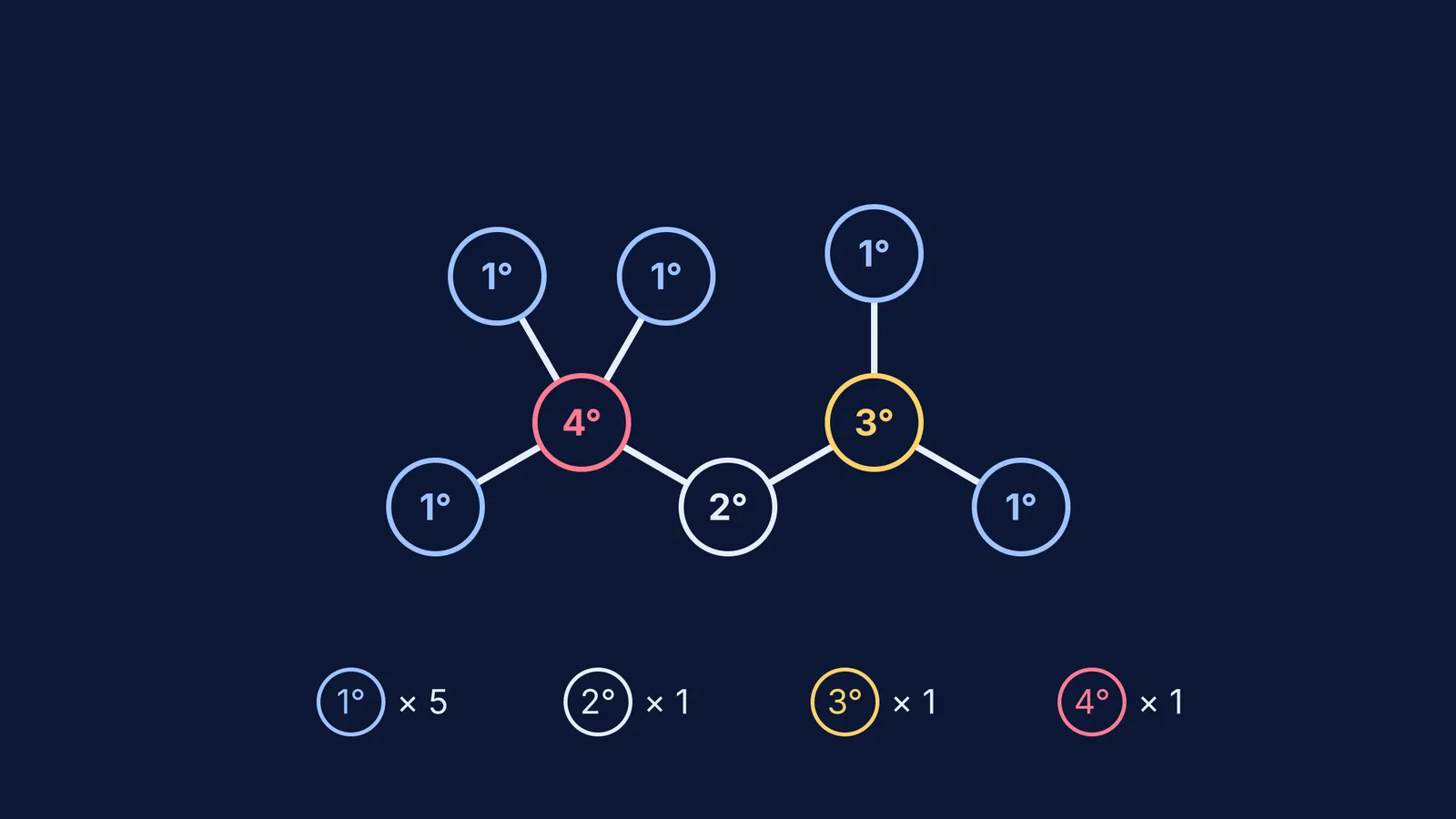
Take 2,2,4-trimethylpentane, (CH3)3C–CH2–CH(CH3)–CH3, the molecule in the diagram above and in the LibreTexts worked example. Walk along it:
C1, the CH3 at the left end, bonds only to C2: 1°.
C2 bonds to C1, C3 and two methyl groups and has no hydrogen: 4°.
The two methyls on C2 each bond only to C2: 1° each.
C3, the CH2, bonds to C2 and C4: 2°.
C4, the CH, bonds to C3, C5 and its own methyl: 3°.
C5 and the methyl on C4 are CH3 ends: 1° each.
Tally: five primary, one secondary, one tertiary and one quaternary carbon. Check the hydrogens: 15 primary + 2 secondary + 1 tertiary = 18, matching C8H18. If your total does not match the formula, you have misread a branch.
How does the label apply to alcohols and alkyl halides?
NCERT's Class 12 unit on alcohols, phenols and ethers classifies an alcohol as primary, secondary or tertiary by the carbon the –OH is attached to, and its intext questions include (CH3)3C–CH2OH, the trap in the box above. The NCERT haloalkanes unit does the same for alkyl halides: the halide is 1°, 2° or 3° according to the carbon carrying the halogen.
The label then predicts behaviour. In the Lucas test (concentrated HCl with ZnCl2), tertiary alcohols turn the solution turbid immediately, while primary alcohols give no turbidity at room temperature, as the NCERT alcohols unit describes. To practise on real isomers, our guide to telling the four C4H10O alcohols and three ethers apart classifies each one.
Why do carbocation questions care about 1°, 2° and 3°?
A carbocation takes its degree from the positively charged carbon. NCERT's Class 11 unit on basic principles of organic chemistry gives the stability order (CH3)3C+ > (CH3)2CH+ > CH3CH2+ > CH3+, explained by hyperconjugation. Its worked problem credits the nine C–H bonds of the tert-butyl cation; in the methyl cation the empty p orbital is perpendicular to the plane of the C–H bonds, so they cannot overlap with it.
That order drives the haloalkane mechanisms. The NCERT haloalkanes unit states that 3° alkyl halides undergo SN1 very fast because of the high stability of 3° carbocations. For SN2, the same unit's Figure 6.3 gives relative rates of 30 for a methyl halide, 1 for ethyl (1°), 0.02 for isopropyl (2°) and 0 for tert-butyl (3°), because bulky groups block the incoming nucleophile. Our explainers on predicting SN1 versus SN2 in haloalkanes and ranking carbocations, carbanions and free radicals take these ideas further.
If hyperconjugation still feels shaky, the Fermi Concept Library gives each chemistry concept its own lesson and its place in the map, so you can step back one idea.
A 30-second checklist for exam questions
Find the carbon that matters: the one holding the –OH, the halogen or the + charge.
Count its carbon neighbours only. Ignore H, O and halogens.
Cross-check with hydrogens: CH3 is 1°, CH2 2°, CH 3°, bare C 4°, one H fewer if the carbon carries a group.
For a whole molecule, check that your hydrogen total matches the formula.
Translate the label: 3° means a stable carbocation, fast SN1 and immediate Lucas turbidity; methyl and 1° favour SN2.
If the count is right but the answer is still wrong, the slip is usually later in the mechanism. Working a few questions in the Fermi Problem Library, where a step-by-step solver explains the reasoning rather than printing an answer, lets you compare each step with your own working.


