

On this page
When a car drives through a sharp dip in the road, the passengers get pressed into their seats, and the car's suspension compresses heavily. This happens because the road is not just supporting the car's weight; it is also forcing the car to change direction and curve back upward.
In physics, a dip is modelled as a concave bridge or a circular arc. To stay on this curved path, the car requires a net force pointing toward the centre of the circle. This upward push is provided by the normal force from the road. Understanding this relationship is a core part of mechanics, much like analysing motion in a plane from position vectors to find velocity and acceleration.
Why does a car feel heavier at the bottom of a dip?
Whenever an object moves in a circular path, it experiences a centripetal acceleration directed toward the centre of the curve. According to OpenStax University Physics, the net force required to maintain this motion is F_c = mv²/r.
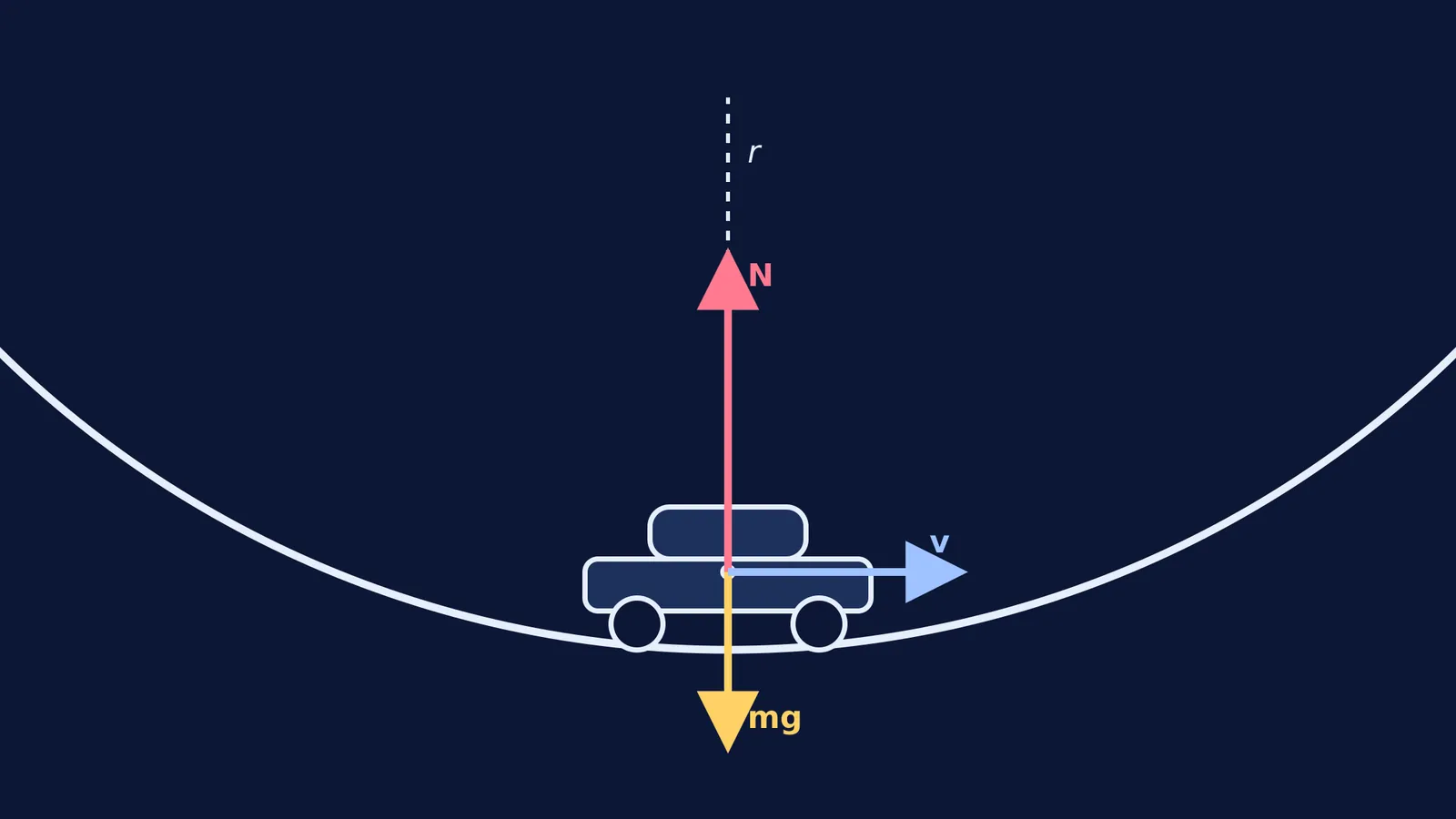
At the exact bottom of a dip, two main vertical forces act on the car:
Weight (mg): The force of gravity pulling the car straight down toward the centre of the Earth.
Normal force (N): The contact force from the road pushing the car straight up.
Because the centre of the circular arc is directly above the car, the net force must be directed upward. Therefore, the upward normal force must be strictly greater than the downward weight. We write Newton's second law for the lowest point as:
N − mg = mv²/r
Rearranging this gives the normal force:
N = mg + mv²/r
The normal force is your "apparent weight"—it is the force you feel pressing against you. Since N is greater than your actual weight (mg), you feel heavier. This same principle dictates why a car over a hump feels lighter: over a convex bridge, the centre of the circle is below, making the normal force less than gravity. If you want to explore how these forces fit together, the Fermi Concept Library has every concept in physics, each with its own lesson and its place in the map.
How does this compare to driving on a flat road?
When a car travels at a constant speed on a perfectly flat, horizontal road, there is no vertical acceleration. The centre of curvature is effectively at an infinite distance, meaning the term mv²/r becomes zero. In this scenario, Newton's second law simplifies significantly. The normal force exactly balances the force of gravity, leaving you with N = mg.
Hitting a dip abruptly changes this balance. The suspension system, which is normally calibrated to support the weight of the car on flat ground, suddenly has to handle the additional force required to push the mass of the car upward along the curve. This is the mechanical reason why driving through a pothole or a dip at high speed can cause the suspension to bottom out and strike the chassis.
How do you calculate normal force on a concave bridge?
To find the normal force, you need the car's mass, its speed, and the radius of the dip. Let's look at a worked example that mirrors the problems you might see in a physics test.
Worked Example: A car of mass 1000 kg is travelling at 20 m/s through a dip with a radius of curvature of 50 m. Take g = 9.8 m/s². What is the normal force on the car at the lowest point?
Calculate the weight: mg = 1000 kg × 9.8 m/s² = 9800 N
Calculate the required centripetal force: mv²/r = 1000 kg × (20 m/s)² / 50 m = 8000 N
Add them to find the normal force: N = 9800 N + 8000 N = 17800 N
In this scenario, the normal force is much greater than the car's stationary weight. The vehicle's suspension must be able to absorb this massive temporary load. If you get stuck applying these equations to different angles along the curve or setting up the initial free-body diagram, Fermi's AI tutor can build a plan for your session and work through the problem alongside you.
What happens if the speed increases?
Looking at the equation N = mg + mv²/r, the normal force depends heavily on the car's velocity because the speed is squared.
If the car stops at the bottom (v = 0), the centripetal term disappears, and N = mg.
As you drive faster, the mv²/r term grows rapidly, making the normal force climb quadratically.
A tighter turn (smaller radius r) also increases the normal force because r is in the denominator.
When solving mechanics problems for exams like JEE or NEET, carefully distinguishing between the net force and the individual applied forces is crucial. Drawing the vectors accurately helps prevent sign errors when substituting values into the formula. For guided practice on circular motion problems, the step-by-step solver in the Fermi Problem Library explains the reasoning behind each step rather than just printing the final answer.


