

On this page
One of the most common places to stumble in electrostatics is looking at a capacitor filled with two different dielectric materials and choosing the wrong equivalent circuit. Do you add the capacitances together, or do you add their reciprocals?
The rule depends entirely on how the materials divide the space between the plates. Picking the right picture first turns a confusing problem into a simple circuit calculation.
Why does a dielectric change capacitance?
Before looking at combinations, it helps to remember what a single dielectric does. An insulating material inserted between the plates of a capacitor becomes polarised by the electric field. This polarisation creates an opposing internal electric field, which weakens the overall field between the plates. A weaker field means a lower potential difference for the same amount of stored charge, which increases the overall capacitance.
When you have a capacitor filled with two dielectrics, the way these opposing fields interact with the plates determines whether you use the series or parallel rule.
Is a capacitor with two dielectrics side by side in series or parallel?
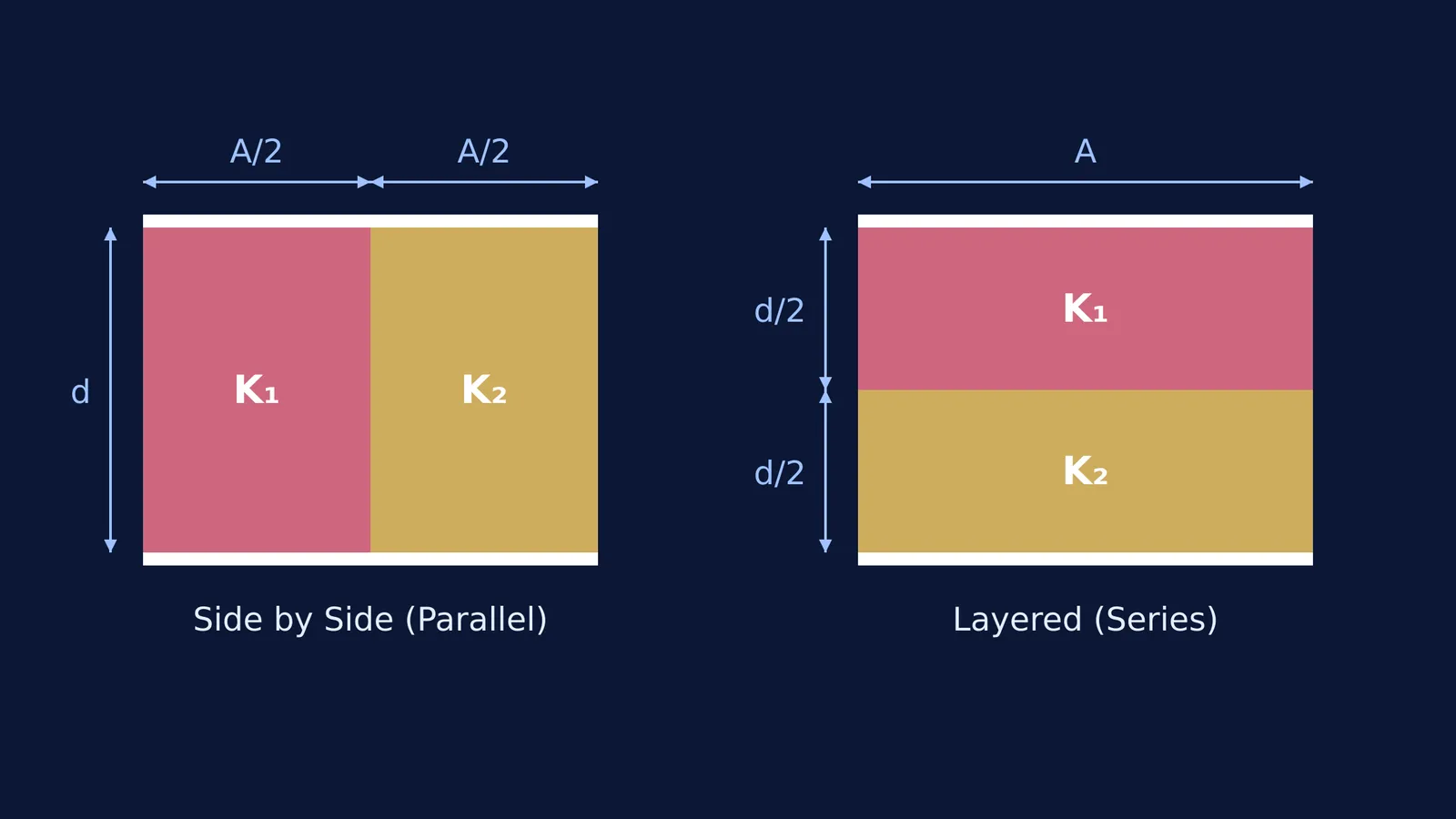
When two dielectrics are placed side by side, they stand vertically between the two horizontal capacitor plates. In this arrangement, the area A of the plates is split between the two materials, but both materials span the full separation distance d.
Because the top and bottom of each dielectric are in contact with the same two conducting plates, they share the exact same potential difference (voltage). When components share the same voltage, they are in parallel.
According to the physical principles of dielectrics, a side-by-side arrangement is modelled as two capacitors connected in parallel. You find the total equivalent capacitance C by simply adding them: C = C₁ + C₂
If each dielectric fills exactly half the area, their individual capacitances are C₁ = ε₀K₁A / (2d) and C₂ = ε₀K₂A / (2d), where K₁ and K₂ are the relative permittivities (dielectric constants).
What is the equivalent capacitance of layered dielectrics?
If the dielectrics are stacked like layers in a cake, the dividing line between them runs parallel to the plates. In this case, each material covers the full area A, but they split the total separation distance d.
Here, the electric field must pass through one material and then the next. The charge on the plates remains identical across the cross-section, but the total voltage is divided between the two layers. When components share the same charge but split the voltage, they are in series.
According to the rules for capacitors, the equivalent capacitance of stacked layers is found by adding their reciprocals: 1/C = 1/C₁ + 1/C₂
If each layer takes up exactly half the distance, their individual capacitances are C₁ = 2ε₀K₁A / d and C₂ = 2ε₀K₂A / d.
Calculating the effective dielectric constant
Examiners often ask for the "effective dielectric constant" (K_eff) of the entire combination. This is the single value of K that would give a uniform, identically sized capacitor the exact same total capacitance as your two-part system.
To find it, you set your calculated equivalent capacitance equal to the standard formula for a uniform capacitor: C = ε₀K_eff A / d
Side by side (equal areas) For two dielectrics side by side filling equal areas, the capacitances add directly. C = (ε₀K₁A / 2d) + (ε₀K₂A / 2d) C = (ε₀A / 2d) × (K₁ + K₂)
Equating this to the uniform capacitor formula, the ε₀A/d terms cancel out. This leaves you with the arithmetic mean of the two constants: K_eff = (K₁ + K₂) / 2
Layered (equal thicknesses) For two layered dielectrics filling equal thicknesses, you must add their reciprocals. 1/C = [d / (2ε₀K₁A)] + [d / (2ε₀K₂A)] 1/C = [d / (2ε₀A)] × (1/K₁ + 1/K₂)
To find C, you take the reciprocal of the entire right side and equate it to the uniform formula. Once again, the physical dimensions cancel out, yielding the harmonic mean: K_eff = 2K₁K₂ / (K₁ + K₂)
Getting help when the circuit looks strange
These two standard cases are just the beginning. Exams often feature dielectrics split diagonally, or partially filled spaces that require you to break the problem into a mix of series and parallel sections.
If you get stuck trying to identify how the parts of a capacitor connect, Fermi's AI tutor can help. Instead of just giving you the final answer, Fermi works out what you already know and builds a plan for the session, drawing the equivalent circuit on the board to teach you how to recognize the shared voltage or charge yourself.
You can review derivations of these standard electrostatic formulas in the Fermi Concept Library, or try your hand at mixed-dielectric circuits with guided help in the Fermi Problem Library.
Related posts:


