

On this page
Electric potential helps us map out the invisible landscape of an electric field. Just as a physical landscape has areas of equal height, an electric field has regions of equal potential. Understanding how these regions behave is crucial for mastering electromagnetism.
Can two equipotential surfaces intersect?
The short answer is no. Equipotential surfaces represent regions in space where the electric potential is exactly the same.
To understand why, imagine what would happen if two different equipotential surfaces—for example, one surface sitting at 10 V and another at 20 V—were to cross paths. The points lying along their line of intersection would have to take on two different potential values simultaneously. Because electric potential is a scalar quantity that assigns exactly one value to every point in space, a single point cannot have two potentials at once (Physics LibreTexts/Book%3A_University_Physics_II_-_Thermodynamics_Electricity_and_Magnetism_(OpenStax)/07%3A_Electric_Potential/7.06%3A_Equipotential_Surfaces_and_Conductors)).
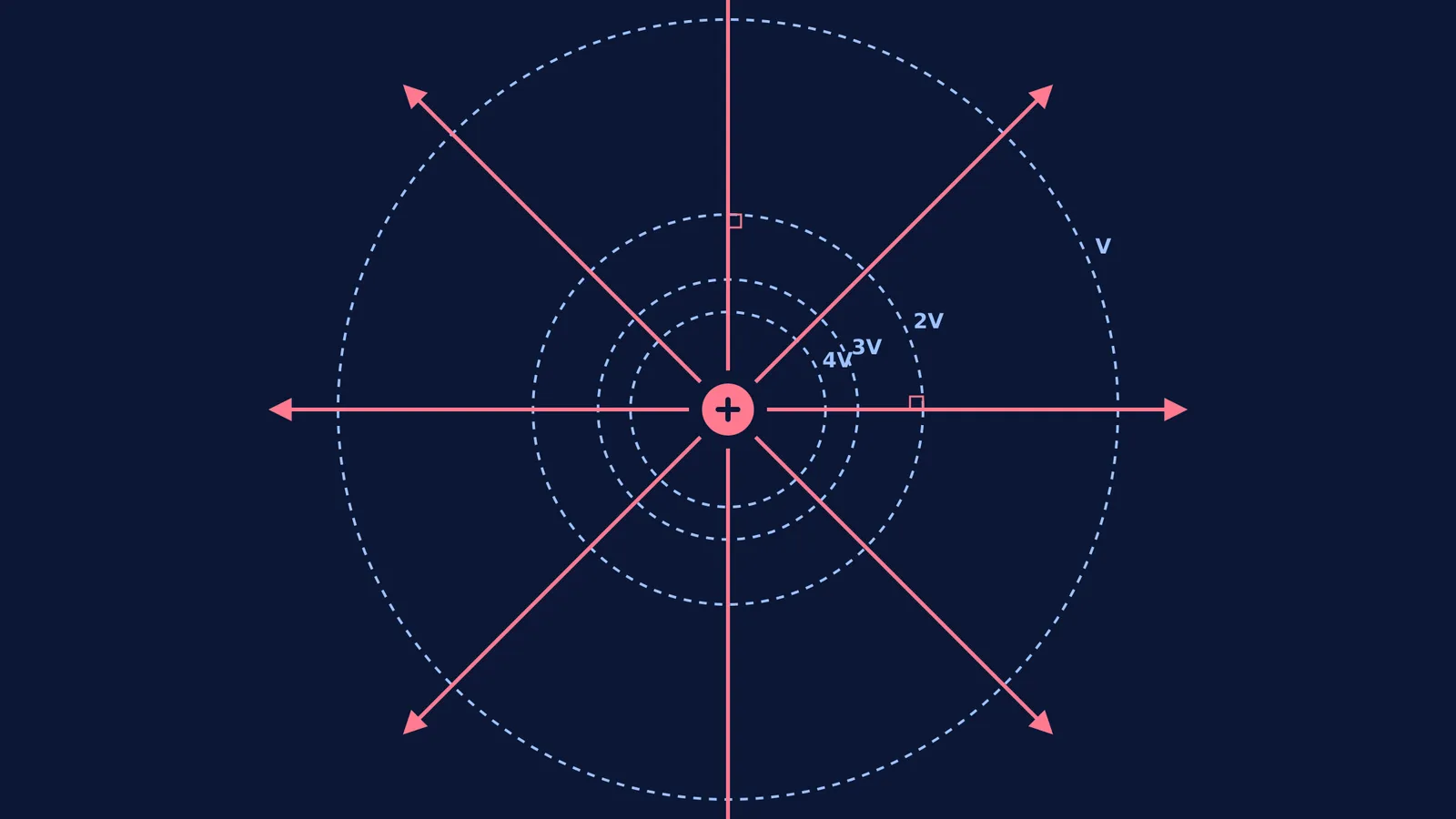
This rule holds true no matter how complex the arrangement of charges becomes. Whether you are dealing with a single isolated point charge, a dipole, or an intricate array of multiple charges, the surfaces of equal potential will bend, warp, and wrap around each other, but they will never cross. You can see how these surfaces shape up around different charge arrangements in our guide on Where is potential zero near two charges? Finding the points.
Why do field lines meet equipotentials at right angles?
The second reason they cannot intersect comes down to the electric field itself. The electric field lines must always be perpendicular to an equipotential surface.
When you move a test charge along an equipotential surface, the change in potential (ΔV) is exactly zero. Since electrical work is defined as W = qΔV, absolutely no work is done moving the charge along that surface. However, work is also defined in mechanics as the dot product of force and displacement (W = F · d). The electric force is F = qE. For the total work to be zero while moving a charge through a non-zero electric field, the electric field vector (E) must sit at exactly 90 degrees to the displacement vector (d).
If two equipotential surfaces intersected, the electric field at that exact point of intersection would have to be perpendicular to both surfaces at the same time. This would require the net electric field to point in two different directions simultaneously. Since a net vector can only have one direction at any given point in space, intersection is physically impossible.
This mathematical relationship is explored further in Finding E from V: using E = −dV/dx with graphs and formulas, where we show how the electric field acts as the negative spatial gradient of the potential.
How to answer this in an exam
This concept frequently appears as a short-answer question in board exams like CBSE and competitive entrance tests like JEE and NEET. When asked to prove or explain why equipotential surfaces cannot intersect, keep your answer brief and focused on the two core contradictions.
A perfect two-mark response should include:
The potential contradiction: State clearly that an intersection would mean a single point in space holds two different values of electric potential. Mention that potential is a single-valued scalar function, making this logically impossible.
The direction contradiction: State that the electric field is always normal (perpendicular) to the equipotential surface. If two surfaces crossed, the field would be forced to have two different normal directions at the identical point, which violates the vector nature of the net electric field.
You can also draw a quick, simple diagram showing two crossing lines, drawing two different perpendicular arrows from the intersection point, and placing a large cross through it to illustrate the impossible physics.
Building a better intuition for fields
Memorising these rules is one thing, but visualising them makes solving complex electrostatics problems much easier. If you struggle to picture these 3D shapes and field lines in your head, the Fermi Simulation Lab lets you drop point charges onto a grid and instantly see the equipotential lines and field vectors drawn around them. Playing with the simulation shows exactly how the lines bend but never cross, giving you a concrete mental model to rely on during exams.
When you encounter problems that require setting up the math from scratch, the Fermi Problem Library offers a step-by-step solver that explains the reasoning behind each step of a calculation. To review the foundational theory behind the formulas, the Fermi Concept Library holds complete, step-by-step lessons mapping out electric fields and potentials.


