

On this page
In the first experiment of the CBSE Class 10 science syllabus, a piece of magnesium ribbon is held with tongs and set alight. The burning magnesium ribbon activity (Activity 1.1) is a classic demonstration of a combination reaction and an exothermic process.
Before we light the burner, we have to prepare the metal, and once it burns, it leaves behind a chemical story we can read with litmus paper.
Why do we rub magnesium ribbon with sandpaper before burning?
Magnesium is a highly reactive metal. When it sits in a laboratory drawer, it slowly reacts with oxygen in the air to form a protective layer of magnesium oxide on its surface.
This dull, greyish layer is stable and prevents the magnesium underneath from catching fire easily. If you try to light the ribbon as it is, it will struggle to burn. We rub the ribbon with sandpaper to scrape away this oxide layer, exposing the pure, shiny magnesium metal to the oxygen it needs to combust.
What happens when magnesium burns?
When you hold the cleaned ribbon in the flame of a spirit lamp or Bunsen burner, two clear things happen:
The dazzling white flame: The magnesium catches fire and burns with an intense, brilliant white light. The reaction releases a huge amount of energy as heat and light. To protect your eyes, you should wear suitable eyeglasses and hold the ribbon as far away as possible.
The white ash: As it burns, the solid ribbon crumbles into a white powder. If you hold a watch glass underneath, you can collect this ash.
These observations tell us that a chemical change has occurred: the solid metal and a gas in the air have combined to form a completely new solid substance. You can read more about identifying these changes in our guide to Types of chemical reactions in Class 10: balancing and examples.
How to write the balanced chemical equation?
The burning of magnesium is a combination reaction. The magnesium metal (Mg) reacts with the oxygen gas (O₂) in the air to form the white powder, which is magnesium oxide (MgO) (NCERT).
First, we write the word equation: Magnesium + Oxygen → Magnesium Oxide
Next, we write the skeletal chemical equation using symbols: Mg(s) + O₂(g) → MgO(s)
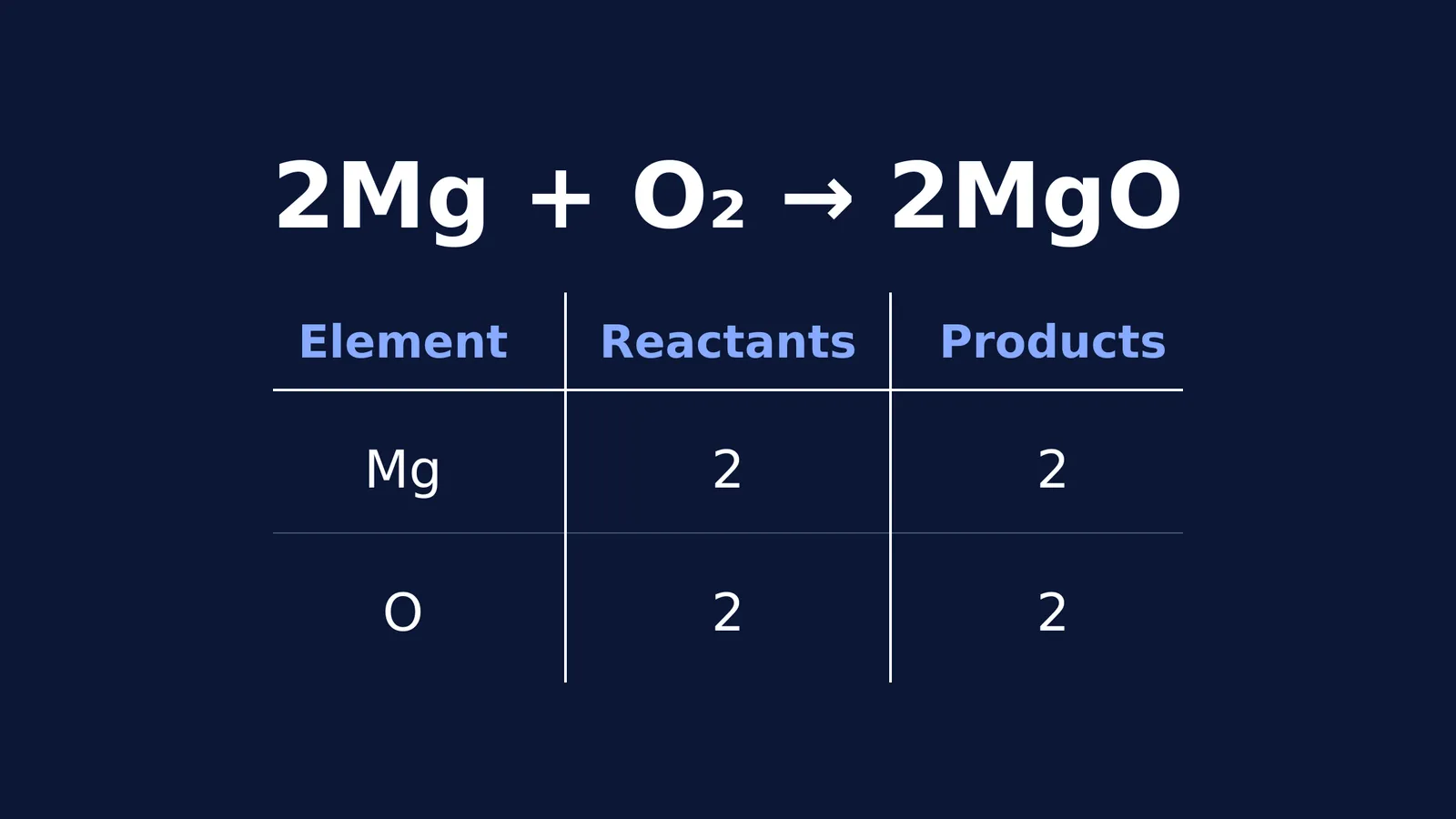
Because oxygen naturally travels in pairs (O₂), we start with two oxygen atoms on the left but only have one on the right. To fix this, we put a 2 in front of the MgO, which gives us two magnesium atoms and two oxygen atoms on the right. Finally, we put a 2 in front of the Mg on the left.
The balanced chemical equation is: 2Mg(s) + O₂(g) → 2MgO(s)
If you are making wrong-method mistakes when balancing atoms on each side of an equation, the Fermi Problem Library has worked problems with a step-by-step solver that explains the reasoning. You can also review the rules in our article on Balancing chemical equations in Class 10: a method that always works.
Is magnesium oxide acidic or basic?
Once you have collected the white magnesium oxide ash in a watch glass, you can test its chemical nature. Most metal oxides are basic, and we can prove this with a simple test.
Take the white powder and mix it with a little water in a test tube. The magnesium oxide reacts with the water to form magnesium hydroxide, a weak alkali.
If you dip red litmus paper into this solution, the paper will turn blue. A blue result on red litmus paper confirms that the solution is basic. (Blue litmus paper will stay blue.) This fits the general rule you will learn when studying Metals and non-metals in Class 10: reactivity series and ionic bonds: metallic oxides are basic in nature.
A checklist for Activity 1.1
When you perform or write about this experiment in an exam, make sure you can check off these key points:
Preparation: Did you mention rubbing the ribbon with sandpaper to remove the oxide layer?
Observation 1: Did you describe the "dazzling white flame"?
Observation 2: Did you identify the white powder as magnesium oxide?
Equation: Did you write the balanced equation with state symbols (s for solid, g for gas)?
Nature of product: Do you know that the oxide turns red litmus blue?


