

On this page
The bacterium *Bacillus thuringiensis* (Bt) is famous for its role in agriculture and pest control, but a common question arises in biology studies: if the bacterium produces such a potent toxin, why doesn't the toxin kill the bacterium itself?
The short answer comes down to the environment. The protein is manufactured in a harmless state and requires very specific conditions—found only inside the digestive tracts of certain insects—to become lethal.
Why does the Bt toxin not kill the bacterium itself?
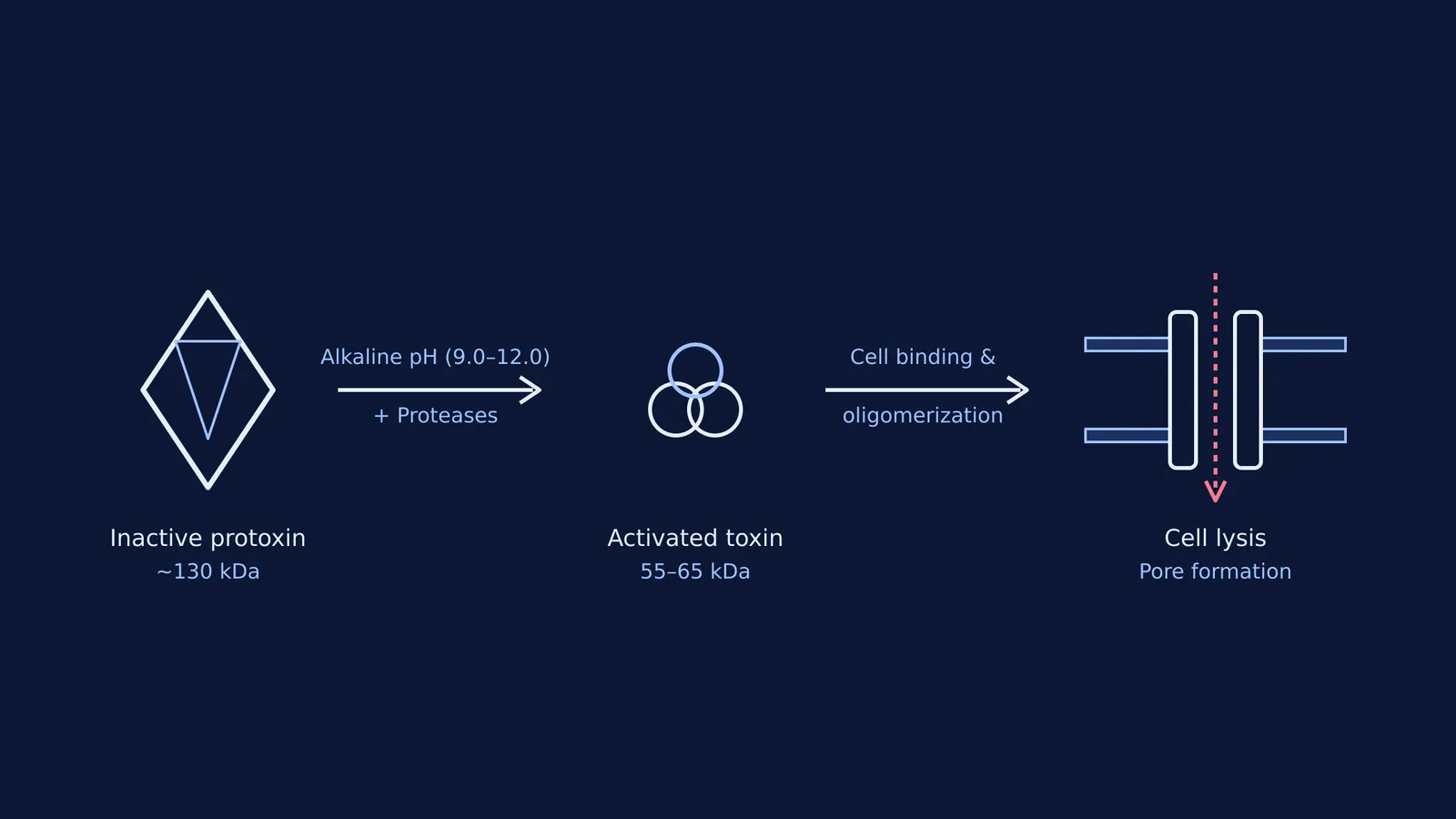
During its sporulation phase, *Bacillus thuringiensis* produces parasporal crystalline inclusions. These crystals are made of inactive proteins known as protoxins, which typically have a mass of approximately 130 kDa Wei et al., 2016.
Because the internal environment of the bacterium is near neutral in pH and lacks the necessary activating enzymes, the protoxin remains locked in its crystalline, inactive form. It poses absolutely no threat to the bacterium that synthesised it.
How does the protoxin activate in the insect gut?
The transformation from a harmless crystal to a deadly toxin begins the moment a susceptible larva, such as a caterpillar, ingests the Bt spores and crystals.
The midgut of these target insects is highly alkaline, with a pH ranging from 9.0 to 12.0 Pardo-López et al., 2013. This extreme alkalinity is the first key requirement: it dissolves the crystalline structure, releasing the soluble protoxin into the gut fluid.
Once solubilized, the protoxin encounters midgut proteases, particularly serine proteases like trypsin and chymotrypsin. These enzymes cleave the larger protoxin, stripping away its ends to yield a smaller, activated toxin core weighing 55–65 kDa Wei et al., 2016.
Understanding enzyme specificity here is much like understanding the six enzyme classes—the proteases must cleave at exactly the right sites to activate the toxin without destroying it entirely.
What happens to the midgut cells?
The activated toxin core must then find its target. It binds to specific receptors, such as cadherin-like proteins and aminopeptidase N, located on the brush border membrane of the insect's midgut epithelial cells.
After binding, the toxin molecules undergo a structural shift and group together (oligomerize). They insert themselves into the cell membrane to form non-selective lytic pores.
These pores completely disrupt the cell's ion balance. Water rushes into the cells due to osmotic shock, causing them to swell and burst (osmotic lysis). The destruction of the gut lining allows alkaline gut fluids and bacteria into the insect's body cavity, leading to starvation, septicemia, and death.
The host specificity checklist
If you are studying for exams like NEET-UG or mapping out biological pathways, it helps to view the Bt toxin mechanism as a biological checklist. For the toxin to be effective, three sequential conditions must be met:
Alkaline solubilization: The host gut must have a pH high enough (9.0–12.0) Pardo-López et al., 2013 to dissolve the crystal.
Proteolytic cleavage: The host must possess specific gut proteases that cleave the protoxin into its active form, rather than degrading it completely.
Receptor binding: The host's midgut cells must carry the exact surface receptors (like cadherin) that match the active toxin.
Humans, other mammals, and most non-target insects fail this checklist. Our stomachs are highly acidic (which degrades the protein) and our gut cells lack the specific receptors required for pore formation. Just as animals differ in their waste processing—as seen in ammonotelic, ureotelic and uricotelic animals—their digestive and cellular profiles determine their vulnerability to specific biological agents.
When you need to untangle complex cellular pathways like this one, the Fermi Concept Library breaks down every concept in physics, chemistry, biology, mathematics and computing. And if you are stuck on a textbook problem about how a missing receptor affects cell lysis, the Fermi Problem Library offers a step-by-step solver that explains the reasoning rather than printing an answer.


