

On this page
The conversion of an aromatic halide into an alcohol with a longer carbon chain is a fundamental operation in organic chemistry. If you are preparing for exams like the CBSE Class 12 boards or the JEE, you will frequently encounter questions that ask you to build larger molecules from simpler ones.
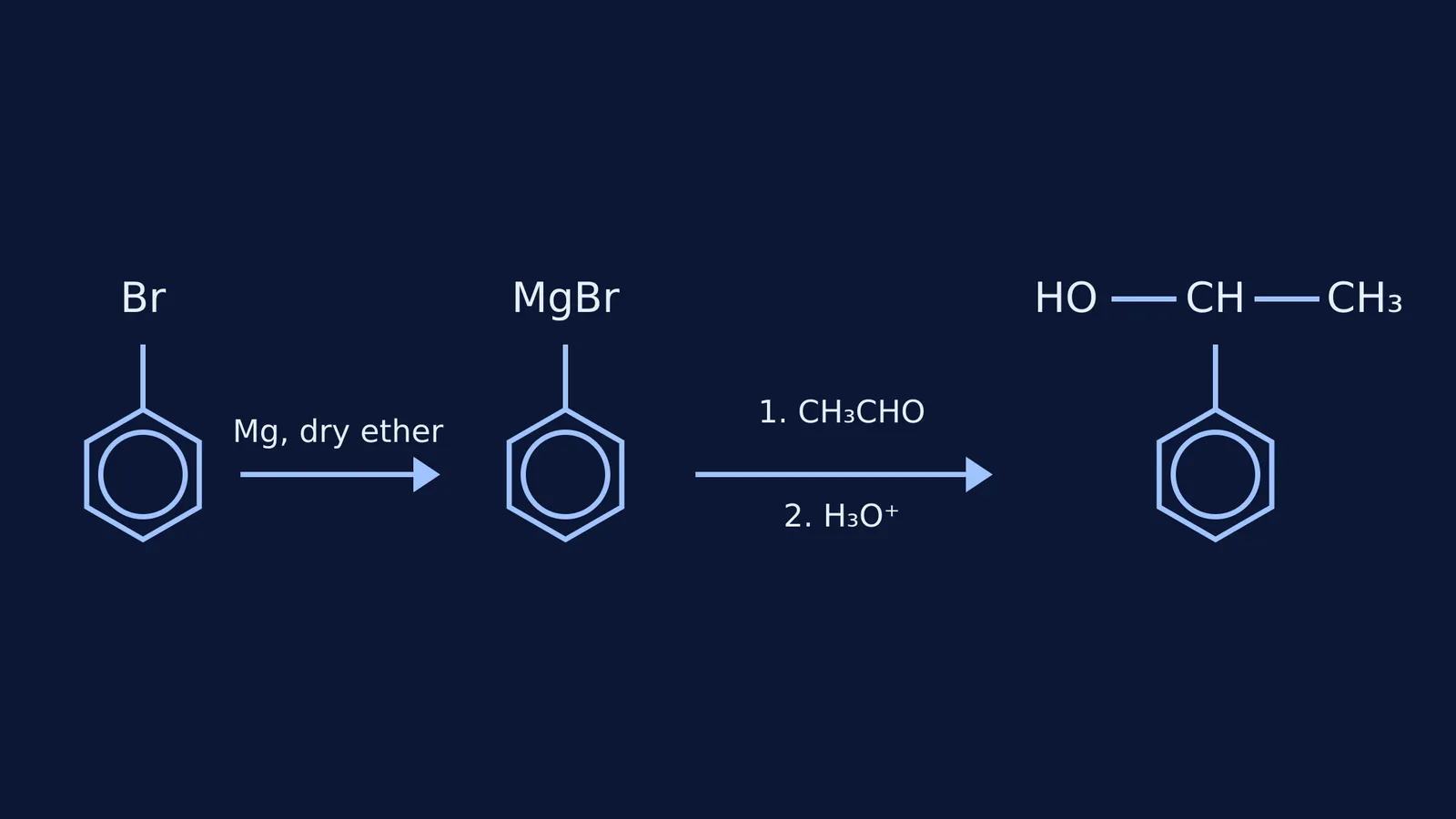
The synthesis of 1-phenylethanol from bromobenzene is one of the most reliable ways to demonstrate this skill. It relies on the Grignard reaction, a two-step process that first creates a powerful carbon nucleophile and then uses it to attack a carbonyl compound.
Why is a Grignard reagent needed?
Bromobenzene on its own is relatively unreactive towards nucleophilic substitution. The bromine atom is tightly held by the benzene ring due to partial double-bond character, making it difficult to replace directly. To make the phenyl ring useful for building a carbon framework, you have to reverse its chemical personality.
This reversal is called umpolung. Phenylmagnesium bromide is formed when bromobenzene is reacted with magnesium metal (Wikipedia). By inserting magnesium between the carbon and the bromine, the carbon atom takes on a partial negative charge. It transforms from an electrophilic target into a highly reactive nucleophile.
This step must be carried out in an anhydrous (water-free) solvent, typically dry diethyl ether. Grignard reagents are very strong bases. If there is even a trace of moisture in your flask, the phenylmagnesium bromide will pull a proton from the water to form benzene, destroying your reagent before it can do any useful work.
If you have gaps in your understanding of these organometallic reactions, the Concept Library has a lesson on every concept in chemistry.
How does ethanal yield a secondary alcohol?
Once you have prepared the phenylmagnesium bromide, the next step is to introduce the remaining two carbon atoms. You achieve this by adding ethanal (also known as acetaldehyde).
The nucleophilic phenyl group attacks the electrophilic carbonyl carbon of the ethanal molecule. The carbon-oxygen double bond breaks, pushing electrons onto the oxygen to form a magnesium alkoxide intermediate.
Grignard reagents react with aldehydes other than formaldehyde to produce secondary alcohols (Wikipedia). Because ethanal has one alkyl group and one hydrogen atom attached to its carbonyl carbon, the addition of the phenyl ring creates a central carbon bonded to two carbon groups.
To isolate the final product, you perform an acidic workup. Adding a dilute acid (such as aqueous hydrochloric acid) protonates the negatively charged oxygen atom, replacing the magnesium complex with a hydrogen atom. This hydrolysis step leaves you with the target molecule: 1-phenylethanol.
To review how different carbonyl compounds behave in these reactions, read our guide on aldehydes and ketones: nucleophilic addition and named reactions.
Is 1-phenylethanol a chiral molecule?
Yes, the product of this reaction has a specific three-dimensional geometry that is important to note for advanced chemistry questions. 1-Phenylethanol is a chiral alcohol because its central carbon is bonded to four different groups (Wikipedia). Those four groups are a phenyl ring, a methyl group, a hydroxyl group, and a hydrogen atom.
During the reaction, the starting ethanal molecule is planar (flat) around its carbonyl carbon. The incoming phenylmagnesium bromide can attack this flat surface from the top face or the bottom face with equal probability. As a result, the synthesis produces a racemic mixture. This means your final flask will contain a 50:50 mixture of the (R) and (S) enantiomers of 1-phenylethanol, which will not rotate plane-polarised light.
What is a reliable framework for Grignard syntheses?
When you face a synthesis problem in an exam, working backwards from the product is often the easiest strategy. This is known as retrosynthetic analysis. Here is a quick framework to design any Grignard synthesis:
Locate the alcohol carbon: Find the carbon atom that holds the -OH group in your target molecule.
Identify the attached groups: In 1-phenylethanol, this central carbon is attached to a methyl group (-CH₃) and a phenyl group (-C₆H₅).
Break a carbon-carbon bond: Choose one of these groups to come from the Grignard reagent, and let the rest of the molecule come from the carbonyl compound.
Route A: Break the bond to the phenyl ring. You need phenylmagnesium bromide and ethanal. (This is the route we just explored).
Route B: Break the bond to the methyl group. You need methylmagnesium bromide and benzaldehyde.
Both routes are chemically valid and will yield 1-phenylethanol. Understanding this flexibility ensures you are never stuck if an exam restricts which starting materials you are allowed to use.
For more details on how alcohols behave once you have synthesised them, check out our notes on alcohols, phenols and ethers: acidity, key reactions and tests. You can also revise the common pitfalls of these reagents in our summary of Grignard reagents: what they make and the common exam traps.


