

On this page
When halogens react with alkanes under UV light, they swap places with hydrogen atoms. But chlorine and bromine behave very differently. If you chlorinate isobutane, you get a mixture of products. If you brominate it, you get almost entirely one product: 2-bromo-2-methylpropane.
Why is bromination so much more selective? The answer lies in the energy of the reaction steps and Hammond's postulate.
What is the selectivity ratio of bromination vs chlorination?
Halogen radicals abstract hydrogens from primary (1°), secondary (2°), and tertiary (3°) carbons at different rates because the resulting alkyl radicals have different stabilities (tertiary radicals are the most stable).
For chlorination at room temperature (25 °C), the relative reactivity ratio is roughly/10%3A_Radicals/10.04%3A_Halogenation_of_Higher_Alkanes):
Primary: 1
Secondary: 3.8
Tertiary: 5
Chlorine is fast and largely unselective. It only reacts 5 times faster with a tertiary hydrogen than a primary one.
For bromination at 125 °C, the ratio is:
Primary: 1
Secondary: 82
Tertiary: 1600
Bromine is highly selective, reacting 1,600 times faster with a tertiary hydrogen. At room temperature, the preference for a tertiary hydrogen over a primary one climbs to a factor of 19,400.
Why is bromination more selective than chlorination?
The first propagation step of free radical halogenation is the rate-determining step, where the halogen radical abstracts a hydrogen atom to leave an alkyl radical.
The carbon–hydrogen bond requires energy to break, but the new hydrogen–halogen bond releases energy when it forms.
A hydrogen–chlorine bond is stronger than a typical C–H bond. Therefore, hydrogen abstraction by a chlorine radical is exothermic.
A hydrogen–bromine bond is weaker than a C–H bond. Therefore, hydrogen abstraction by a bromine radical is endothermic.
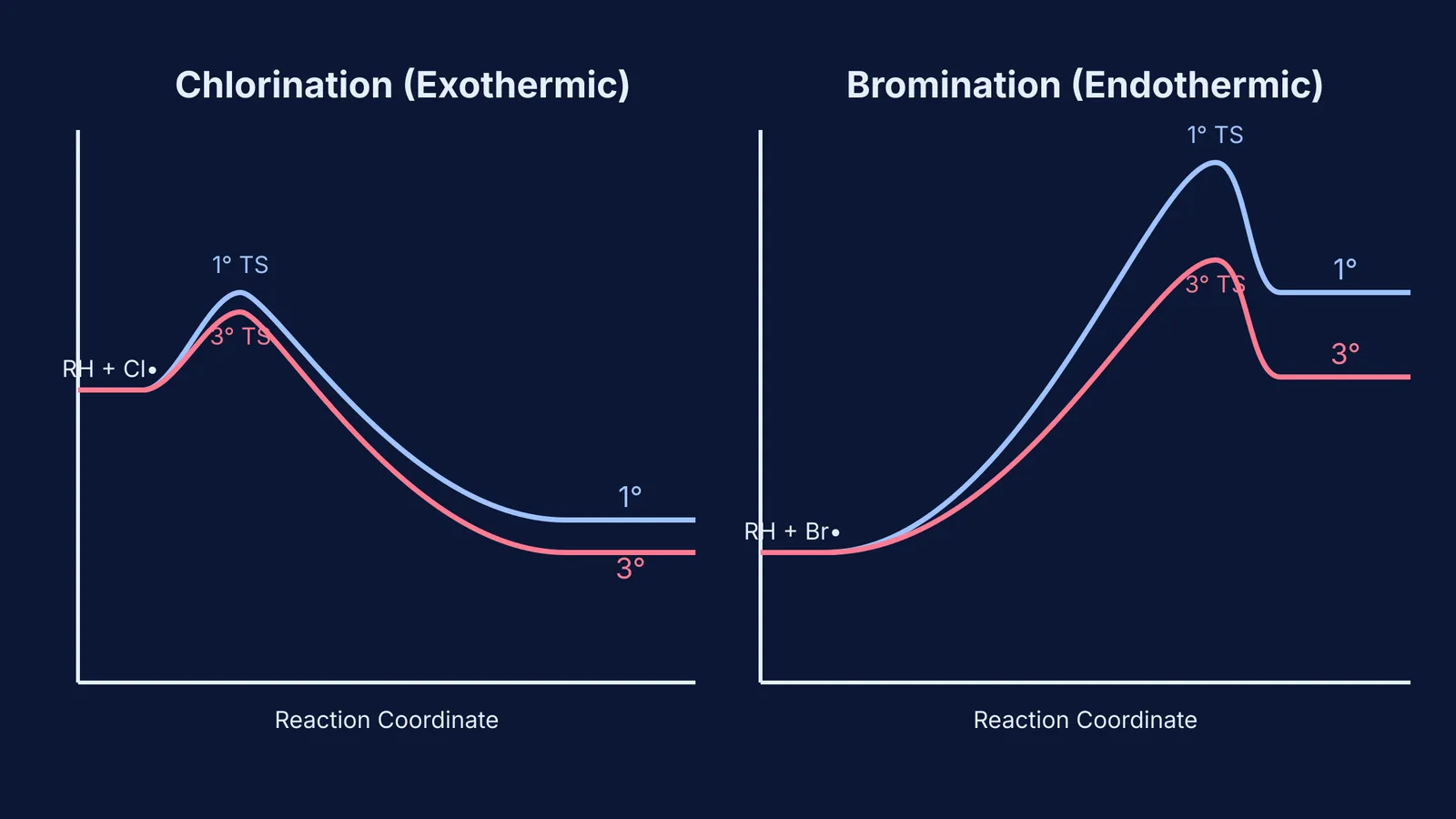
This is where Hammond's postulate comes in. It states that the transition state of a reaction resembles the stable species closest to it in energy.
Chlorination has an "early" transition state
Because the step is exothermic, the transition state is closer in energy to the reactants. It is an "early" transition state where the C–H bond has barely begun to break. Since the radical character has not fully developed on the carbon atom, the energy difference between forming a primary, secondary, or tertiary radical is very small (marked as the small ΔE on the energy graph). Chlorine essentially grabs the first hydrogen it bumps into.
Bromination has a "late" transition state
Because the step is endothermic, the transition state is closer in energy to the products. It is a "late" transition state where the C–H bond is almost entirely broken and the carbon atom has taken on strong radical character. The full stability advantage of a tertiary radical (due to hyperconjugation and inductive effects) is felt in the transition state. This creates a much lower activation energy pathway for the tertiary hydrogen (the large ΔE on the energy graph), making the reaction highly selective.
Working through organic mechanisms requires keeping track of these energy differences. If you are preparing for exams and need to spot the major product, the Fermi Concept Library contains every concept in physics, chemistry, biology, mathematics and computing, each with its own lesson and its place in the map. For worked examples, the Fermi Problem Library has worked problems with a step-by-step solver that explains the reasoning rather than printing an answer.


