

On this page
In the qualitative analysis of salts, identifying the correct anion is a core part of chemistry practicals. Concentrated sulphuric acid (H₂SO₄) is a classic reagent used in the laboratory to detect the presence of these anions. While it produces a predictable, simple acid-base reaction with chlorides, adding it to a bromide or iodide salt sets off a secondary, more complex redox reaction.
Because bromide and iodide ions are powerful reducing agents, they reduce the sulphuric acid. This completely changes the gases you see escaping the test tube, giving you a clear visual confirmation of which halide is present.
What happens in the bromide test?
When you add concentrated sulphuric acid to a solid bromide salt (such as sodium bromide or potassium bromide), an acid-base reaction happens first. The acid donates a proton to the bromide ion, creating steamy, colourless fumes of hydrogen bromide (HBr).
However, hydrogen bromide is a strong reducing agent. It immediately reduces the concentrated sulphuric acid to sulphur dioxide (SO₂). In this process, the hydrogen bromide itself is oxidised to elemental bromine (Br₂).
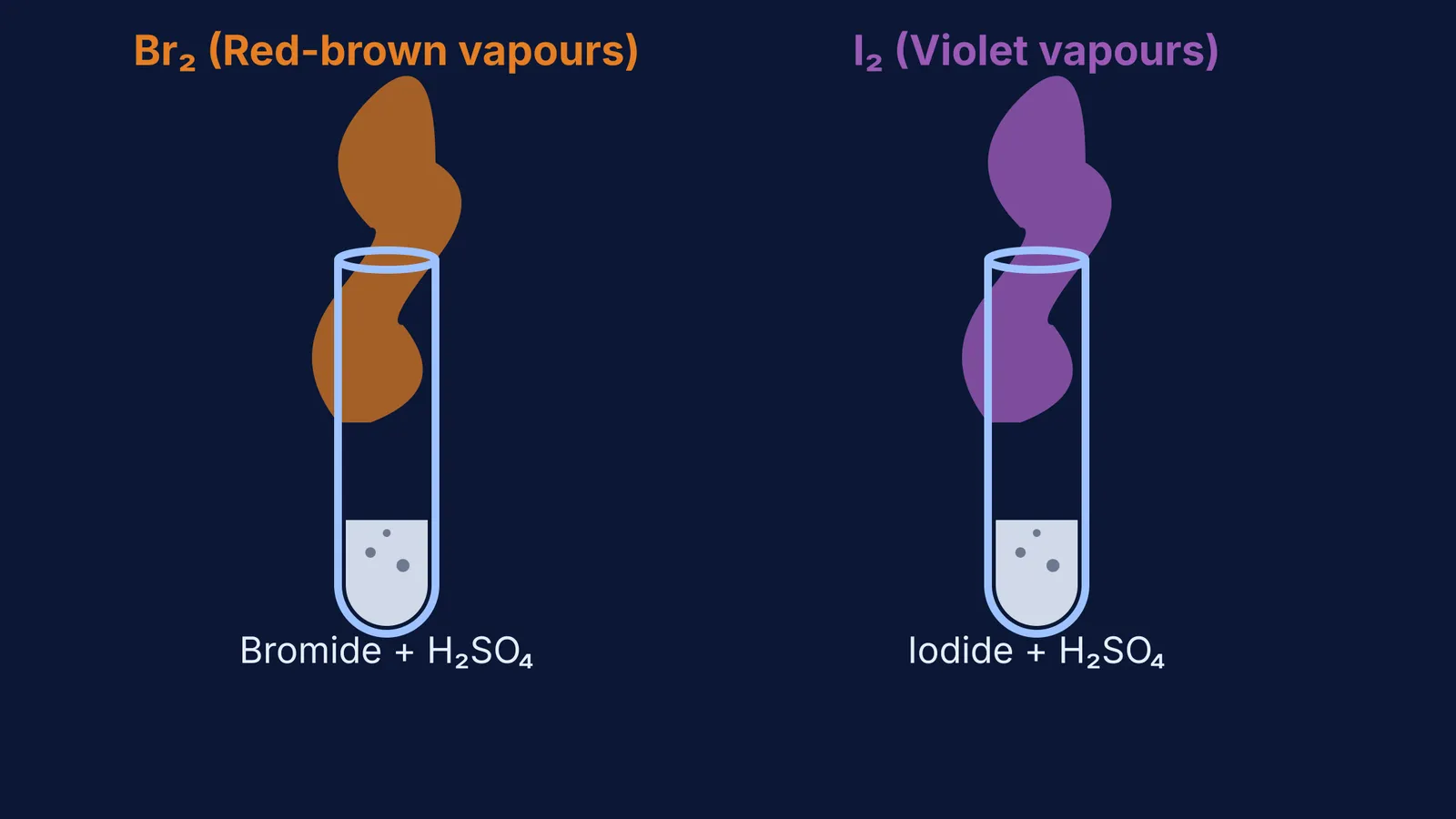
Because elemental bromine is a volatile liquid that vaporises easily at these temperatures, you observe thick, reddish-brown vapours mixed in with the steamy fumes. The oxidation state of bromine changes from -1 in the bromide ion to 0 in elemental bromine, while the sulphur in sulphuric acid is reduced from +6 to +4 in sulphur dioxide.
The two chemical equations for these steps are:
NaBr + H₂SO₄ → NaHSO₄ + HBr
2HBr + H₂SO₄ → Br₂ + SO₂ + 2H₂O
What happens in the iodide test?
Iodide ions (I⁻) are even stronger reducing agents than bromide ions due to their larger atomic radius and the fact that their outer electrons are further from the nucleus and more easily lost. Therefore, when you add concentrated sulphuric acid to a solid iodide salt, the redox reaction goes much further.
Initially, steamy fumes of hydrogen iodide (HI) are formed. But hydrogen iodide quickly reduces the sulphuric acid. It does not just stop at sulphur dioxide. It is strong enough to reduce the sulphuric acid all the way past sulphur dioxide to solid elemental sulphur (which is yellow) and finally to hydrogen sulphide gas (H₂S).
Hydrogen sulphide is a highly toxic gas notorious for its smell of rotten eggs. During this reduction, the hydrogen iodide is oxidised to elemental iodine (I₂). The heat of the reaction vaporises the iodine, producing striking, deep violet vapours. You will also see a dark grey solid form on the cooler parts of the test tube, which is solid iodine.
The main redox equation for this process is: 8HI + H₂SO₄ → 4I₂ + H₂S + 4H₂O
The Fermi Problem Library has worked problems with a step-by-step solver that explains the reasoning rather than printing an answer for balancing complex redox equations like this one.
Why is the chloride test different?
If you perform the exact same test with a chloride salt, such as sodium chloride, you will only see the steamy, colourless fumes of hydrogen chloride (HCl) gas.
This happens because the chloride ion is a much weaker reducing agent. It holds onto its electrons more tightly than bromide or iodide. It is not strong enough to reduce concentrated sulphuric acid. The reaction stops at the first acid-base step, leaving the HCl intact without forming any greenish-yellow chlorine gas.
If you are reviewing the halogens for your exam, Fermi offers a Concept library: every concept in physics, chemistry, biology, mathematics and computing, each with its own lesson and its place in the map.
Why can you not use H₂SO₄ to prepare HBr or HI?
This classic qualitative test also explains a very practical rule in the synthetic laboratory. If you need to make pure hydrogen chloride gas, reacting a chloride salt with concentrated sulphuric acid works perfectly. The HCl gas escapes pure and unreacted.
But if you want to prepare pure hydrogen bromide or hydrogen iodide for a reaction, concentrated sulphuric acid fails completely. It acts as an oxidising agent, destroying the HBr or HI as fast as it is made and contaminating your product with elemental halogens and sulphur compounds.
To prepare pure HBr or HI, chemists must use a non-oxidising acid instead. Concentrated phosphoric acid (H₃PO₄) is the standard choice, as it provides the necessary protons without oxidising the resulting hydrogen halides.
For more on how halogens behave in the laboratory, read our guide on Finkelstein and Swarts reactions: making alkyl iodides and fluorides, or explore the industrial production of the acid used in this test in Contact process for sulphuric acid: steps and conditions for JEE.


