

On this page
In IUPAC nomenclature, a ligand that connects two or more central metal atoms in a coordination complex is called a bridging ligand. According to Section IR-9.2.5.2 of the IUPAC Nomenclature of Inorganic Chemistry (2005), this bridging is indicated by adding the Greek letter μ (mu) before the ligand's name.
What is a bridging ligand?
In many dimeric and polymeric complexes, certain atoms or molecules do not just bind to a single metal; they bridge the gap between two metals, holding the structure together. To distinguish these from terminal ligands (which bind to only one metal), we use the μ prefix.
For example, a chloride ion that connects two metal centres is written as μ-chlorido. Notice the spelling: the 2005 IUPAC recommendations updated anionic ligands ending in *-ide* to end in *-ido*. This means the older terms "chloro" and "hydroxo" are now formally "chlorido" and "hydroxido". A water molecule acting as a bridge remains "aqua", but takes the μ prefix to become μ-aqua.
How to name complexes with bridging ligands mu?
When writing the systematic name of a complex, bridging ligands are treated much like terminal ligands, but with the μ marker to indicate their special role in the molecule's architecture.
The μ prefix: Place a hyphen between the μ and the ligand name. For example, a bridging hydroxide is written as μ-hydroxido.
Alphabetical order: List all ligands in alphabetical order by their core name (so "amido" comes before "hydroxido"). The μ prefix itself is ignored when sorting alphabetically.
Multipliers for identical bridges: If the complex has two identical bridging ligands, add a standard multiplicative prefix (di-, tri-, tetra-) directly in front of the μ. For instance, two bridging chlorides become di-μ-chlorido.
If you are stuck on a difficult nomenclature assignment, the Fermi Problem Library provides a step-by-step solver that explains the reasoning rather than just printing an answer, helping you apply the IUPAC rules correctly.
How do you name simple chloro and hydroxo examples?
Let us put the rules together for some classic dimeric complexes.
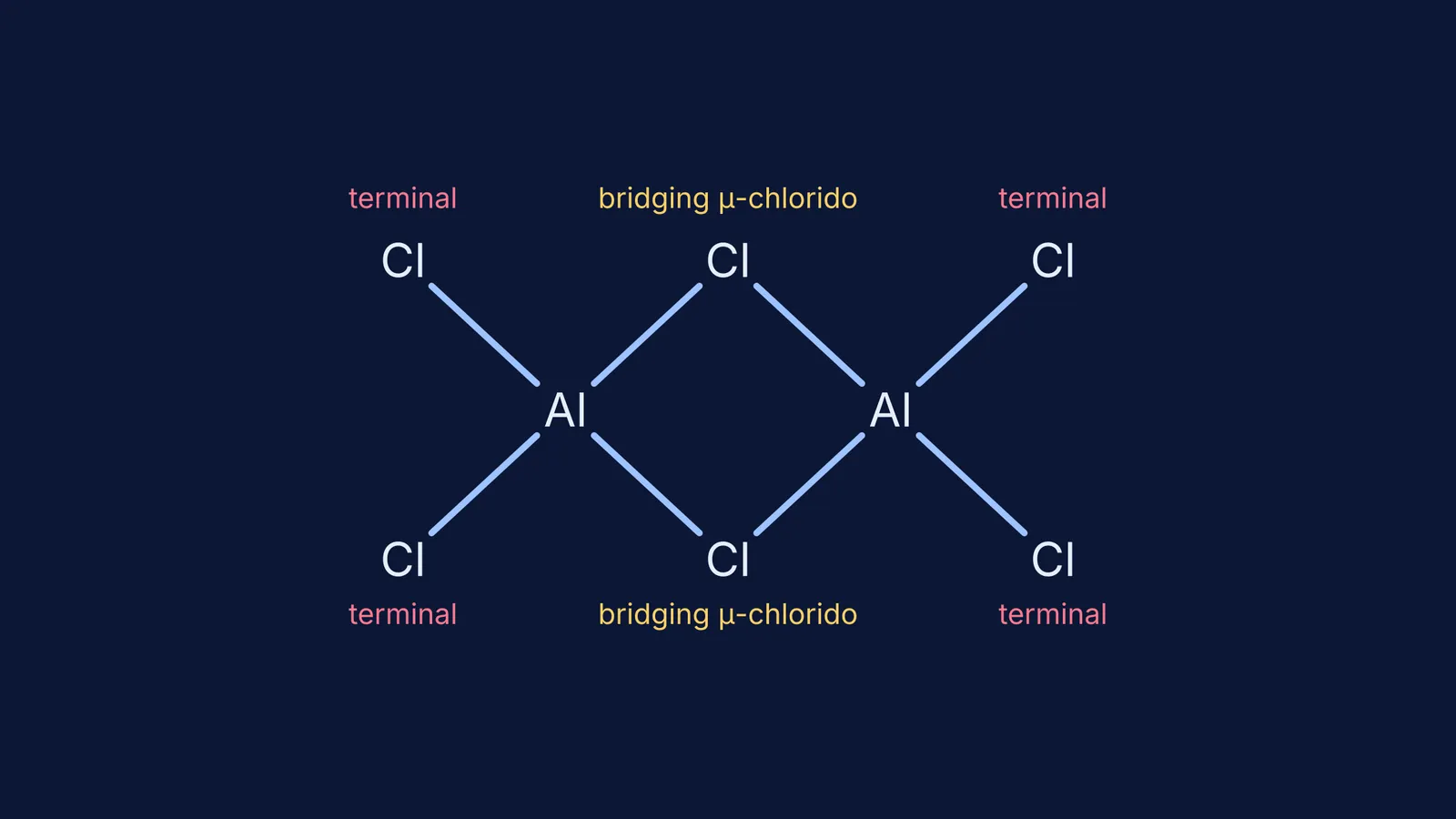
Take aluminium trichloride in its dimeric gas-phase form, [Al₂Cl₄(μ-Cl)₂]. The structure consists of two aluminium atoms bridged by two chloride ligands, with each aluminium also carrying two terminal chlorides. To name it systematically:
We have two bridging chlorides: di-μ-chlorido.
We have four terminal chlorides: tetrachlorido.
We have two aluminium atoms: dialuminium.
Putting it together gives di-μ-chlorido-tetrachloridodialuminium. (For symmetric dimers, IUPAC also allows naming half the molecule and using the "bis" multiplier: di-μ-chlorido-bis(dichloridoaluminium)).
Now consider a cationic complex like [Fe₂(μ-OH)₂(H₂O)₈]⁴⁺.
Two bridging hydroxides give di-μ-hydroxido.
Eight terminal water molecules give octaaqua.
Two iron(III) centres give diiron(III).
The complete name is octaaqua-di-μ-hydroxidodiiron(III). The oxidation state of the metal is placed at the very end in Roman numerals, just as it is for mononuclear complexes.
How do you name asymmetric dimeric complexes?
If the two metal centres or their terminal ligands differ, you simply list all ligands (both bridging and terminal) alphabetically before naming the metals. If a complex features two different bridging ligands, such as one amido and one hydroxido group, each gets its own μ prefix. You would write it as μ-amido-μ-hydroxido, reflecting the alphabetical order of the ligands.
When dealing with a complex where the two metal centres are in different oxidation states, or bounded to entirely different terminal ligands, you name the metals one by one, associating each with its respective terminal ligands. However, for most school and standard exam problems, you will encounter symmetrical dimers.
What is a reliable checklist for naming dimeric complexes?
To ensure you never miss a step when naming a coordination complex with bridging ligands, follow this practical checklist:
Identify the central metals: Determine the element and its oxidation state.
Locate the bridging ligands: Count how many ligands bridge the two metals. Apply the μ prefix to their names.
Locate the terminal ligands: Count the non-bridging ligands on the outside of the complex.
Alphabetise all ligands: Sort them by their base names. Remember that prefixes like di-, tri-, and μ do not affect the alphabetical order.
Assemble the name: Write the bridging ligands (with their μ prefixes), then the terminal ligands, then the metal, and finally the oxidation state.
Once you know the rules for coordination complexes, the logic is very similar to naming carbon compounds: you identify the core pieces, arrange them alphabetically, and use prefixes to count them. And just as you use precipitation tests for counting ionisable chlorides in Werner complexes, you use X-ray crystallography or spectroscopy to confirm whether a ligand is bridging or terminal before you name it.


