

On this page
The question "how many bricks are needed for a wall?" is a classic mathematics problem that tests your understanding of 3D space. It asks you to figure out how many small rectangular prisms (bricks) fit inside a much larger one (the wall). While the core logic is a straightforward division of volumes, the trick lies in consistent units and paying attention to the mortar holding it all together.
Mastering this problem type is essential for school geometry exams. It builds a foundation for more complex surface area and volume questions, teaching you how to break down real-world structures into manageable mathematical parts.
How do you calculate the number of bricks in a wall?
The most common mistake students make is multiplying meters by centimeters. Before you calculate any volumes, check the units. A typical question gives the wall's length in meters but its thickness in centimeters. You must convert them so they match.
Converting all lengths to the same unit is half the battle. If you find units tricky, reading up on converting a quantity between unit systems using dimensions can help build your confidence.
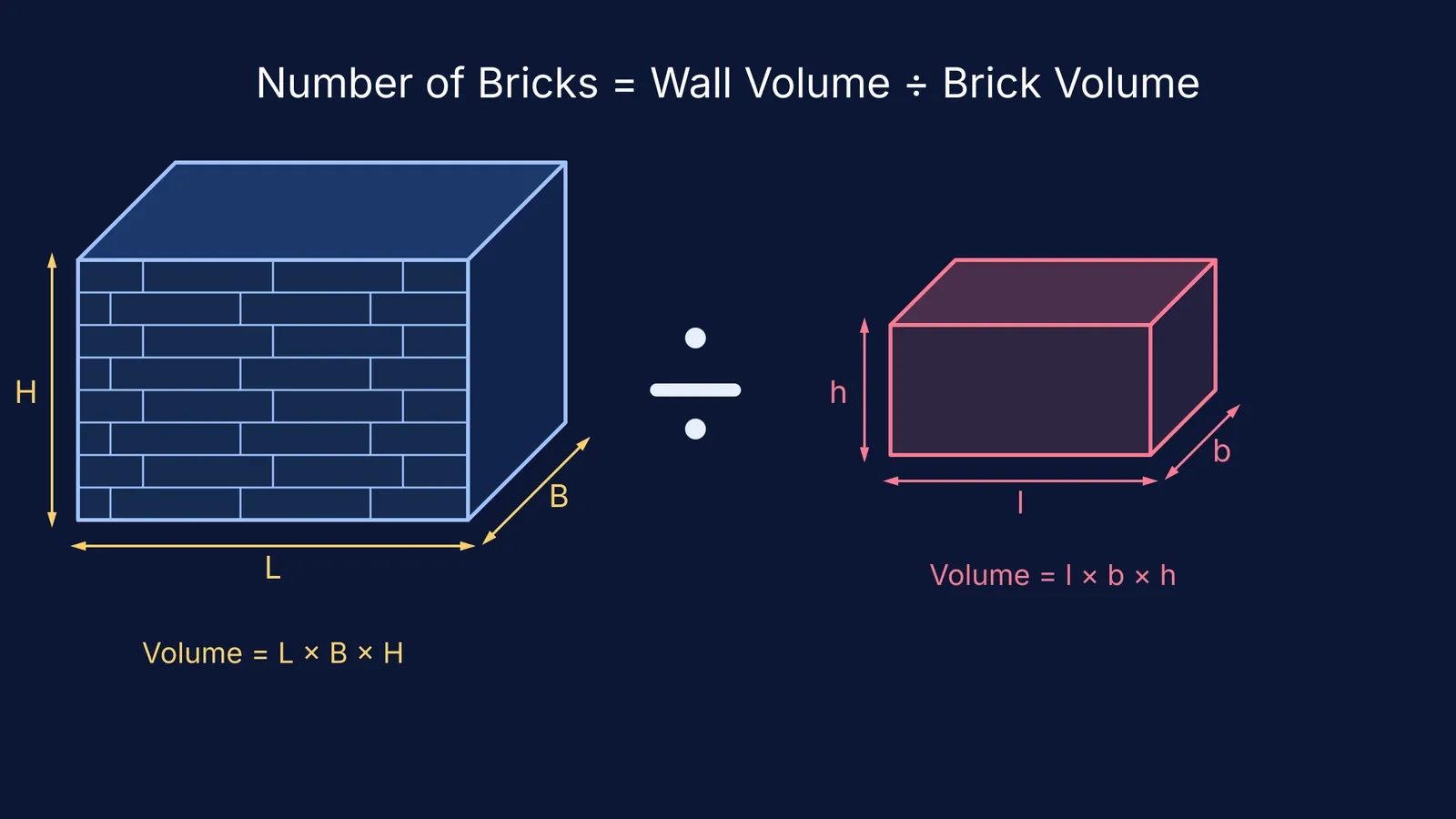
Once your units match, use this fundamental formula:
Number of bricks = Volume of wall ÷ Volume of one brick
To find the volume of either, you multiply its length, breadth (or thickness), and height (L × B × H).
What if the wall has mortar?
Bricks are held together by mortar made of cement and sand. Often, a math problem will tell you exactly how much space this mortar takes up.
For example, a classic NCERT Exemplar problem asks you to calculate the bricks for a wall where the mortar occupies 1/10th of the volume Cuemath. In these cases, you must subtract the mortar from the total wall volume *before* you divide by the brick volume.
The modified formula becomes: Number of bricks = (Volume of wall - Volume of mortar) ÷ Volume of one brick
How many bricks will be required to construct a wall?
Let's walk through a standard textbook problem: How many bricks will be required to construct a wall 13.5 m long, 6 m high, and 22.5 cm thick, if each brick measures 27 cm × 12.5 cm × 9 cm? Byju's
Step 1: Convert wall dimensions to centimeters.
Length = 13.5 m = 1350 cm
Height = 6 m = 600 cm
Thickness = 22.5 cm
Step 2: Calculate the wall's volume.
Volume = 1350 × 600 × 22.5 = 18,225,000 cm³
Step 3: Calculate the volume of one brick.
Volume = 27 × 12.5 × 9 = 3,037.5 cm³
Step 4: Divide the wall volume by the brick volume.
Number of bricks = 18,225,000 ÷ 3,037.5 = 6,000
Word problems about area and volume often share logic with quadratic word problems in Class 10, as both require you to build a reliable equation from a real-world scenario.
How do you calculate the number of bricks with mortar?
What happens when the mortar is included? Let's use the NCERT Exemplar problem we mentioned earlier. Imagine a wall 24 m long, 0.4 m thick, and 6 m high, constructed with bricks each measuring 25 cm × 16 cm × 10 cm. The mortar occupies 1/10th of the volume of the wall.
Step 1: Calculate the total wall volume in cubic meters.
Volume of wall = 24 × 0.4 × 6 = 57.6 m³
Step 2: Calculate and subtract the mortar volume.
The problem states the mortar takes up 1/10th of the wall.
Volume of mortar = 57.6 ÷ 10 = 5.76 m³
Volume of the wall taken up by bricks = 57.6 - 5.76 = 51.84 m³
Step 3: Calculate the volume of a single brick in cubic meters.
Convert the brick dimensions from centimeters to meters: 0.25 m × 0.16 m × 0.10 m.
Volume of one brick = 0.25 × 0.16 × 0.10 = 0.004 m³
Step 4: Divide the brick-only wall volume by the single brick volume.
Number of bricks = 51.84 ÷ 0.004 = 12,960 bricks.
How should you set out your working in an exam?
In an exam, write down the knowns clearly before you calculate anything. List the length (L), breadth or thickness (B), and height (H) for the wall on one side of your page. On the other, list the length (l), breadth (b), and height (h) for the single brick. Note any necessary unit conversions directly beside these variables so the examiner can follow your logic.
Always write out the main formula before you plug in the numbers. Showing the examiner that you know the wall volume is divided by the brick volume secures partial marks, even if you make an arithmetic error later on.
If you are struggling to piece together word problems like these, the Fermi Problem Library has worked problems with a step-by-step solver that explains the reasoning rather than printing an answer. This helps you see exactly where the logic fits together.


