

On this page
If you have ever stopped to catch your breath after running up a flight of stairs, you know that physical activity changes how your lungs work. Measuring exactly how much it changes is a classic school biology experiment. It does not require any special equipment, and it shows you a live demonstration of cellular respiration happening inside your own body.
How do you do the breathing rate before and after exercise experiment?
To see how your lungs respond to movement, you only need a timer, a pen, and a place to sit. You will measure your baseline, your peak rate, and the time it takes your respiratory system to recover.
Sit quietly in a chair for five minutes to let your body settle into a relaxed state.
Set a timer for 60 seconds and count your breaths. One full inhale and one full exhale counts as a single breath. Write this number down as your resting baseline.
Stand up and do two minutes of vigorous exercise. Running in place, doing jumping jacks, or performing burpees will work well.
Sit back down and immediately count your breaths for the next 60 seconds. Write this number down as your peak exercise rate.
Keep counting your breaths every minute until the number returns to your original baseline, recording each minute's count.
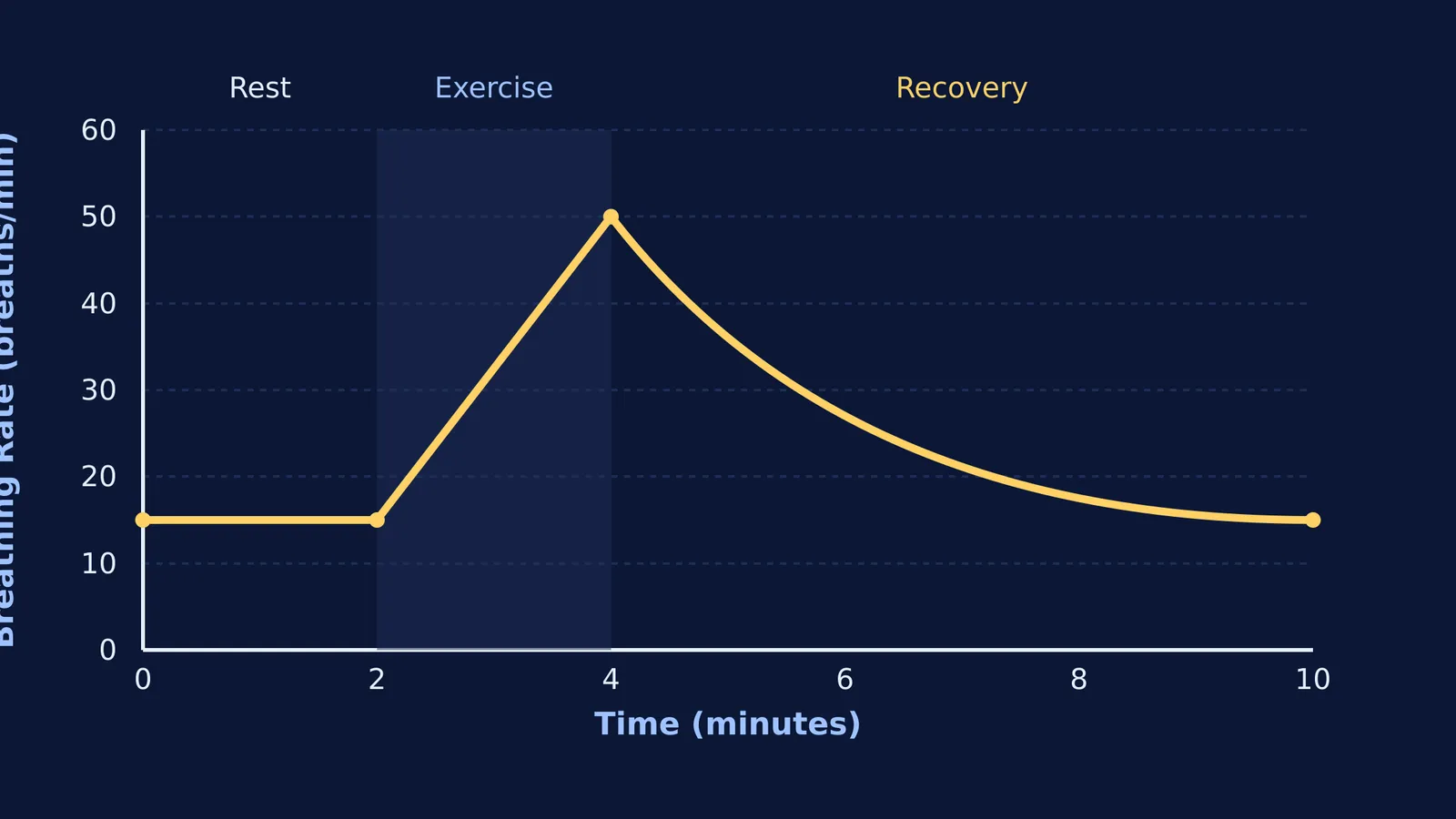
If you plot these numbers on a graph, with time on the horizontal axis and your breathing rate on the vertical axis, you will see a clear curve. It will start as a flat line, form a sharp peak immediately after the exercise, and then trace a gradual downward slope during the recovery period.
What is a normal resting breathing rate?
When you are sitting still or reading a book, your muscles do not need much energy. Your breathing is slow and shallow, using only a small fraction of your total lung capacity to keep your blood oxygenated.
According to the American Lung Association, a normal adult breathing rate at rest is 12 to 15 times a minute. This rate is not universal; children naturally breathe faster than adults. Furthermore, endurance athletes who train regularly often have a lower resting rate because their heart and lungs have become highly efficient at delivering oxygen with fewer, deeper breaths.
Why does breathing rate increase during exercise?
Every time a muscle contracts, it uses up energy. Your cells generate this energy through a continuous chemical reaction called cellular respiration. This biological process pulls in oxygen and produces carbon dioxide as a waste product.
When you start doing jumping jacks, your leg and arm muscles suddenly demand a massive increase in energy to keep moving. As a result, your muscle cells pull oxygen out of your bloodstream much faster, and they simultaneously dump a large volume of carbon dioxide back into it.
Your brain constantly monitors the chemical makeup of your blood. When specialized receptors detect rising carbon dioxide levels, your brain immediately signals the respiratory muscles in your chest and diaphragm to contract faster and more forcefully. The European Lung Foundation notes that during heavy exercise, a person's breathing rate can increase to 40 to 60 times a minute.
Your heart rate also spikes at the same time to pump this newly oxygenated blood down to the working muscles. If you are struggling to map out how all these anatomical systems work together, you can trace the biological pathways in the Fermi Concept Library, which has every concept in physics, chemistry, biology, mathematics and computing.
Why do you keep breathing heavily after you stop?
You might notice that your breathing does not instantly drop back down to 15 breaths a minute the moment you sit back in your chair. The recovery curve on your graph takes several minutes to flatten out.
If your two minutes of exercise were intense enough, your body probably could not take in oxygen fast enough to meet the peak demand. To keep your muscles moving without enough oxygen, your body temporarily switched to anaerobic respiration. This is a backup metabolic process that makes energy without oxygen, but it leaves behind lactic acid in your muscle tissues.
After you stop exercising, your body has to break down this accumulated lactic acid and clear it away. Doing so requires a significant amount of extra oxygen. This phenomenon is known in biology as the oxygen debt. You continue to pant and breathe heavily while sitting still until you have "repaid" the debt, cleared the acid, and restored your normal resting oxygen levels.
Understanding these physical gas exchanges is crucial for biology exams. You can explore the mechanics of lung volumes and capacities further in our guide to breathing and gas exchange: lung volume sums and oxygen transport. And if you are curious about how scientists first realised that oxygen levels control breathing, the history of J. S. Haldane, carbon monoxide and the animals that warned miners shows exactly how these discoveries were made.


