

On this page
A truck pulls away from a signal with a wooden crate loose on its bed. Does the crate ride along, or slide towards the tailgate? This Class 11 and JEE favourite has a clean answer: the crate stays put only up to a = μs g. Here is where that rule comes from, what happens after a slip, and a check you can reuse.
Why does a box move with the truck at all?
The engine pushes the truck, not the box. Gravity and the normal force are vertical, so they cannot speed the box up horizontally. Ignoring air, static friction from the truck bed is the only horizontal force on the box, and it points forward, in the direction the truck accelerates.
Friction resists *slipping between surfaces*, not motion. The bed is trying to move out from under the box, so friction drags the box forward with it.
OpenStax University Physics gives the limit on static friction as fs ≤ μs N, where μs is the coefficient of static friction and N is the normal force (OpenStax, section 6.2). Static friction adjusts to whatever is needed, up to that ceiling.
What is the maximum acceleration before the box slides?
For the box to move with the truck, it needs the truck's acceleration a. Newton's second law for the box gives f = ma. On a flat bed N = mg, so the condition f ≤ μs mg becomes ma ≤ μs mg.
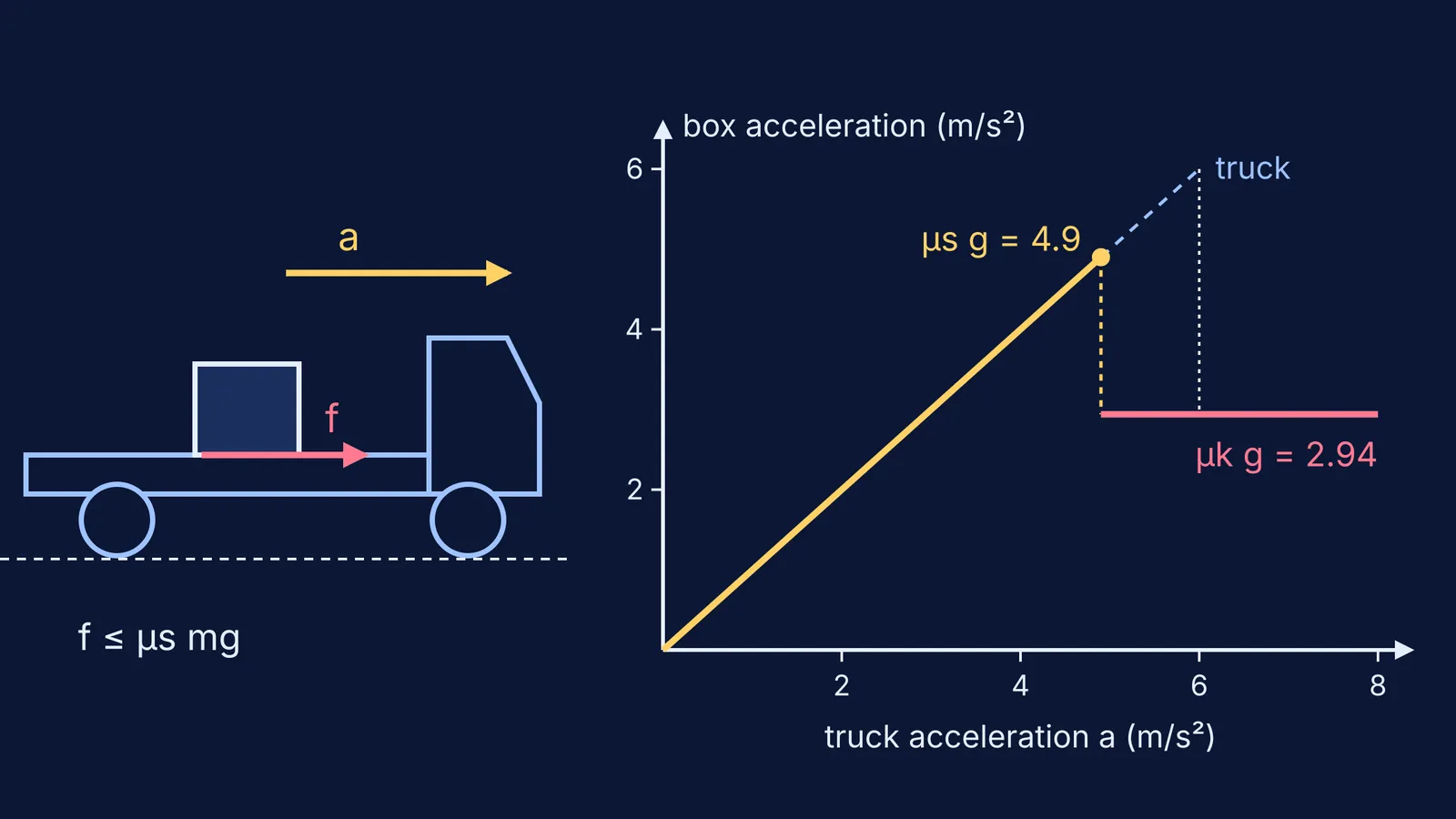
The mass cancels. A box stays at rest on the truck bed only if a ≤ μs g, and a heavy box and a light box with the same surfaces slip at the same moment.
The same OpenStax section lists μs = 0.5 and μk = 0.3 for wood on wood (OpenStax table 6.1). With g = 9.8 m/s², a wooden crate on a wooden bed can take up to 0.5 × 9.8 = 4.9 m/s².
In the truck's frame you get the same answer: friction must balance a backward pseudo force ma. Our guide to solving problems from an accelerating frame explains that view.
What happens to the box when it slips?
Once a > μs g, the box slides. Kinetic friction takes over, with magnitude fk = μk N (OpenStax, section 6.2). It still points forward, because the bed is still sliding forward under the box.
So the box accelerates at a fixed μk g relative to the road, however hard the truck accelerates. Relative to the truck, its acceleration is μk g − a, which is negative: it drifts towards the tailgate.
OpenStax works one version of this in its Example 6.13: a 50.0 kg crate on a truck bed needs 100 N of static friction at 2.00 m/s², but at 5.00 m/s² the required force exceeds the 196 N maximum, so the crate slips and accelerates at −2.06 m/s² relative to the bed (OpenStax Example 6.13).
Worked example: how long until the crate reaches the tailgate?
Take the wood-on-wood values from the OpenStax friction table: μs = 0.5, μk = 0.3. The crate starts 2.0 m from the tailgate, and the truck accelerates at 6.0 m/s² from rest.
Test for slipping: μs g = 4.9 m/s². Since 6.0 > 4.9, the crate slips.
Crate's acceleration relative to the road: μk g = 0.3 × 9.8 = 2.94 m/s², forward.
Relative to the truck: 2.94 − 6.0 = −3.06 m/s², so 3.06 m/s² backward.
Time to slide 2.0 m in the truck's frame, starting from relative rest: 2.0 = ½ × 3.06 × t², so t² ≈ 1.31 and t ≈ 1.14 s.
Speed relative to the truck at the tailgate: 3.06 × 1.14 ≈ 3.5 m/s.
The crate never moves backward relative to the road: someone on the pavement sees it speed up forward, just more slowly than the truck. For the stacked-block version, see our guide to static vs kinetic friction and blocks on blocks.
A four-step check for any version of this problem
These steps also cover a box on a train floor or a braking truck (friction then points backward, and the box slides towards the cab).
List the horizontal forces on the box alone (usually just friction).
Assume no slipping. Find the friction needed: f = ma.
Compare with the ceiling μs mg. If f fits, the box moves with the truck and you are done.
If it does not fit, use fk = μk mg, find the box's own acceleration, then subtract the truck's to get motion relative to the bed.
For more practice, the Fermi Problem Library has worked problems with a step-by-step solver that explains the reasoning rather than printing an answer. If static versus kinetic friction still feels shaky, the Fermi Concept Library gives each concept its own lesson.
Next, try the tilted version of the same idea in our post on angle of repose and the tan θ = μ result.


