

On this page
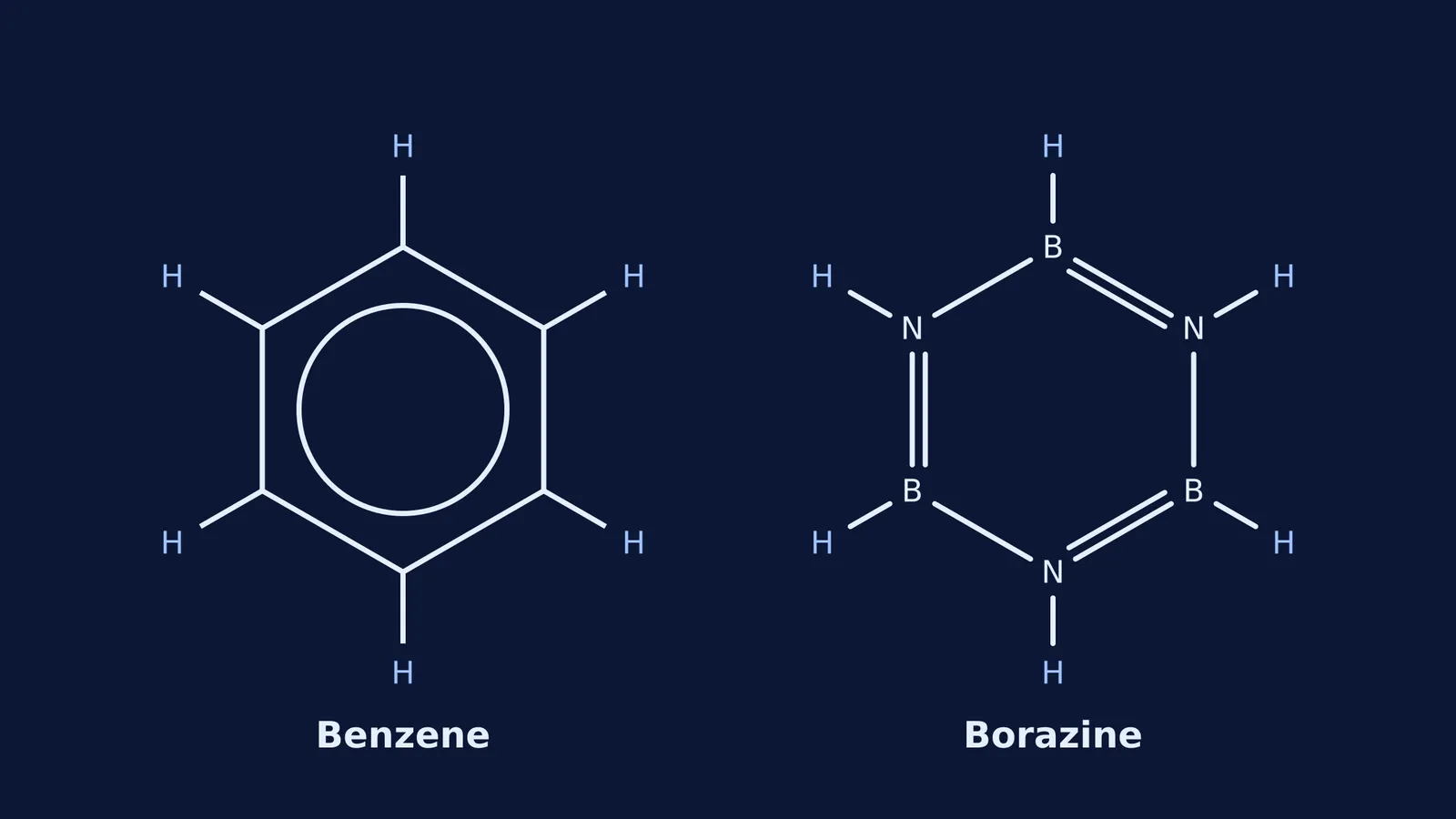
If you look at the structure of borazine (B₃N₃H₆) alongside benzene (C₆H₆), they appear to be identical twins. Both are colourless liquids, both have six-membered planar rings, and they share similar physical properties, such as borazine's boiling point of 55 °C University of Bristol.
However, in a chemistry exam, treating them as identical will cost you marks. While their shapes are the same, their chemical behaviour is not.
Why is borazine called inorganic benzene?
German chemists Alfred Stock and Erich Pohland first synthesised borazine in 1926 by reacting diborane (B₂H₆) with ammonia (NH₃) at 250–300 °C. They immediately noticed its physical resemblance to benzene and coined the term "inorganic benzene" University of Bristol.
The comparison is built on two key similarities:
They are isoelectronic: Both molecules have the same number of total electrons and valence electrons.
They are isostructural: Both form a planar, six-membered ring. In benzene, the ring is made of six carbon atoms. In borazine, it consists of three boron and three nitrogen atoms alternating around the ring.
Like benzene, borazine follows Hückel's rule with six π (pi) electrons delocalised over the ring.
Why is borazine more reactive than benzene?
The illusion of similarity breaks down when the molecules react. Benzene is famously stable. Its aromatic ring resists addition reactions because breaking the continuous electron cloud would require too much energy. Benzene has a high aromatic stabilisation energy of 151 kJ/mol.
Borazine's aromatic stabilisation energy is only about 42 kJ/mol (roughly 28% of benzene's) University of Bristol. The reason lies in electronegativity.
In benzene, every carbon-carbon bond is non-polar because the atoms share electrons equally. In borazine, nitrogen has a Pauling electronegativity of 3.04, while boron is only 2.04 University of Bristol. This large difference means the nitrogen atoms pull the shared electrons toward themselves, creating polar B–N bonds. The nitrogen atoms carry a partial negative charge (δ-), and the boron atoms carry a partial positive charge (δ+).
Because the π electrons are localised closer to the nitrogen atoms, the electron cloud is "lumpy" rather than perfectly smooth. This polarity makes borazine highly susceptible to chemical attack.
The HCl addition reaction: where do the atoms go?
If you mix benzene with hydrogen chloride (HCl), nothing happens under normal conditions. The stable carbon ring ignores the acid.
If you mix borazine with HCl, the molecule undergoes a rapid addition reaction. The polar bonds act as targets:
The nitrogen atom is nucleophilic (electron-rich, δ-). It attracts the positively charged hydrogen ion (H⁺).
The boron atom is electrophilic (electron-deficient, δ+). It attracts the negatively charged chloride ion (Cl⁻).
Hydrogen chloride molecules add across the B=N bonds, destroying the aromaticity completely and forming a non-planar molecule called B-trichlorocyclotriborazane (B₃N₃H₉Cl₃). The ring puckers into a "chair" shape, much like cyclohexane.
If you are unsure why polarity changes a molecule's reactions, the Fermi Concept Library contains every concept in chemistry, biology, physics, and mathematics, each with its own lesson and its place in the map.
Checklist: Comparing borazine and benzene in exams
When faced with an assertion-reason question comparing the two, use this quick checklist:
Number of π electrons: Both have six (isoelectronic).
Bond lengths: Benzene's C–C bonds are all identical. Borazine's B–N bonds are also identical to each other (1.429 Å) University of Bristol.
Bond polarity: Benzene is non-polar; borazine is highly polar.
Preferred reaction: Benzene undergoes electrophilic *substitution* to protect its stability. Borazine readily undergoes *addition*.
Understanding why a molecule reacts—rather than just memorising the product—is the safest way to tackle organic and inorganic chemistry.


