

On this page
In many chemistry exams, drawing a full molecular orbital (MO) diagram for every molecule takes too much time. When a question asks you to compare bond lengths, bond strengths or magnetic properties, finding the bond order instantly is a major advantage.
For most second-period diatomic molecules and their ions, a simple electron-counting trick delivers the answer in seconds without drawing a diagram.
What is the 14-electron shortcut?
The shortcut relies on counting the total number of electrons in the diatomic molecule or ion. It works well for species containing between 8 and 20 electrons.
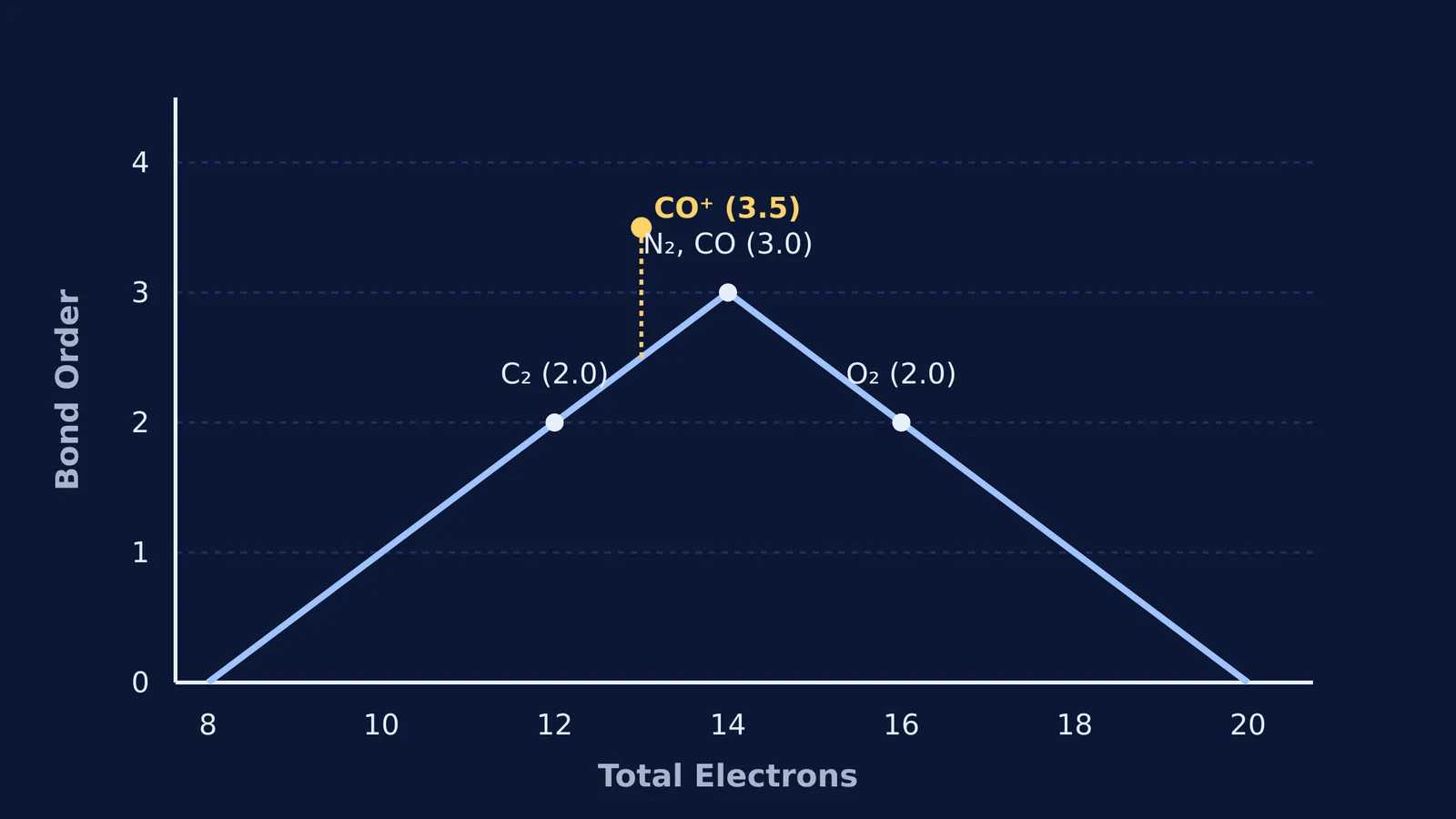
The benchmark is 14 electrons, which corresponds to a bond order of 3 [[1]](https://en.wikipedia.org/wiki/Bond_order). For every electron you move away from 14—whether you add one or subtract one—the bond order decreases by 0.5.
12 electrons = 2.0 (e.g., C₂)
13 electrons = 2.5 (e.g., N₂⁺, CN)
14 electrons = 3.0 (e.g., N₂, CO, CN⁻)
15 electrons = 2.5 (e.g., O₂⁺, NO)
16 electrons = 2.0 (e.g., O₂)
17 electrons = 1.5 (e.g., O₂⁻)
18 electrons = 1.0 (e.g., F₂)
How do you apply the electron count trick?
To find the bond order, simply sum the atomic numbers of the two atoms and adjust for any charge. The resulting number tells you exactly how many steps you are away from the 14-electron peak.
Example 1: The oxygen series Oxygen (O₂) has 8 + 8 = 16 electrons. Starting from 14 electrons (bond order 3), a count of 16 is two steps away. Therefore, the bond order is 3 − 2(0.5) = 2.
The superoxide ion (O₂⁻) has 16 + 1 = 17 electrons. That is three steps away from 14, making its bond order 1.5. Because it has a lower bond order, O₂⁻ has a longer and weaker bond than O₂.
Example 2: Cyanide The cyanide ion (CN⁻) has 6 (from carbon) + 7 (from nitrogen) + 1 (for the negative charge) = 14 electrons. It has a bond order of 3, meaning it shares a strong triple bond, just like molecular nitrogen.
If you find yourself guessing the geometry or bonding of more complex molecules, the Fermi Concept Library has every concept in physics, chemistry, biology, mathematics and computing, each with its own lesson and its place in the map.
Where does the shortcut fail?
The shortcut only applies to simple diatomic molecules with 8 to 20 electrons. It cannot be used for polyatomic molecules, which often require you to calculate an average bond order from resonance structures, nor does it apply to heavier elements or transition metal complexes.
For example, comparing NH₃ vs PH₃ bond angles requires VSEPR theory and Drago's rule, not just an electron count. The shortcut is purely a counting tool for first- and second-period diatomics.
However, the most famous exception for diatomic molecules—and a favourite in chemistry tests—is the CO⁺ cation.
Why is the bond order of CO⁺ 3.5?
Carbon monoxide (CO) has 14 total electrons and a bond order of 3. When it is ionised to form CO⁺, it has 13 total electrons. According to the shortcut, its bond order should drop to 2.5.
However, experimental data reveals that the bond length of CO⁺ (1.115 Å) is shorter than that of CO (1.128 Å) [[2]](https://www.echemi.com/community/what-is-the-bond-order-of-co-and-co-plus-why-is-the-bond-order-of-co-plus-higher-than-that-of-co_mjart2203092040_743.html). Since a shorter bond length means a stronger bond, the bond order of CO⁺ actually increases to 3.5 [[2]](https://www.echemi.com/community/what-is-the-bond-order-of-co-and-co-plus-why-is-the-bond-order-of-co-plus-higher-than-that-of-co_mjart2203092040_743.html).
The reason lies in molecular orbital theory and significant s-p mixing. In heteronuclear diatomics like CO, the highest occupied molecular orbital (the 5σ orbital) has strong antibonding character. Removing an electron from an antibonding orbital reduces the destabilising effect on the bond, increasing the overall stability and bond order of the molecule.
This makes CO⁺ the unique case where ionisation strengthens the bond. If you need to map out the exact molecular orbital energy levels to see this mixing, the Fermi Problem Library has worked problems with a step-by-step solver that explains the reasoning rather than printing an answer.


