

On this page
Press a book flat against a wall and it stays put. Your push is horizontal and gravity is vertical, so what holds it up? In Class 11 and JEE Main problems, the usual trap is writing friction = μF.
Why doesn't the block fall if the push is horizontal?
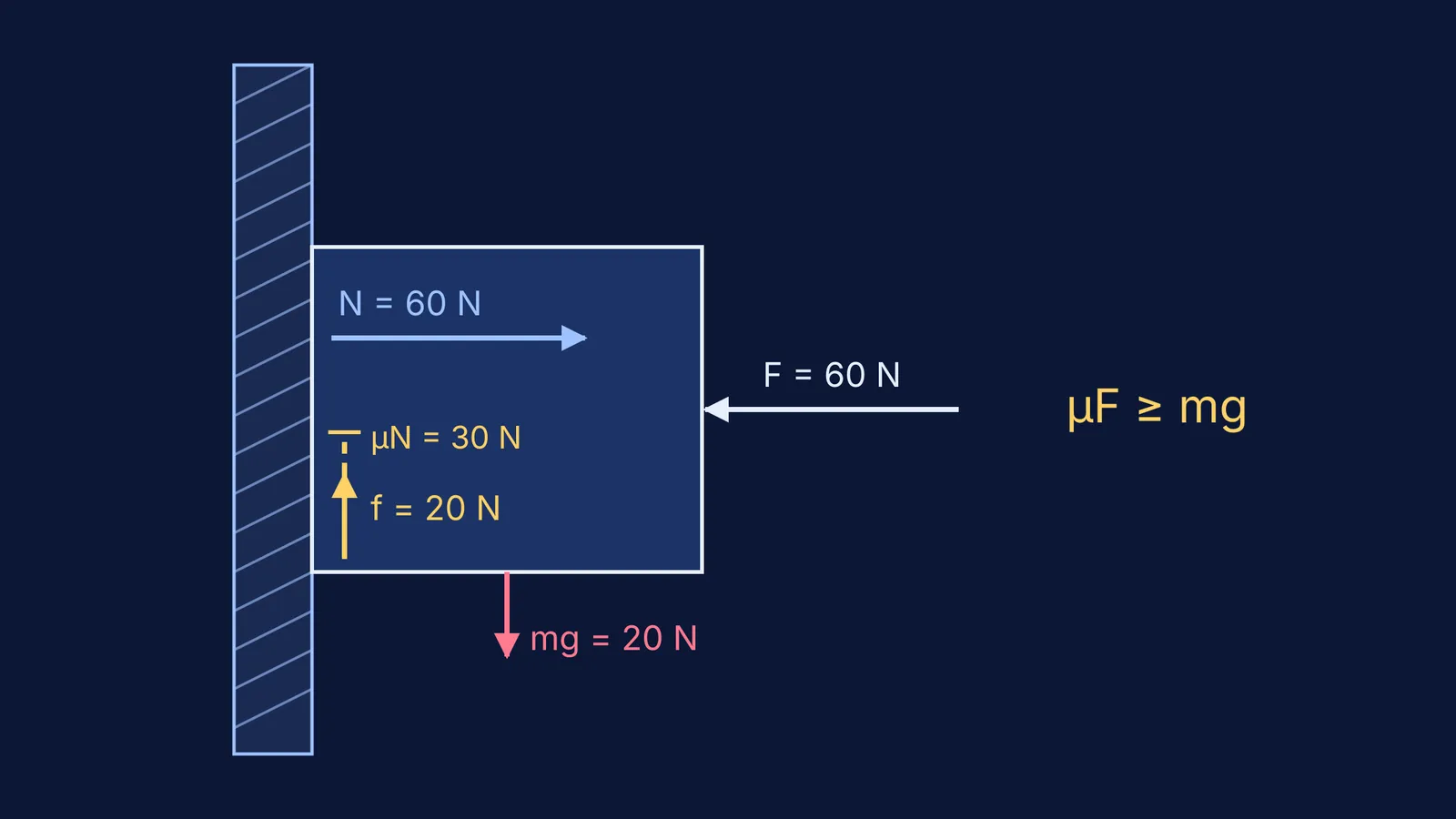
A horizontal push cannot cancel a vertical weight. Its only job is to press the block into the wall, and the wall pushes back with a normal force N equal to your push. What holds the block up is static friction from the wall, acting upward along the surface.
Static friction adjusts itself. OpenStax University Physics, Section 6.2 describes it as "a responsive force that increases to be equal and opposite to whatever force is exerted, up to its maximum limit."
The same section gives that limit as f ≤ μN, where μ is the coefficient of static friction and N is the normal force (OpenStax).
So the block obeys two separate equations:
Perpendicular to the wall: N = F.
Along the wall, while the block is not slipping: f = mg.
Friction equals mg, not μF. The product μF is only the ceiling.
What is the minimum force to hold a block against a wall?
The block stays up when the friction it needs (mg) is no more than the friction available (μN = μF). That gives the condition μF ≥ mg, so the minimum horizontal push is F = mg/μ.
Worked example: a 2 kg block, μ = 0.5 and g = 10 m/s². The weight is 20 N, so the minimum push is 20/0.5 = 40 N.
Now push with 60 N. Friction is not 0.5 × 60 = 30 N. It is 20 N, because that is all the block needs; the other 10 N of capacity sits unused. Push with only 30 N and the limit drops to 15 N, less than the 20 N weight, so the block slides down.
Maximum static friction depends on the normal force and the materials, not the contact area (OpenStax), so a smaller face still needs 40 N.
What if you push at an angle?
Push with force F at angle θ above the horizontal. The part F cos θ presses into the wall, so N = F cos θ. The part F sin θ pushes upward and carries some of the weight.
If the block would slide down, friction acts upward, and it holds when F sin θ + μF cos θ ≥ mg. So the minimum push is F = mg/(sin θ + μ cos θ).
Same block, θ = 37° (sin θ = 0.6, cos θ = 0.8), μ = 0.5: F = 20/(0.6 + 0.4) = 20 N, half the horizontal answer.
There is also a maximum. Push too hard and the block slides up, so friction flips to point down. It holds while F sin θ − mg ≤ μF cos θ, giving F = mg/(sin θ − μ cos θ) = 20/(0.6 − 0.4) = 100 N. Any push from 20 N to 100 N keeps the block still. This upper limit exists only when tan θ > μ; here 0.75 > 0.5.
Push at θ below the horizontal instead and F sin θ adds to the weight: you need μF cos θ ≥ mg + F sin θ, so F = mg/(μ cos θ − sin θ). That needs μ > tan θ; at 37° with μ = 0.5, no push of any size holds the block.
What if the wall is accelerating?
Now put the block on the front face of a cart accelerating at a. Nobody pushes the block; the cart must push it with N = ma. Friction again carries the weight, and the block holds when μma ≥ mg, so the minimum acceleration is a = g/μ.
With μ = 0.5 and g = 10 m/s², the cart needs at least 20 m/s². The mass cancels. At 25 m/s², friction on a 2 kg block is still 20 N, not μma = 25 N.
How do you solve any block-on-wall problem?
Draw the free-body diagram with N, f, mg and the push or acceleration.
Write the equation perpendicular to the wall to find N.
Decide which way the block would slide without friction; friction points the other way.
Write the equation along the wall with f as an unknown.
Use f = μN only at the edge of slipping, to find a minimum or maximum.
Check that the answer can exist, such as μ > tan θ for a downward push.
The same idea returns in angle of repose and the tan θ = μ result and the best angle to drag a block on a rough floor. Finding N from an acceleration is the same step as in the contact force between blocks pushed together.
If you keep writing μN where friction is below its limit, the Fermi Problem Library has worked problems with a step-by-step solver that explains the reasoning rather than printing an answer.


