

On this page
When you stand in a lift that is speeding up as it rises, you feel pressed into the floor. This happens because the lift floor must exert a greater support force to accelerate you upwards against gravity. The lift is a non-inertial frame of reference, and from inside it, this effect can be treated as a "pseudo force" acting downwards.
How Does Upward Acceleration Change Gravity?
According to a standard physics explanation from Georgia State University's HyperPhysics, the apparent weight of an object of mass m in a lift accelerating upwards at a is m(g + a). The effective acceleration due to gravity, often written as g_eff, is simply g + a. Every object in the lift behaves exactly as if it were on a planet with a slightly stronger gravitational pull.
Instead of drawing separate force vectors for gravity and the acceleration of the reference frame, physicists combine them. This effective gravity trick turns a complex accelerating-frame problem into a straightforward stationary one. Inside the moving frame, you simply modify the value of gravity and proceed with standard free-body diagrams.
What is the Acceleration of a Block on the Incline?
Normally, a block placed on a stationary, smooth incline of angle θ experiences a force of mg sin θ pulling it down the slope. Since the mass m cancels out in Newton's second law (F = ma), the block's acceleration is g sin θ.
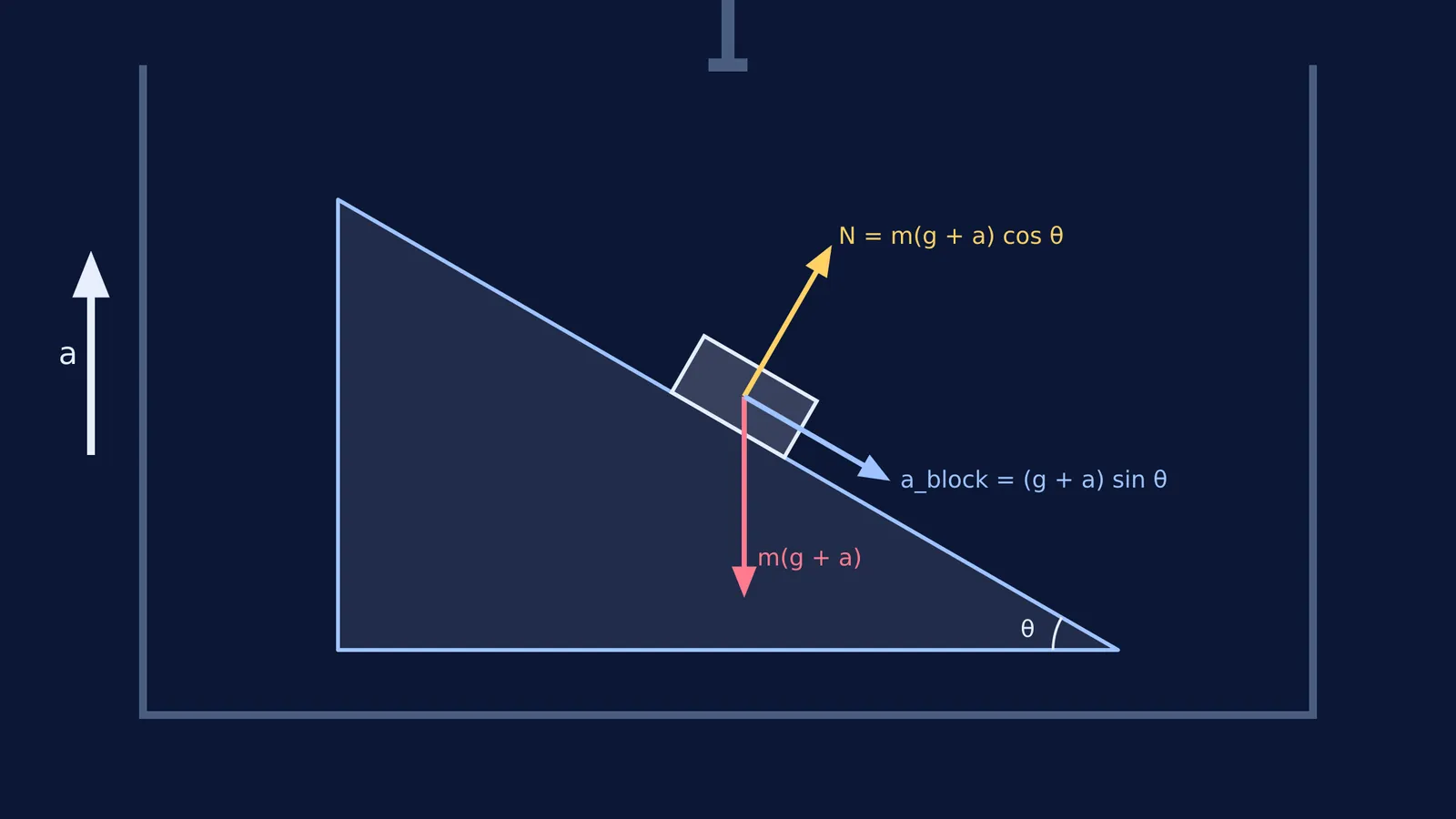
When you place that same incline inside a lift accelerating upwards with acceleration a, you replace g with g + a. The total downward force acting on the block, straight toward the floor of the lift, is m(g + a).
Breaking this force into components relative to the incline:
The component pulling the block down the slope is m(g + a) sin θ.
The component pressing perpendicularly into the surface is m(g + a) cos θ.
Using Newton's second law again, the block's acceleration relative to the incline becomes: a_block = (g + a) sin θ
If you are stuck trying to visualise how these force vectors shift in moving frames, the Fermi Concept Library holds lessons mapping out Newton's laws and pseudo forces step by step.
What Happens to the Normal Force?
The normal force is the perpendicular push the incline exerts to keep the block from falling through it. In a stationary lift, the normal force on a smooth incline is mg cos θ.
When the lift accelerates upwards, the block presses harder against the incline because of the additional pseudo force pushing it downward. The normal force must balance the perpendicular component of both true gravity and the pseudo force. Therefore, the new normal force is N = m(g + a) cos θ.
Because the normal force is larger, the block is forced heavier against the surface. If the incline were rough, this increased normal force would proportionally increase the sliding friction. However, on a completely smooth incline, this change in normal force does not slow the block down; only the parallel force dictates its sliding acceleration.
What If the Lift Accelerates Downwards?
If the lift accelerates downwards at a rate a (where a < g), you feel lighter. The floor does not need to push up as hard to support you. The effective gravity becomes g - a. Consequently, the acceleration of the block down the incline shrinks to (g - a) sin θ.
If the lift were to enter free fall (where a = g), the effective gravity would be exactly zero. The block would experience complete weightlessness, the normal force would vanish, and the block would not slide down the incline at all. Instead, it would hover in place, as both the block and the incline fall at the same rate.
How to Find the Time to Slide?
Suppose a block sits at the top of a smooth incline of length L and angle θ. The lift accelerates upwards at a. How long does it take for the block to reach the bottom?
Identify the block's acceleration along the slope: a_block = (g + a) sin θ.
Use the standard equation of motion s = ut + 1/2 a_block t².
Since the block starts from rest, u = 0, meaning L = 1/2 (g + a) sin θ × t².
Rearrange the equation to solve for time: t = √[ 2L / ((g + a) sin θ) ].
Compare this to the standard time for a block to slide down a rough incline. The method remains identical; you simply swap out standard gravity for the effective gravity.
When facing a complex setup like the contact force between blocks pushed together or a monkey climbing a rope inside a moving lift, applying the effective gravity rule simplifies the work and prevents algebraic mistakes.


