

On this page
Which way does friction act on an inclined conveyor belt?
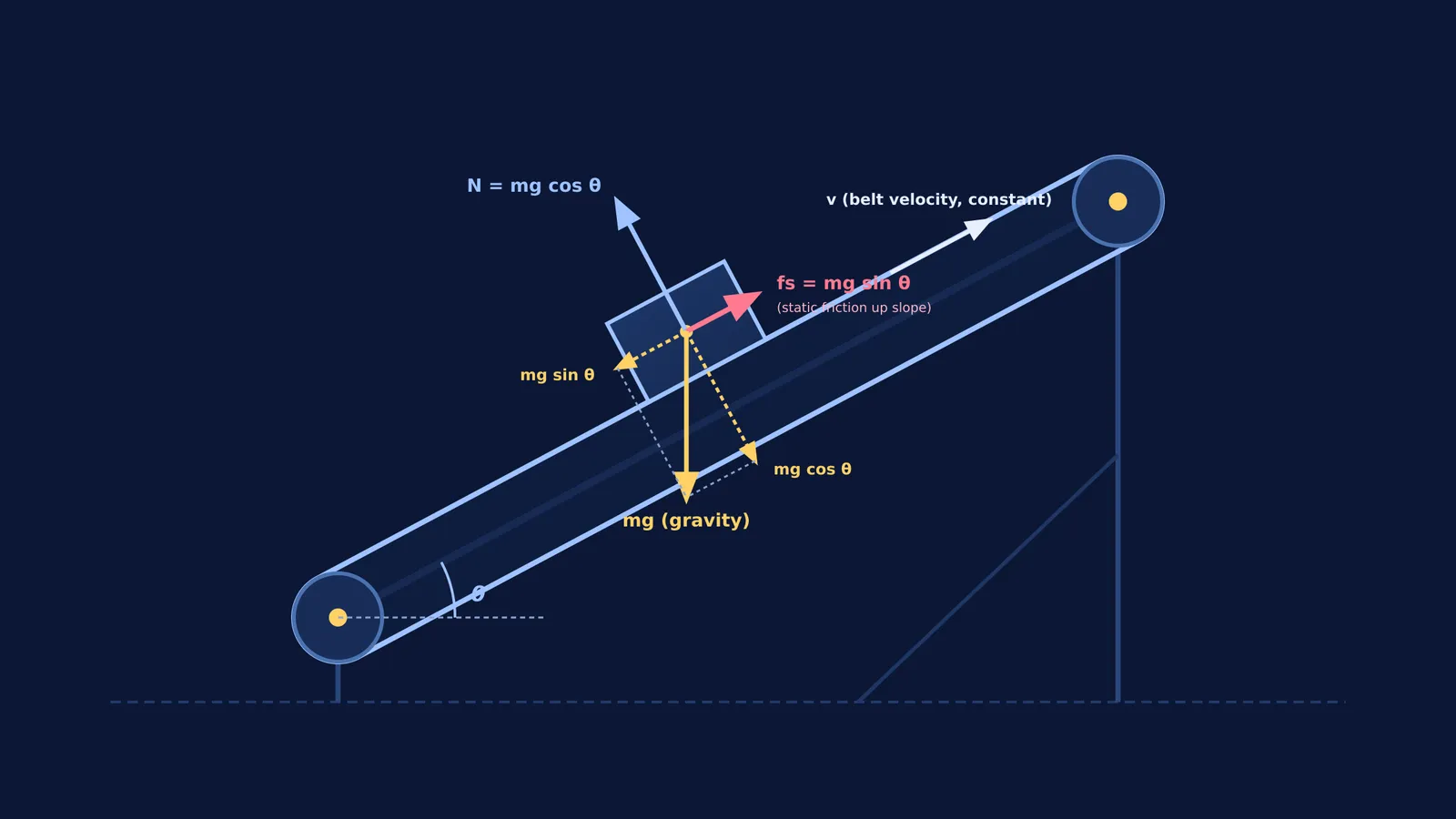
When a parcel rides an inclined conveyor belt upward at constant speed, many students assume friction points downward because friction opposes motion.
That reasoning confuses motion relative to the ground with motion relative to the contact surface. As defined in NCERT Class 11 Physics, friction opposes relative motion or impending relative motion between touching surfaces. Because the box rides the belt without slipping, both surfaces share the exact same velocity; their relative velocity is zero.
To find friction's direction, imagine the belt is frictionless. Gravity's component along the slope, mg sin θ, pulls the box downward. To prevent this downward slide, the belt must exert an upward contact force. That force is static friction, directed up the slope.
Why is static friction equal to mg sin θ instead of μN?
After recognizing that friction acts uphill, students often calculate its magnitude as f_s = μ_s N = μ_s mg cos θ. In research published in The Physics Teacher, Shih-Yin Lin and Chandralekha Singh found that only 35% of introductory physics students correctly solved a target static friction problem even with an analogical tension problem, with many assuming static friction always equals μ_s N. Their work in Physical Review Special Topics - Physics Education Research showed that learners often treat static friction as a fixed formula rather than an adjustable constraint force.
Static friction is self-adjusting, supplying only the force needed to prevent relative sliding. At constant belt speed, acceleration along the incline is zero (a = 0). By Newton's second law:
Σ F_parallel = f_s - mg sin θ = 0
f_s = mg sin θ
The coefficient μ_s sets the upper threshold before slip occurs: f_s ≤ μ_s N = μ_s mg cos θ. Avoiding slippage requires mg sin θ ≤ μ_s mg cos θ, or tan θ ≤ μ_s, matching calculating the angle of repose and static friction threshold.
What happens when the conveyor belt accelerates or moves downward?
Conveyor dynamics change when speed varies or direction reverses, as outlined in NCERT Class 11 Physics:
Accelerating upward: Matching upward acceleration a requires f_s - mg sin θ = m a, so f_s = m(g sin θ + a). Friction acts up the slope and exceeds mg sin θ. Slipping begins if acceleration exceeds a_max = g(μ_s cos θ - sin θ).
Moving downward at constant speed: With zero acceleration (a = 0), force balance along the incline is still f_s - mg sin θ = 0. Static friction points up the incline, holding the box against gravity.
Accelerating downward: Downward acceleration gives mg sin θ - f_s = m a, or f_s = m(g sin θ - a). When a < g sin θ, friction acts uphill. At a = g sin θ, friction vanishes. If a > g sin θ, static friction acts down the slope to pull the box faster than gravity alone. These shifts are key when distinguishing static and kinetic friction in multi-body problems.
A step-by-step worked example for exam day
Consider a problem from NCERT Class 11 Physics: A 10 kg parcel rides an inclined belt at θ = 30° at a steady 2.0 m/s. The coefficients are μ_s = 0.70 and μ_k = 0.50, with g = 9.8 m/s². Find the friction force and the maximum upward acceleration before slipping.
Steady friction: At constant speed, acceleration is zero. Static friction balances gravity along the slope: f_s = mg sin 30° = 10 × 9.8 × 0.5 = 49.0 N uphill.
Slipping threshold: Normal force is N = mg cos 30° = 10 × 9.8 × 0.8660 = 84.87 N. Maximum static friction is f_s,max = μ_s N = 0.70 × 84.87 = 59.41 N. Because 49.0 N ≤ 59.41 N, the parcel does not slip.
Maximum acceleration: At the slip limit, f_s,max - mg sin 30° = m a_max. Substituting gives 59.41 - 49.0 = 10 a_max, so a_max = 1.04 m/s².
If the incline steepens past the threshold, kinetic friction governs the slide, as detailed when timing a block sliding down a rough inclined plane.
How to test friction direction in any mechanics problem
Use this three-step checklist whenever analyzing friction:
Identify relative motion: If contact surfaces stay locked together, friction is static.
Run the frictionless test: Imagine surfaces have zero friction. The direction the object would slip gives the direction of impending motion; static friction opposes that slip.
Solve from equilibrium: Set Σ F = m a along the surface to find friction, then verify f_s ≤ μ_s N.
When practicing mechanics problems, the Fermi Problem Library provides worked problems with a step-by-step solver that explains the reasoning rather than printing an answer. You can review fundamental force balances in the Fermi Concept Library, which covers every concept in physics with its own lesson and its place in the map. For dynamic setups, the Fermi Simulation Lab offers interactive simulations for ideas that are easier to see than to read, letting you observe static friction vectors adapt as you change incline angle and belt speed.


