

On this page
It is a JEE circular-motion classic: a small block at the top of a smooth hemisphere gets a tiny nudge, slides, and at some point flies off. The answer, cos θ = 2/3, matters less than the method, which solves a whole family of problems.
At what angle does a block leave a smooth hemisphere?
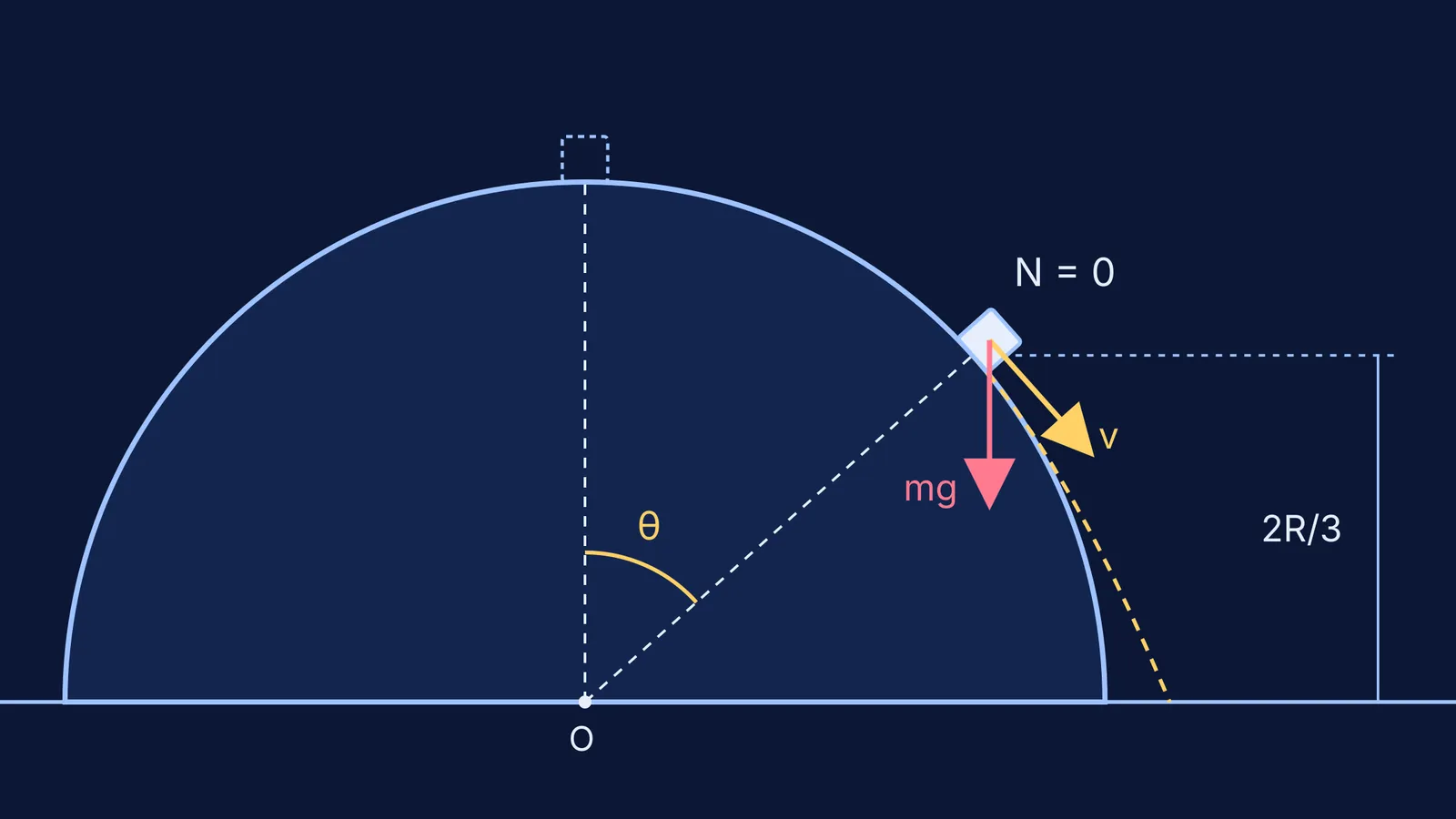
Measure θ from the vertical through the centre O; the radius is R. On the surface, two forces act: gravity mg and the outward normal force N.
Radial equation (Newton's second law towards the centre): mg cos θ − N = mv²/R.
Energy conservation (no friction, and N does no work): the block has fallen R(1 − cos θ), so v² = 2gR(1 − cos θ).
Substitute the second into the first and you get N = mg(3 cos θ − 2). The block leaves when N reaches zero, so 3 cos θ = 2.
A small sphere placed on top of a static frictionless sphere slips until it leaves the surface at θ = cos⁻¹(2/3), as the abstract of a BITS Pilani Goa paper on a sphere moving over a sphere states. That is 48.19° from the vertical, the value Roberto Lineros gives in the European Journal of Physics for a fixed hemisphere.
It leaves 2R/3 above the centre at speed √(2gR/3). Mass, radius and g all cancel, so a coin on a football and a crate on a dome leave at the same angle.
Why does the block leave before it reaches the bottom?
To keep moving in a circle, the block needs an inward force mv²/R, which grows as it speeds up. The only inward pull is mg cos θ, which shrinks as θ grows. N shrinks to make up the difference. Once gravity alone is not enough, the surface would have to pull the block in, and a surface cannot pull. So N = 0 marks the last moment of contact.
How do you solve any leaving-the-surface problem?
The same three steps work every time:
Write the radial equation, with N still in it, in a frame where the surface is not accelerating at that instant.
Find v² at angle θ from energy, and from momentum too if something else can move.
Set N = 0 and solve for cos θ. If it comes out above 1, the body leaves at the start.
Our guide to circular motion, banking and vertical circles has more radial-equation practice. If you tangle the algebra, the Fermi Problem Library has worked problems with a step-by-step solver that explains the reasoning rather than printing an answer.
Does a ball on a sphere leave at the same angle?
Only if it slides from rest.
With a starting speed u. Energy now gives v² = u² + 2gR(1 − cos θ). Setting g cos θ = v²/R gives cos θ = 2/3 + u²/(3gR). If u² ≥ gR, it leaves at the top.
A ball that rolls without slipping. Part of the energy now goes into spin. For a solid ball of radius r on a fixed sphere of radius R, its centre moves on a circle of radius R + r, and its kinetic energy is (7/10)mv². The three steps give 1 − cos θ = 0.7 cos θ, so cos θ = 10/17, about 54°: the pure-rolling limit (very large friction) in the same BITS Pilani Goa paper. It stays on longer because it moves more slowly at each angle. The energy split is covered in our post on rolling without slipping.
What changes if the hemisphere is free to slide?
Put the hemisphere (mass M) on a smooth floor and let a particle of mass m slide down it. The hemisphere recoils, so you add momentum to step 2. Lineros's paper studies this setup and finds that the last contact angle depends only on the mass ratio, not on g or R. It is largest (48.19°) for a fixed hemisphere and falls to 0° when the sliding body is extremely heavy.
Call u the particle's speed relative to the hemisphere and k = m/(m + M). Horizontal momentum is conserved, so the hemisphere moves backwards at V = ku cos θ. Energy then gives u² = 2gR(1 − cos θ)/(1 − k cos²θ).
The trick: at the instant N = 0, nothing pushes the hemisphere sideways, so its acceleration is zero and g cos θ = u²/R holds in its frame with no pseudo force. Combining gives k cos³θ − 3 cos θ + 2 = 0.
For equal masses, k = 1/2 and the equation becomes cos³θ − 6 cos θ + 4 = 0, which factors as (cos θ − 2)(cos²θ + 2 cos θ − 2) = 0. The physical root is cos θ = √3 − 1 ≈ 0.732, so θ ≈ 42.9°. Similar thinking drives block-on-a-moving-wedge problems.
If the moving-hemisphere step feels shaky, revise relative motion and momentum in the Fermi Concept Library, then redo the equal-mass case on paper.


