

On this page
When learning about radioactivity, you are taught that an atom's nucleus contains only protons and neutrons. Yet, in beta minus decay, a nucleus suddenly ejects a high-speed electron (the beta particle).
This creates an immediate contradiction: if there are no electrons in the nucleus, where does the beta particle come from?
Where do beta particles come from if the nucleus has no electrons?
The short answer is that the electron is born at the exact moment of decay. It does not exist inside the nucleus beforehand.
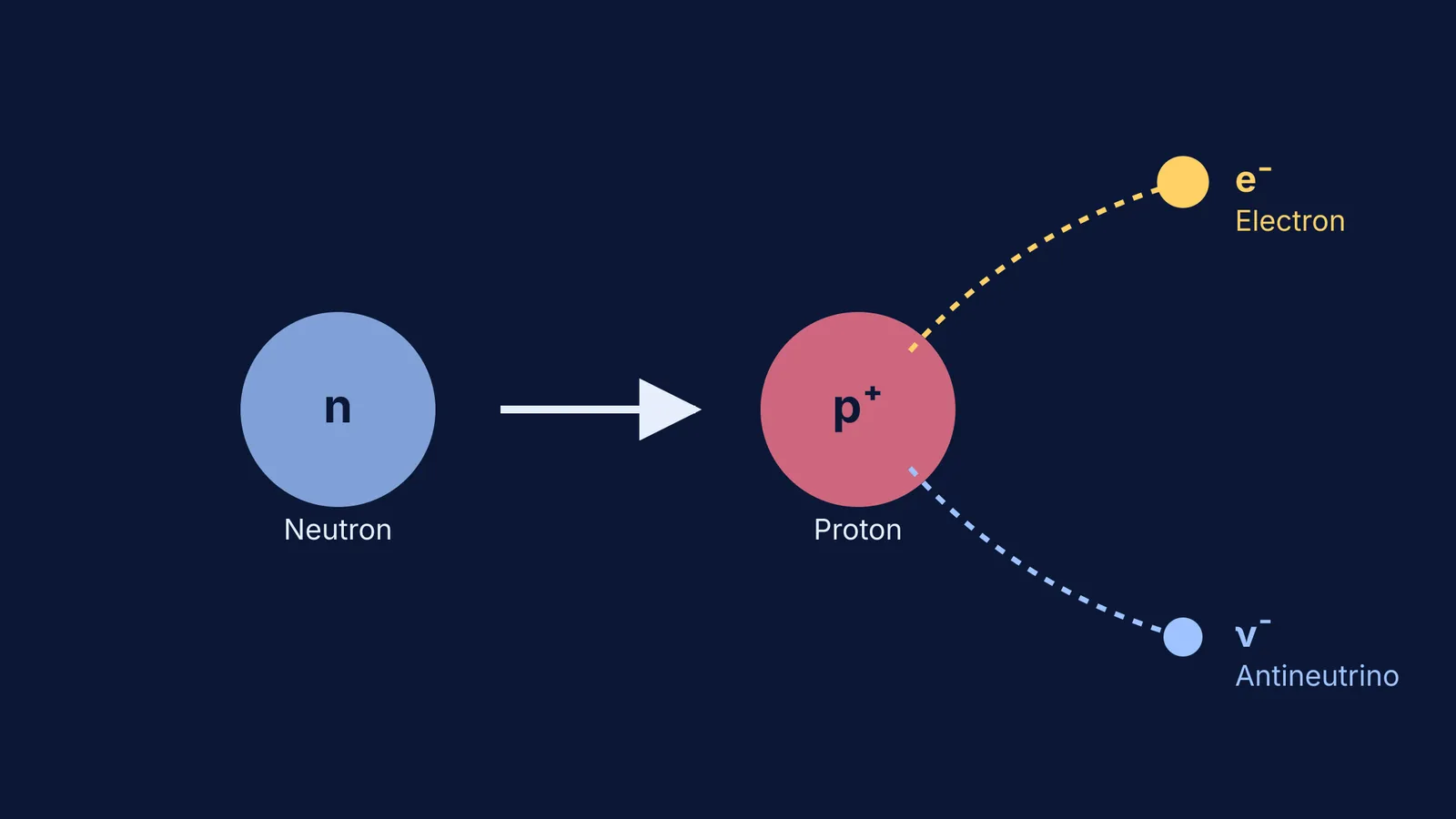
According to the NCERT Class 12 Physics textbook, during beta decay, a neutron inside the nucleus transforms into a proton, an electron (e⁻) and an antineutrino (ν̄). The proton stays behind, increasing the atomic number by one, while the newly created electron and antineutrino are immediately ejected.
This process is fundamentally different from alpha decay, where a chunk of the existing nucleus (two protons and two neutrons) breaks off. In beta decay, the particles emitted are entirely new creations. Once you know how a single beta emission shifts the atomic number, you can apply the same logic to longer chain reactions, such as counting alpha and beta decays in a radioactive decay series.
How can a neutron turn into a proton and an electron?
To understand how a particle can just be "created," you have to look deeper into what a neutron is made of. Protons and neutrons are not fundamental particles; they are built from smaller, elementary units called quarks.
A neutron consists of one "up" quark and two "down" quarks. A proton consists of two "up" quarks and one "down" quark.
During beta decay, the weak nuclear force causes one of the neutron's down quarks to change its "flavour" and become an up quark. This single quark swap effectively turns the original neutron into a proton. To conserve the overall electrical charge and energy of the system, this change is accompanied by the creation of an electron (which carries away the necessary negative charge) and an antineutrino.
Getting comfortable with particle creation
The idea that particles can pop into existence feels strange if you picture atoms as permanent, solid balls. It helps to think of mass and energy as interchangeable, as Albert Einstein showed with E = mc².
The original neutron actually has slightly more mass than the combined mass of the resulting proton and electron. This tiny difference in mass provides the energy needed to create the new particles and give them the kinetic energy to fly away safely. This transformation happens at a predictable rate for any given isotope, which is the basis for calculating radioactive decay and half-life.
When you study nuclear physics for competitive exams like JEE or NEET, you have to shift your perspective from thinking about "what is inside" to "what is conserved". Charge, mass-energy, and nucleon number must all balance exactly across the reaction arrow: n → p⁺ + e⁻ + ν̄.
If you are stuck on balancing these nuclear equations, the Fermi Problem Library has worked problems with a step-by-step solver that explains the reasoning rather than printing an answer.
By remembering that the beta particle is a product of fundamental transformation, not a hidden passenger, the rules of nuclear decay become much easier to follow.


