

On this page
If you can solve a linear first-order equation, you can already solve a Bernoulli equation. The method is one division and one substitution, then the integrating factor work you already know.
What is a Bernoulli differential equation?
A Bernoulli differential equation is a first-order equation of the form dy/dx + P(x)y = Q(x)yⁿ, where n is a real number (Wikipedia: Bernoulli differential equation). The yⁿ term on the right makes it non-linear. Some authors exclude n = 0 and n = 1, because n = 0 gives a linear equation and n = 1 a separable one.
The same article says Jacob Bernoulli discussed the equation in 1695, and Gottfried Leibniz published the solution method still used today in the same year.
How do you solve a Bernoulli differential equation?
These steps follow Lamar University's differential equations notes: divide by yⁿ, then substitute v = y¹⁻ⁿ.
Write the equation as dy/dx + P(x)y = Q(x)yⁿ and read off P, Q and n.
Divide every term by yⁿ: y⁻ⁿ dy/dx + P(x)y¹⁻ⁿ = Q(x).
Put v = y¹⁻ⁿ. Differentiating gives dv/dx = (1 − n)y⁻ⁿ dy/dx, so y⁻ⁿ dy/dx = dv/dx divided by (1 − n).
Substitute and multiply through by (1 − n): dv/dx + (1 − n)P(x)v = (1 − n)Q(x). This is linear in v.
Solve with the integrating factor e^∫(1 − n)P dx, then replace v by y¹⁻ⁿ.
A common slip is in step 4: the factor (1 − n) multiplies both P and Q. When n = 2 it equals −1 and flips both signs.
Worked example 1: what happens when n = 2?
Solve dy/dx + y/x = xy² for x > 0.
Here P = 1/x, Q = x and n = 2. Divide by y²: y⁻² dy/dx + (1/x)y⁻¹ = x.
Put v = y⁻¹, so dv/dx = −y⁻² dy/dx. The equation becomes −dv/dx + v/x = x, or dv/dx − v/x = −x.
Integrating factor: e^∫(−1/x) dx = 1/x.
Then d/dx(v/x) = −1, so v/x = −x + C and v = Cx − x².
Answer: 1/y = Cx − x², that is, y = 1/(Cx − x²).
Differentiate your answer and substitute it back; this quick check catches sign slips.
Worked example 2: what if n is a fraction?
Solve dy/dx + y/x = √y for x > 0.
Here n = 1/2, so 1 − n = 1/2. Divide by √y: (1/√y) dy/dx + (1/x)√y = 1.
Put v = √y, so dv/dx = (1/(2√y)) dy/dx. That means (1/√y) dy/dx = 2 dv/dx.
The equation becomes 2 dv/dx + v/x = 1, or dv/dx + v/(2x) = 1/2.
Integrating factor: e^∫1/(2x) dx = √x. Then d/dx(v√x) = √x/2, so v√x = x√x/3 + C.
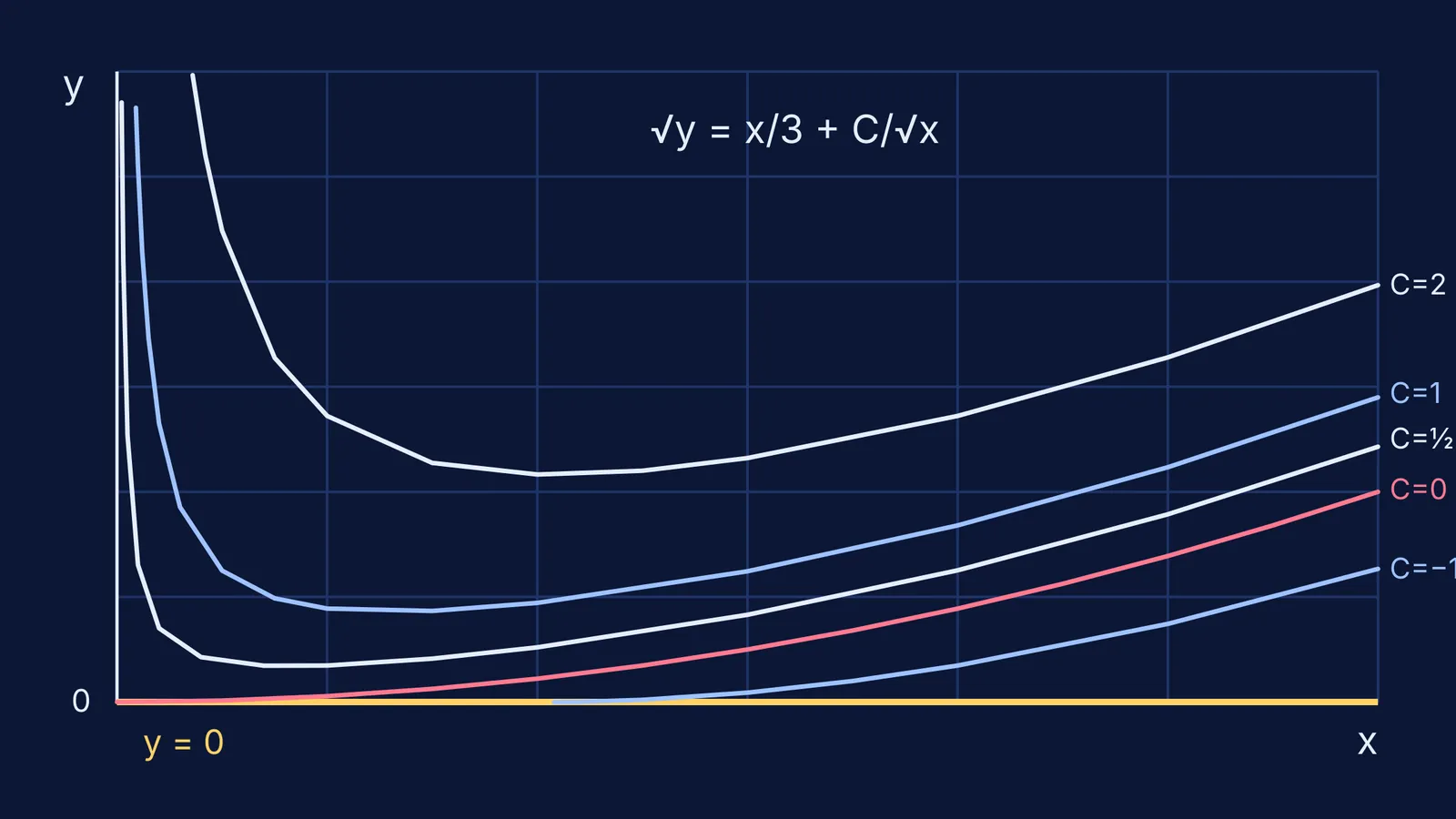
Answer: √y = x/3 + C/√x.
The diagram above plots this family for five values of C. Dividing by yⁿ assumes y is never zero. For positive n, the constant function y = 0 is also a solution, as the Wikipedia article notes.
How does JEE disguise a Bernoulli equation?
Under differential equations, NTA's JEE Main 2027 syllabus lists separation of variables, homogeneous equations, and linear equations of the type dy/dx + p(x)y = q(x) (NTA JEE Main 2027 syllabus, PDF). Bernoulli is not named there, so questions use it as a route to that linear form. Watch for these patterns:
Plain form, unusual n: n = 3, n = −1 or n = 1/2. The only trap is the (1 − n) factor.
Extra factor in front: x dy/dx + y = x³y² becomes dy/dx + y/x = x²y² once you divide by x.
Roles reversed: dx/dy + P(y)x = Q(y)xⁿ. Treat x as the unknown and put v = x¹⁻ⁿ.
Hidden function of y: f′(y) dy/dx + P(x)f(y) = Q(x). Put t = f(y). For example, sec²y dy/dx + P(x)tan y = Q(x) is linear in t = tan y. Bernoulli is the case where f(y) is a power of y.
Initial condition: a value such as y(1) = 1 fixes C, and the question then asks for y at another point.
If you set up the substitution and the signs keep going wrong, the Fermi Problem Library has worked problems with a step-by-step solver that explains the reasoning rather than printing an answer.
What should you revise alongside it?
The Bernoulli method depends on your integrating factor work, so revise linear differential equations and the integrating factor method first. The same idea of substituting to reach a form you know drives homogeneous differential equations with y = vx. Picking v is close to choosing the right t in integration by substitution. If integrating factors themselves feel shaky, the Fermi Concept Library has a lesson for every concept in mathematics, each with its place in the map.


