

On this page
In organic synthesis, preparing disubstituted benzene rings requires strict attention to reaction sequencing. Converting benzene into m-nitroacetophenone is a classic question testing regiochemical control in Class 12 board examinations and competitive exams like JEE Main and JEE Advanced. The target molecule contains two functional groups: an acetyl group (-COCH3) and a nitro group (-NO2), positioned meta (1,3) to each other.
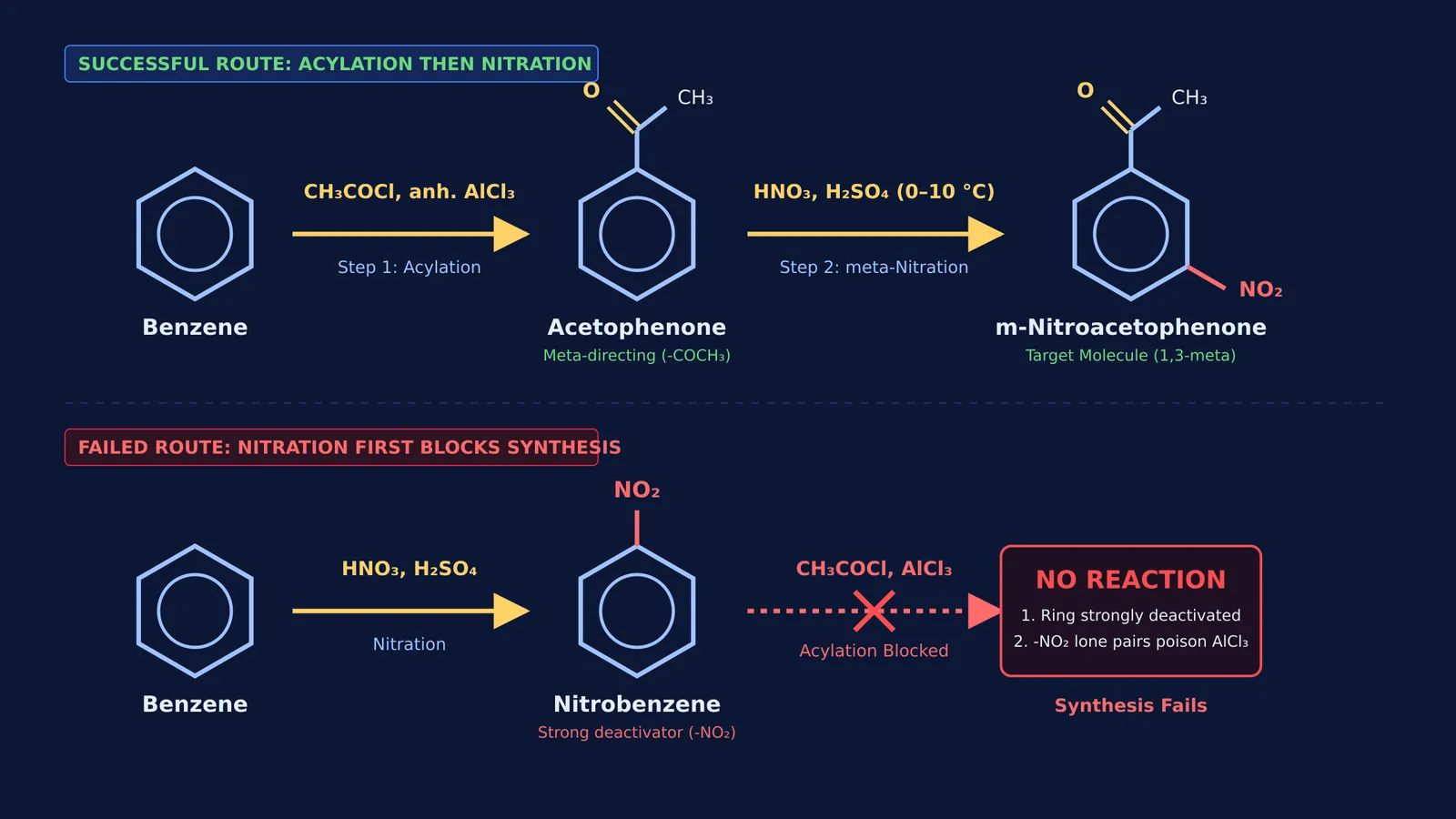
To achieve this orientation, carry out Friedel-Crafts acylation first to form acetophenone, followed by nitration. Reversing the order causes complete synthetic failure.
Why must Friedel-Crafts acylation come before nitration?
The orientation of incoming substituents on an aromatic ring depends on substituents already present, a central principle in directing groups in electrophilic aromatic substitution. In acetophenone, the electronegative carbonyl oxygen withdraws electron density from the benzene ring through resonance (-M) and inductive (-I) effects.
Resonance structures of acetophenone show positive charges developing at the ortho and para positions. Consequently, the meta positions remain comparatively higher in electron density. When an electrophile attacks, meta attack avoids placing a positive charge on the ring carbon directly bonded to the carbonyl group, resulting in a lower activation barrier than ortho or para attack.
Because the acetyl group is meta-directing, synthesizing acetophenone first ensures that subsequent nitration occurs predominantly at the meta position. Nitrating benzene first to make nitrobenzene would strongly deactivate the ring, completely blocking subsequent Friedel-Crafts acylation.
Step 1: How do you convert benzene to acetophenone?
The first step is the Friedel-Crafts acylation of benzene, an electrophilic aromatic substitution reaction rooted in Friedel and Crafts' original discovery. Benzene reacts with acetyl chloride (CH3COCl) in the presence of anhydrous aluminium chloride (AlCl3) as a Lewis acid catalyst, as outlined in NCERT Chemistry Class 11 Hydrocarbons.
Aluminium chloride abstracts chloride from acetyl chloride, generating an electrophilic acylium ion (CH3-C≡O⁺). Benzene's pi system attacks this ion to form a resonance-stabilized arenium ion, which loses a proton to restore aromaticity, yielding acetophenone and hydrogen chloride.
Unlike alkylation where AlCl3 acts catalytically, acylation requires stoichiometric amounts of Lewis acid because AlCl3 complexes with the carbonyl oxygen of the ketone product. C. R. Noller and Roger Adams in the Journal of the American Chemical Society demonstrated that reacting benzene with aliphatic acid anhydrides and aluminium chloride delivers 76% to 83% yield of acetophenone. Because the newly introduced acetyl group deactivates the ring, polyacylation does not occur.
Step 2: How do you nitrate acetophenone to m-nitroacetophenone?
Once acetophenone is isolated, the second step is electrophilic aromatic nitration. Acetophenone is dissolved in concentrated sulphuric acid and treated dropwise with a chilled mixture of concentrated nitric and sulphuric acids.
According to NCERT Chemistry Class 12 Aldehydes, Ketones and Carboxylic Acids, the reaction mixture must be kept between 0 °C and 10 °C (273 K to 283 K) in an ice bath. Concentrated sulphuric acid protonates nitric acid, generating the nitronium ion (NO2⁺):
HNO3 + 2 H2SO4 ⇌ NO2⁺ + H3O⁺ + 2 HSO4⁻
Under these chilled conditions, the nitronium ion attacks the meta position. In *Organic Syntheses*, B. B. Corson and R. K. Hazen established that nitration of acetophenone produces 55% to 61% isolated yield of m-nitroacetophenone, obtaining a light yellow solid with a melting point of 76 °C to 78 °C. Minor ortho and para isomers remain largely in solution when the mixture is poured onto crushed ice and recrystallized from ethanol.
Why does nitrobenzene fail to undergo Friedel-Crafts acylation?
Understanding why the synthetic sequence cannot be reversed is essential for exam problems. If you nitrate benzene first to obtain nitrobenzene, subsequent treatment with acetyl chloride and anhydrous aluminium chloride produces no reaction.
Two factors explain this failure:
Severe ring deactivation: The nitro group (-NO2) is a powerful electron-withdrawing group via resonance (-M) and induction (-I). It depletes pi-electron density so strongly that the ring is insufficiently nucleophilic to attack an acylium ion.
Catalyst poisoning: The nitro oxygen atoms act as Lewis bases, coordinating directly to anhydrous AlCl3. This complexation consumes the catalyst and places a formal positive charge next to the ring, further suppressing reactivity.
Nitrobenzene is so unreactive toward Friedel-Crafts electrophiles that chemists frequently employ it as an inert solvent for acylating other rings.
How to tackle electrophilic aromatic substitution conversions in exams?
When solving multi-step aromatic synthesis questions in CBSE or JEE examinations, apply a three-step checklist:
Check substituent orientation: If the target substituents are meta (1,3), install the meta-directing group first, or convert an ortho/para director into a meta director later.
Verify functional group compatibility: Never attempt Friedel-Crafts acylation on rings carrying strong deactivators (-NO2, -SO3H, -COCH3, -COOH) or amino groups (-NH2), which complex with AlCl3—similar to why protecting aniline with acetylation before nitration is necessary.
Confirm reaction conditions: Specify critical controls, such as keeping temperatures below 10 °C during nitration to prevent side reactions.
The Fermi Problem Library offers worked problems with a step-by-step solver that explains the reasoning rather than printing an answer, helping students evaluate synthetic routes. For conceptual foundations, the Fermi Concept Library provides lessons for every concept across chemistry, showing each reaction's place in the map.


