

On this page
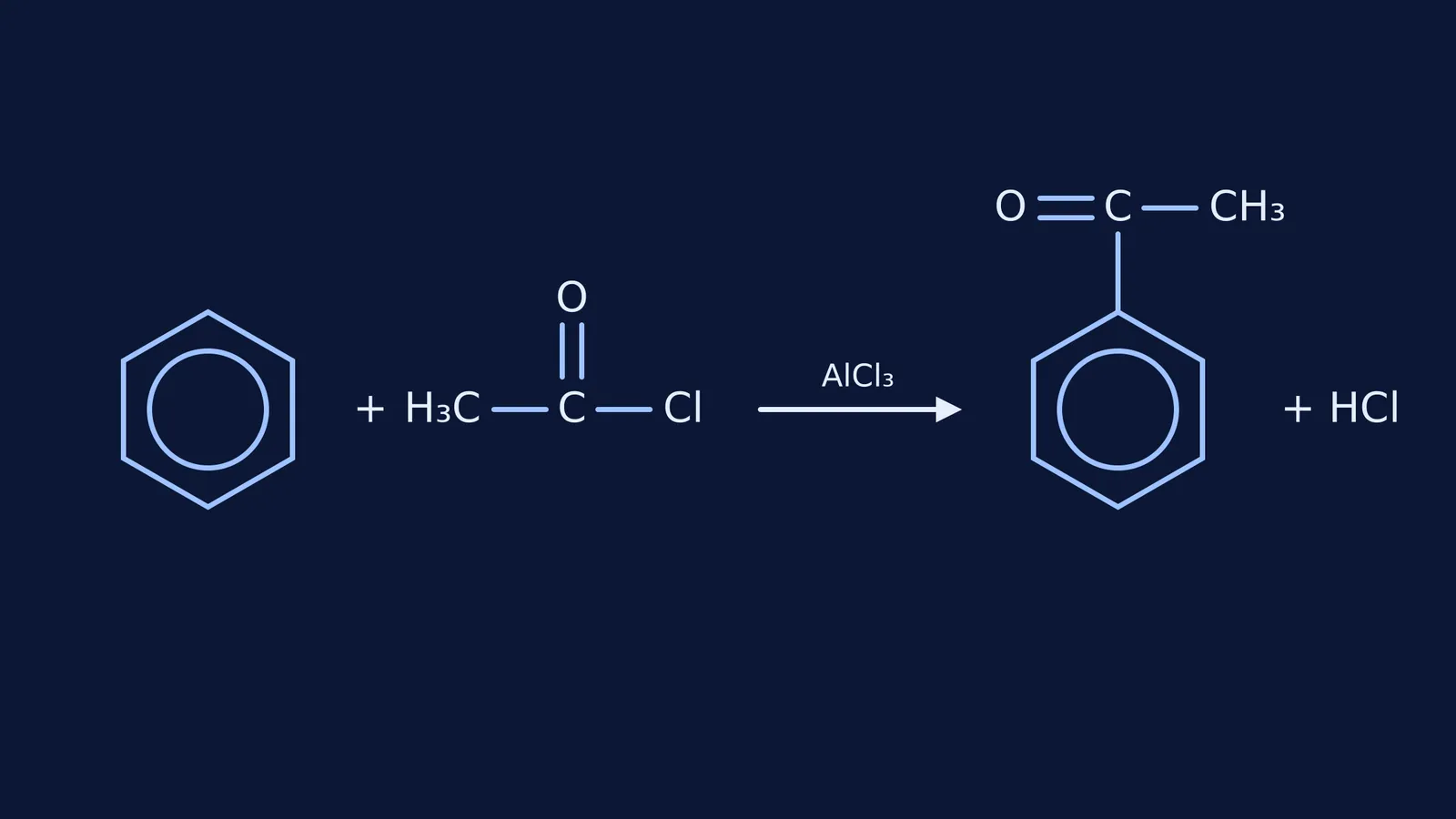
Converting benzene to acetophenone is a standard procedure in organic chemistry, typically achieved through Friedel-Crafts acylation.
If you attempt to add an alkyl group directly to benzene, you often encounter two major side effects: the carbon chain rearranging into an unexpected shape, and the reaction running away to attach multiple groups to the same ring. Acylation solves both problems elegantly.
How do you convert benzene to acetophenone?
To synthesize acetophenone, benzene is reacted with acetyl chloride (CH₃COCl) in the presence of anhydrous aluminum chloride (AlCl₃) as a catalyst, as detailed in the Wikipedia guide to Friedel–Crafts acylation.
The aluminum chloride acts as a Lewis acid, reacting with the acetyl chloride to generate a highly reactive, positively charged intermediate called an acylium ion. The electron-rich benzene ring then attacks this acylium ion. After the loss of a proton, aromaticity is restored, leaving you with acetophenone and hydrogen chloride gas as a byproduct.
If you are reviewing how electrophiles attack aromatic rings, the Fermi Concept Library has a lesson on the full substitution mechanism.
Why does Friedel-Crafts acylation prevent carbocation rearrangement?
In a standard Friedel-Crafts alkylation, the intermediate is a carbocation. Primary and secondary carbocations are relatively unstable and will readily shift a neighboring hydrogen or methyl group to form a more stable tertiary carbocation. If you try to attach a straight chain of three or more carbons to benzene, it will rearrange before attaching, giving you a branched product instead.
Acylation uses an acylium ion (CH₃–C⁺=O) rather than a standard carbocation. This ion is uniquely stable because of resonance. The positive charge on the carbon atom can be shared with the adjacent oxygen atom, which donates a lone pair of electrons to form a carbon-oxygen triple bond (CH₃–C≡O⁺).
Because the acylium ion is already stabilised by this resonance, it does not undergo the skeletal rearrangements typical of alkyl carbocations. The carbon chain remains exactly as it was in the starting acetyl chloride, guaranteeing that you get exactly the ketone you planned.
Why is polysubstitution avoided in acylation?
The second major flaw of Friedel-Crafts alkylation is polyalkylation. Alkyl groups are electron-donating. When you add an alkyl group to a benzene ring, the resulting product (such as ethylbenzene) is actually more reactive than the original benzene. The reaction therefore continues, adding a second and sometimes a third alkyl group to the ring.
Acylation completely avoids this run-away reaction. The acetyl group introduced to form acetophenone contains a carbonyl (C=O) bond directly attached to the ring. This carbonyl group is highly electron-withdrawing due to its electronegative oxygen atom.
Once the first acetyl group attaches, it pulls electron density away from the aromatic ring, making the product significantly less reactive than the starting benzene. Because the ring is deactivated, it cannot undergo a second electrophilic attack under standard conditions. The reaction naturally and cleanly stops at the mono-substituted product, giving a high yield of acetophenone.
What makes acylation better than alkylation?
When attaching carbon chains to a benzene ring, acylation offers three major advantages over alkylation:
No rearrangement: The acylium ion is stabilised by resonance and does not shift its carbon skeleton.
No polysubstitution: The resulting carbonyl group is electron-withdrawing, which deactivates the ring and halts the reaction after one substitution.
Predictable yields: Because it avoids run-away reactions and unexpected isomers, acylation produces a clean, high-yield product.
How do you make a straight-chain alkylbenzene?
Because acylation is so strictly controlled against rearrangement and polysubstitution, organic chemists frequently use it as a workaround to make straight-chain alkylbenzenes.
If you need propylbenzene, for example, directly reacting benzene with 1-chloropropane will yield mostly isopropylbenzene because the intermediate primary carbocation shifts into a more stable secondary carbocation before the ring can attack it.
Instead, chemists split the synthesis into two reliable steps. They first perform a Friedel-Crafts acylation with propanoyl chloride to attach the three-carbon chain securely without any risk of rearrangement. This yields a ketone. In the second step, they remove the carbonyl oxygen entirely using a Clemmensen reduction (boiling the ketone with zinc amalgam and hydrochloric acid) or a Wolff-Kishner reduction (using hydrazine and a strong base). This reduces the ketone to a straight-chain alkane, successfully leaving a perfectly unbranched carbon chain attached to the benzene ring.
To practice synthesis questions with a step-by-step solver, try the Fermi Problem Library.


