

On this page
Transforming benzaldehyde into benzophenone takes a two-step organic route: a Grignard addition followed by oxidation. This sequence builds a heavier aromatic ketone from a simple aldehyde, a fundamental exercise in carbon–carbon bond formation. Whether you are revising for JEE Main, preparing for a practical exam, or mapping out a synthetic pathway, understanding this sequence covers two crucial reaction types: nucleophilic addition and the oxidation of secondary alcohols.
What are the steps to convert benzaldehyde to benzophenone?
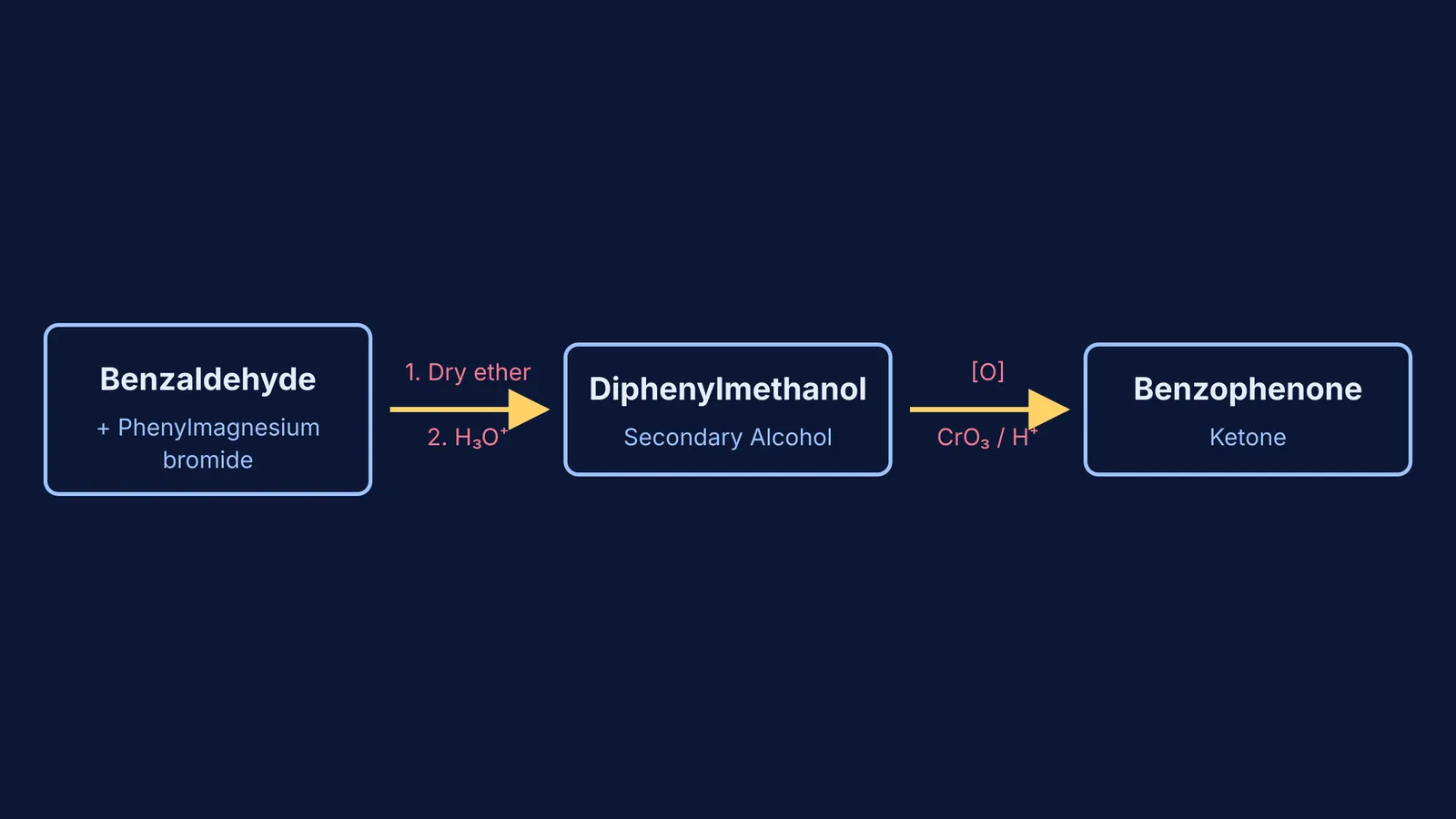
Converting benzaldehyde to benzophenone requires two distinct chemical transformations, each targeting a different part of the molecule's structure.
First, you must add a second benzene ring to the aldehyde carbon. Benzaldehyde (C₆H₅CHO) has only one phenyl group attached to its carbonyl carbon. Benzophenone (C₆H₅COC₆H₅) has two. To attach the second phenyl ring, you use a Grignard reaction. This step creates a carbon–carbon bond, turning the aldehyde into a secondary alcohol called diphenylmethanol (also known as benzhydrol).
Second, you must restore the carbonyl group. The Grignard addition leaves you with an -OH group where the C=O double bond used to be. By treating diphenylmethanol with an oxidising agent, you remove hydrogen and reform the carbon–oxygen double bond, yielding benzophenone.
How do you convert benzaldehyde to diphenylmethanol?
The first step is a nucleophilic addition using a Grignard reagent. When you treat benzaldehyde with phenylmagnesium bromide (C₆H₅MgBr) in a solvent like dry ether, the electron-rich phenyl group attacks the electrophilic carbonyl carbon of the aldehyde.
This attack forms a magnesium alkoxide intermediate. Because the phenyl ring is bulky, the reaction is often exothermic and can form a milky precipitate. You then hydrolyse this intermediate with a dilute acid (such as aqueous HCl) to protonate the oxygen, giving diphenylmethanol.
The entire Grignard sequence must be run under strictly anhydrous conditions. Any moisture will donate a proton to the Grignard reagent, destroying it to form benzene instead of your target alcohol. This sensitivity to water is a hallmark of the reaction, a coupling method that earned Victor Grignard the 1912 Nobel Prize in Chemistry.
If you are unsure which Grignard reagent and carbonyl compound to pair, the Fermi Problem Library has worked problems with a step-by-step solver that explains the reasoning rather than printing an answer.
Why must the Grignard reaction be completely dry?
A common pitfall when converting benzaldehyde to benzophenone is failing to maintain strictly anhydrous conditions during the first step. Phenylmagnesium bromide is a powerful nucleophile, but it is also a very strong base. If even a single drop of water is present in your reaction flask, the Grignard reagent will react with the water instead of the benzaldehyde.
In this unwanted side reaction, the phenyl group acts as a base and extracts a proton from the water molecule. This immediately destroys the Grignard reagent, converting it into benzene and leaving behind a basic magnesium salt. Because this acid-base reaction is much faster than the nucleophilic addition to the aldehyde, any moisture will drastically reduce your yield of diphenylmethanol.
To prevent this, laboratory syntheses require you to dry all glassware in an oven beforehand. You must also use an anhydrous solvent, typically dry diethyl ether, which has been distilled over a drying agent like sodium metal or lithium aluminium hydride to remove trace water. The ether solvent also plays a crucial chemical role: the lone pairs of electrons on the oxygen atoms of the ether molecules coordinate with the electron-deficient magnesium atom, stabilising the Grignard reagent as it forms.
How is diphenylmethanol oxidised to benzophenone?
Once you have isolated your secondary alcohol, the next stage is to oxidise it to a ketone. You can use several common laboratory oxidising agents, such as acidified potassium dichromate, Jones reagent (chromium trioxide in sulfuric acid), or even household bleach paired with a phase-transfer catalyst for a greener approach.
During oxidation, the -OH group of diphenylmethanol loses hydrogen to become a C=O double bond. This transformation physically changes the compound: diphenylmethanol is a white solid that melts at 69 °C, while the resulting benzophenone melts at 48.5 °C.
Unlike primary alcohols, which can over-oxidise into carboxylic acids, secondary alcohols stop cleanly at the ketone stage. Because benzophenone lacks the α-hydrogen needed for further oxidation under standard conditions, you do not have to worry about the reaction going too far.
If you struggle to remember why aldehydes and ketones behave differently under oxidation, the Fermi Concept Library has every concept in chemistry, each with its own lesson and its place in the map.
A checklist for the conversion route
When writing this route in a theoretical exam or running it in a lab, follow this sequence to ensure maximum yield and correct mechanism steps:
Prepare the Grignard reagent: React bromobenzene with magnesium turnings in dry ether to form phenylmagnesium bromide. Keep the flask perfectly dry.
Perform the addition: Slowly drip benzaldehyde into the Grignard solution. Keep the mixture cool to manage the exothermic reaction.
Hydrolyse the intermediate: Add dilute acid (like dilute HCl or NH₄Cl solution) to protonate the alkoxide, which will separate the mixture into an organic layer and an aqueous layer. Extract the diphenylmethanol from the organic layer.
Oxidise the alcohol: React the purified diphenylmethanol with your chosen oxidising agent (like CrO₃/H₂SO₄). The secondary alcohol will convert to benzophenone.
Purify the product: Recrystallise the crude benzophenone from a solvent like petroleum ether to obtain pure crystals.
This two-step synthesis not only tests your grasp of named reactions but also your ability to control conditions. For more practice with carbonyl conversions, see our guides on aldehydes and ketones, the Cannizzaro reaction, and the Rosenmund, Stephen and Etard reactions.


