

On this page
When a battery or cell drives a current through a circuit, not all of its energy reaches the device you want to power. Some energy is inevitably lost as heat inside the cell itself. Understanding how to calculate this loss is a frequent requirement in physics exams, but it also explains why our power grids and car batteries are designed the way they are.
What is the efficiency of a cell in a circuit?
The efficiency of any power source is the ratio of the useful power delivered to the outside circuit (P_out) to the total power generated by the source (P_total). In an ideal world without internal resistance, all the generated power would reach the external circuit, making the cell perfectly efficient. However, because the materials inside a real battery naturally resist the flow of electrons, a portion of that energy is always converted into thermal energy before it can leave the battery terminals.
If a cell has an electromotive force (EMF) E and an internal resistance r, and it is connected to an external resistance R, the current I flowing through the circuit is calculated as E / (R + r).
The total power generated by the chemical reactions within the cell is I²(R + r). The useful power delivered to the external resistance, which actually powers your device, is I²R.
To find the efficiency, you simply divide the useful power by the total power generated: Efficiency = I²R / I²(R + r) = R / (R + r)
This clean formula, R / (R + r), tells you exactly what fraction of the cell's energy is doing useful work. To get the final percentage, you just multiply that ratio by a factor of a hundred.
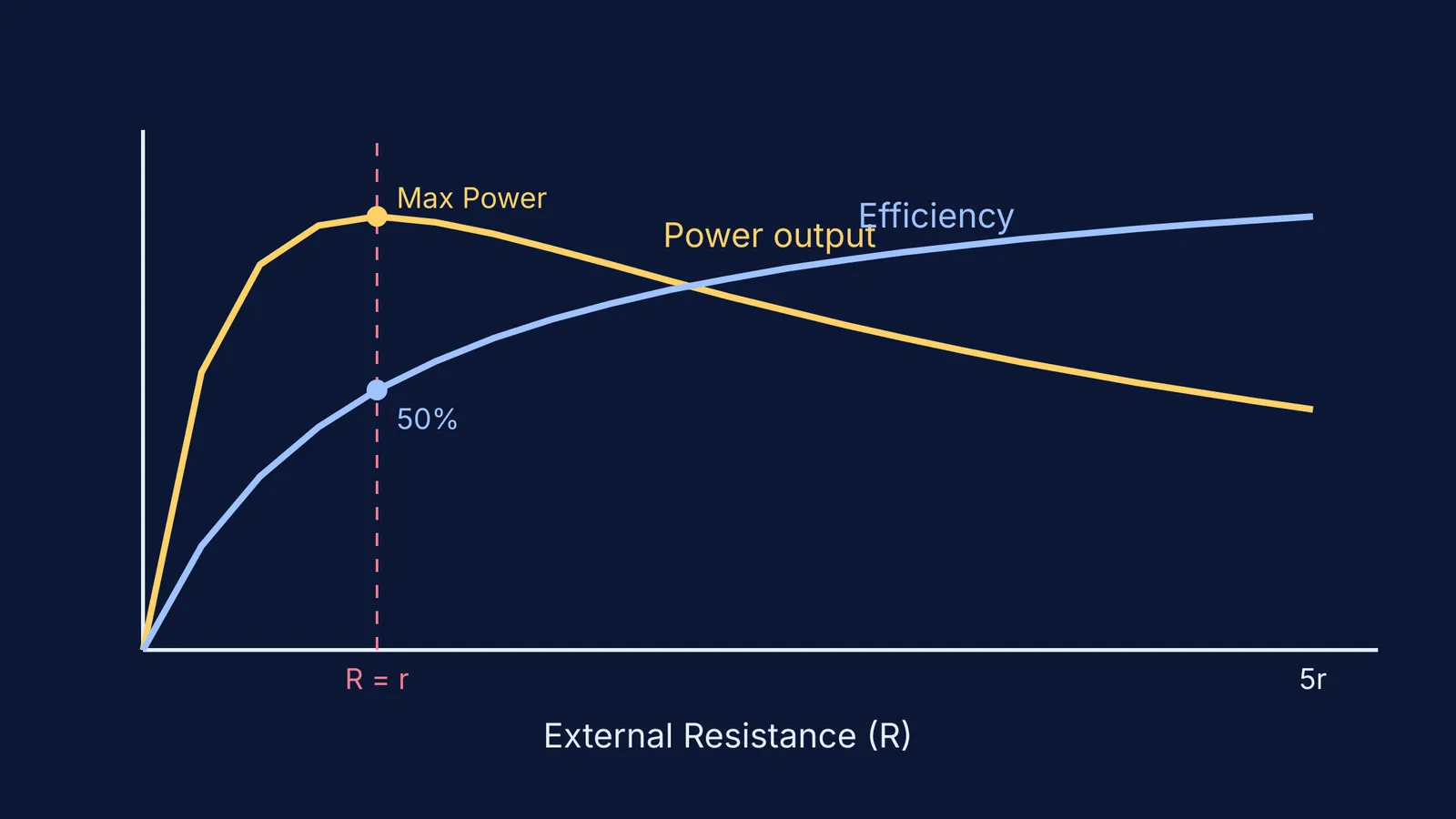
Why does efficiency drop to 50% at maximum power transfer?
The maximum power transfer theorem states that a source delivers the most possible power to a load when the external resistance exactly matches the internal resistance (R = r) 1.
If you plug R = r into the efficiency formula, you get: Efficiency = r / (r + r) = r / 2r = 0.5
This means that at the exact moment a battery is delivering its maximum possible power, its efficiency is only 50% 1. Half of the total energy is doing useful work, and the other half is being wasted as heat inside the battery.
High efficiency vs maximum power
In the late 1800s, some scientists mistakenly believed that electric motors could never be more than 50% efficient because they assumed systems had to be designed for maximum power transfer 1. Thomas Edison realised that by making the internal resistance of the generator much smaller than the load resistance (r ≪ R), the efficiency could be pushed to 90% or higher 1.
Today, car batteries and electrical grids are designed for high efficiency, not maximum power. If a car battery operated at maximum power transfer and wasted half of its energy as internal heat, it would overheat and suffer a catastrophic failure. Instead, the external resistance is kept much larger than the internal resistance, allowing the system to run cool and efficiently.
How to tackle battery efficiency in exams
Exam questions on this topic usually fall into two categories:
Finding the ratio: You will be given an internal resistance r and an external resistance R (for example, R = 3r). Using R / (R + r), the efficiency is 3r / 4r = 0.75.
The maximum power trap: A question might describe a complex circuit and ask for the efficiency when maximum power is drawn. You do not need to calculate the equivalent resistance; the answer is always 50% 1.
If you find yourself guessing when to apply the maximum power theorem versus when to calculate standard power output, the Fermi Problem Library has worked problems with a step-by-step solver that explains the reasoning rather than printing an answer. It checks your understanding as it goes.
Once you are comfortable with single cells, you can apply these power concepts to more complex networks using the node potential method, or see how cell properties change by learning to calculate from cell EMF to ΔG° and K. Mastering these fundamentals will give you a significant edge when analyzing both simple and advanced electrical systems.


