

On this page
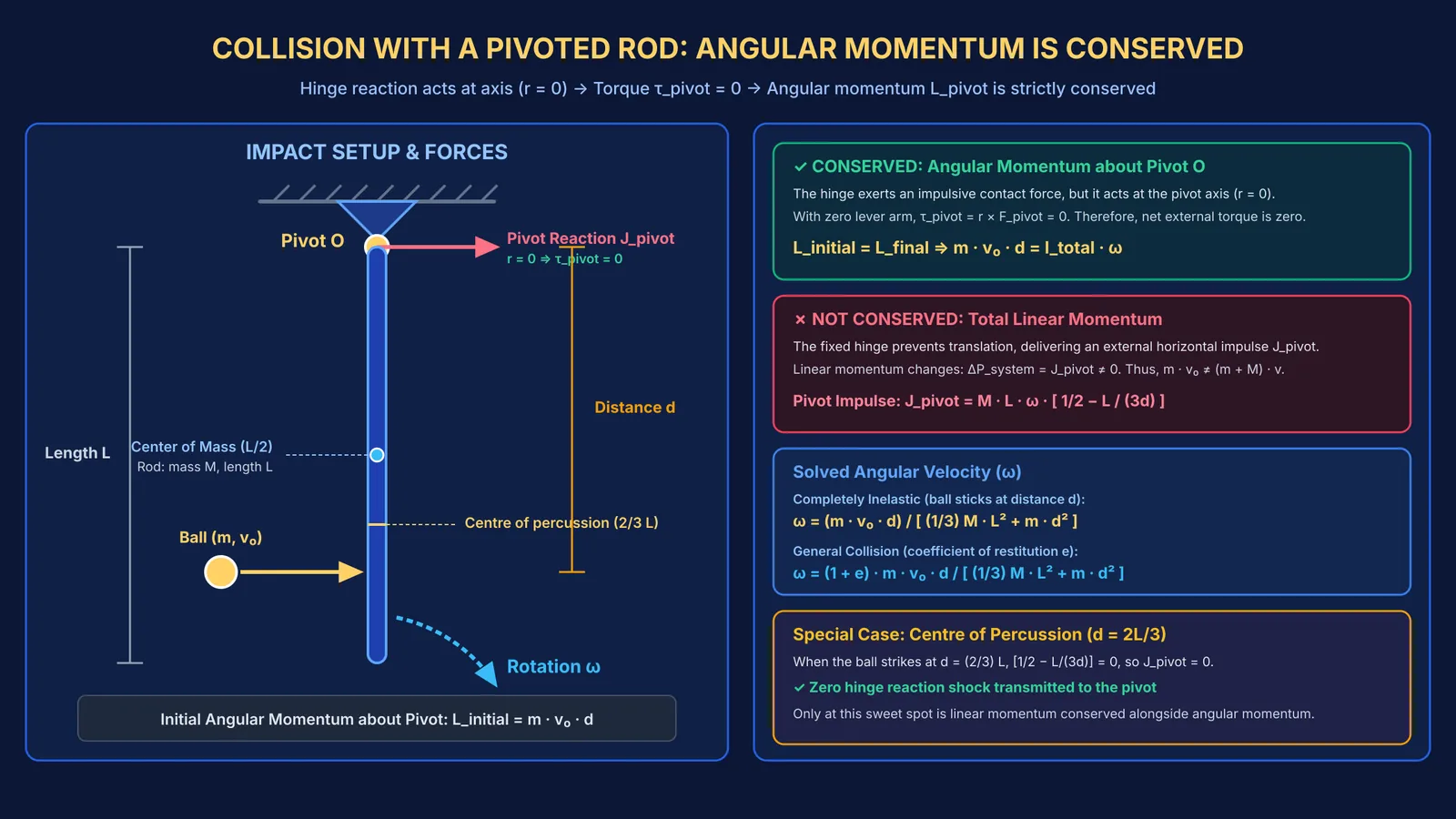
Imagine a uniform rod of mass M and length L hanging at rest from a frictionless hinge at one end. A ball of mass m, moving horizontally at speed v₀, strikes the rod perpendicularly at distance d from the pivot. A common mistake in JEE Advanced is equating initial and final linear momentum: m v₀ = (m + M) v.
That equation fails because the fixed pivot prevents translation, exerting an impulsive horizontal force on the rod during impact. Under Newton's second law, total linear momentum changes whenever an external impulse acts. In physics education research, Hunter G. Close and Paula R. L. Heron (American Journal of Physics, 2011) showed that before instruction, only 20% of introductory physics students correctly identified reference-point dependence, with many assuming linear and angular momentum are jointly conserved. Lorenzo G. Rimoldini and Chandralekha Singh (Physical Review Special Topics - Physics Education Research, 2005) found similar confusion where students misapplied translational momentum to constrained rotating bodies. Because the pivot reaction delivers an external impulse, linear momentum is not conserved. You can contrast this with unconstrained systems in our guide to collisions and momentum problems.
Why is angular momentum about the pivot conserved?
Rotational dynamics provides an exact conservation law when you choose the pivot as your origin. Newton's second law for rotation states that the net external torque about an axis equals the rate of change of total angular momentum: Σ τ_ext = dL/dt.
The pivot exerts a reaction force, but that force acts directly at the hinge axis (r = 0). With zero lever arm, its torque about the pivot is zero: τ_pivot = r × F_pivot = 0. Internal collision forces between ball and rod are equal and opposite, so their mutual torques cancel out. As established in the NCERT Class 11 Physics syllabus, when net external torque about an axis is zero during impact, total angular momentum about that axis remains constant: L_initial = L_final.
Before impact, the particle moving in a straight line carries angular momentum about the pivot: L_initial = m v₀ d. You can review the geometry in our guide to the angular momentum of a particle moving in a straight line.
How do you find angular velocity after the collision?
Conserving angular momentum about the pivot lets you solve for the post-impact angular velocity ω directly.
Case 1: Inelastic collision (ball sticks)
Before collision, only the moving ball has angular momentum about the pivot: L_initial = m v₀ d.
After collision, the stuck ball and rod rotate together. The moment of inertia of the rod about one end is I_rod = (1/3) M L², and the stuck mass contributes I_ball = m d². Total inertia is I_total = (1/3) M L² + m d². Setting L_initial = I_total ω yields: ω = (m v₀ d) / [(1/3) M L² + m d²].
If the ball strikes the tip (d = L), this simplifies to ω = 3 m v₀ / [(M + 3m) L].
Case 2: Elastic collision with restitution coefficient e
If v' is the ball's forward velocity after impact, the restitution equation gives v_rod − v' = e v₀, so v' = ω d − e v₀.
Conserving angular momentum about the pivot: m v₀ d = (1/3) M L² ω + m v' d = [(1/3) M L² + m d²] ω − e m v₀ d.
Solving for angular velocity gives: ω = (1 + e) m v₀ d / [(1/3) M L² + m d²].
For an elastic collision (e = 1), the numerator becomes 2 m v₀ d. The Fermi Problem Library has worked problems with a step-by-step solver that explains the reasoning rather than printing an answer, showing how to connect restitution equations with angular momentum.
What is the pivot reaction impulse and the sweet spot?
Calculating the pivot reaction impulse J_pivot clarifies why linear momentum is lost. Angular impulse on the rod gives contact impulse J = (1/3 M L² ω) / d. The linear impulse-momentum equation for the rod's centre of mass at L/2 is J + J_pivot = M (L/2) ω.
Substituting J gives the pivot reaction impulse: J_pivot = M L ω [1/2 − L / (3d)].
This formula reveals three cases:
If d = (2/3) L, J_pivot = 0. This point is the centre of percussion, or "sweet spot." Striking here transmits zero shock to the hinge, and linear momentum is conserved.
If d > (2/3) L (such as striking the tip d = L), J_pivot > 0, meaning the hinge pushes forward.
If d < (2/3) L, J_pivot < 0, meaning the hinge pulls backward.
To see how impulse acts on unhinged objects, check our guide on angular impulse on rigid bodies.
How should you approach hinged collision problems?
In exams, follow this 5-step checklist for pivoted collisions:
Identify the pivot: Mark the fixed axis of rotation.
Rule out linear momentum: The hinge exerts an external reaction force, so linear momentum is not conserved unless d = (2/3) L.
Compute initial angular momentum: Calculate L_initial = m v₀ d about the pivot.
Set up final angular momentum: Use I_total ω if the ball sticks, or I_rod ω + m v' d if it bounces.
Solve for ω first: Find angular velocity before computing linear speeds or hinge forces.
When practicing multi-concept mechanics, Fermi's AI tutor can work out what you already know and build a plan for the session, guiding you through pivot selection and torque conditions. You can also explore the Fermi Concept Library, which covers every concept in physics, chemistry, biology, mathematics and computing, each with its own lesson and its place in the map.


