

On this page
It is a classic physics problem: a solid ball rolls along a table, reaches the edge, and falls to the floor. While its path through the air is a standard parabola, what happens to its rotation?
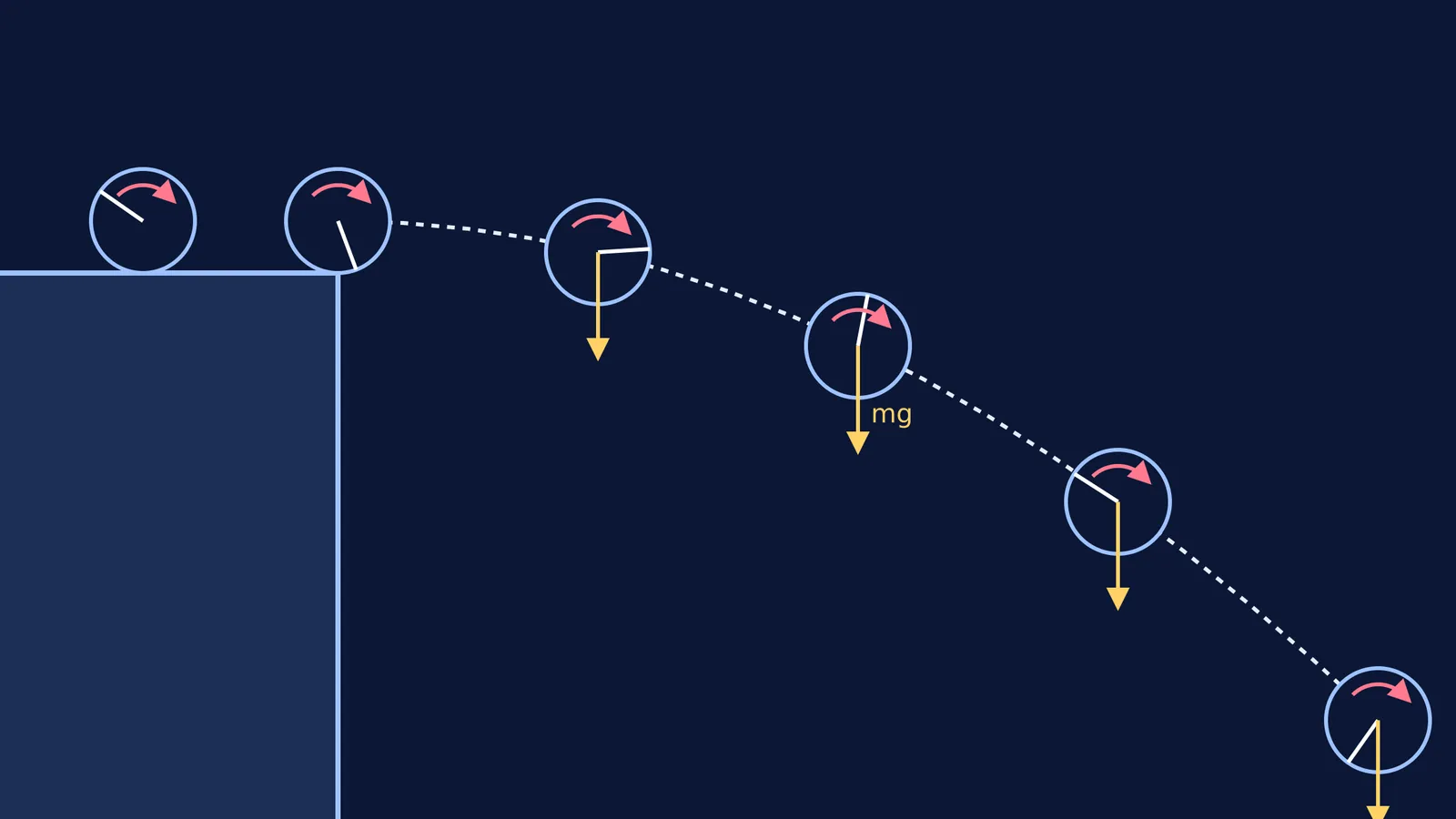
The short answer is that its spin rate remains exactly the same while it falls. To understand why, we have to look closely at the forces acting on the ball once it is airborne, and why those forces do not change how fast the ball rotates.
The moment it leaves the edge
While the ball is on the table, it rolls without slipping. The table provides an upward normal force and a frictional force that keeps the rotation tied to its forward speed. If the ball is moving faster, it is spinning faster.
As the ball's centre of mass passes the edge of the table, it goes through a brief pivoting phase. Gravity begins to tip the ball over the edge, and the normal force drops. This transition adds a tiny "kick" of angular velocity, meaning the ball leaves the table spinning slightly faster than when it was rolling flat. But once the ball is entirely clear of the table, it enters free fall. From this point until it hits the ground, its rotational motion is strictly conserved.
Why does it keep spinning at the same rate?
According to Newton's second law for rotation, an object's spin will only change if a net external torque acts upon it. Torque is the turning effect of a force, and it depends on two things: the size of the force, and the distance from the pivot point (the lever arm).
While the ball is in free fall, the only significant force acting on it is gravity (its weight). The weight of an object acts exactly through its centre of gravity, which for a uniform ball is the same as its centre of mass.
Because the force of gravity is applied directly at the pivot point (the centre), the lever arm is zero. With no lever arm, gravity exerts no torque. According to the conservation of angular momentum (a principle taught in standard textbooks like OpenStax College Physics), with zero net external torque, the ball's angular momentum—and therefore its spin rate—remains constant. It simply rotates blindly at whatever speed it left the table, completely unaware that it is falling.
What about air resistance?
For a solid, dense object like a marble or a billiard ball, the effect of air on its spin is negligible. However, if the ball is very light and moving fast (like a table tennis ball), air resistance comes into play.
The spin creates a pressure difference in the air around the ball, known as the Magnus effect. Topspin will cause the ball to dive toward the ground faster than a normal projectile, while backspin creates lift, extending its flight. Even so, the change to the ball's *spin rate* from air friction during a short fall is incredibly small. The aerodynamic torque is generally too weak to slow the spin noticeably before the ball hits the floor.
The landing kick: what happens when it hits the floor?
When the ball hits the floor, it still has that constant topspin from its journey through the air. This is where things get interesting.
If you are working through a physics problem, the key is to treat the ball's motion as two completely separate components once it leaves the table:
Translational motion: The centre of mass follows a standard parabolic path. The horizontal velocity remains constant, and the vertical velocity increases under gravity. You can solve this exactly like a Horizontal projectile from a cliff. You use the standard kinematic equations to find the time of flight and the horizontal range.
Rotational motion: The ball spins about its own centre of mass with a constant angular velocity, ω. Because calculating Torque as r × F requires a lever arm, and gravity has none, ω does not change throughout the flight.
By separating the flight into these two motions, complex physics exam questions become much easier to handle. If you want to review concepts like rotational motion and centre of mass, check out the Fermi Concept Library.


