

On this page
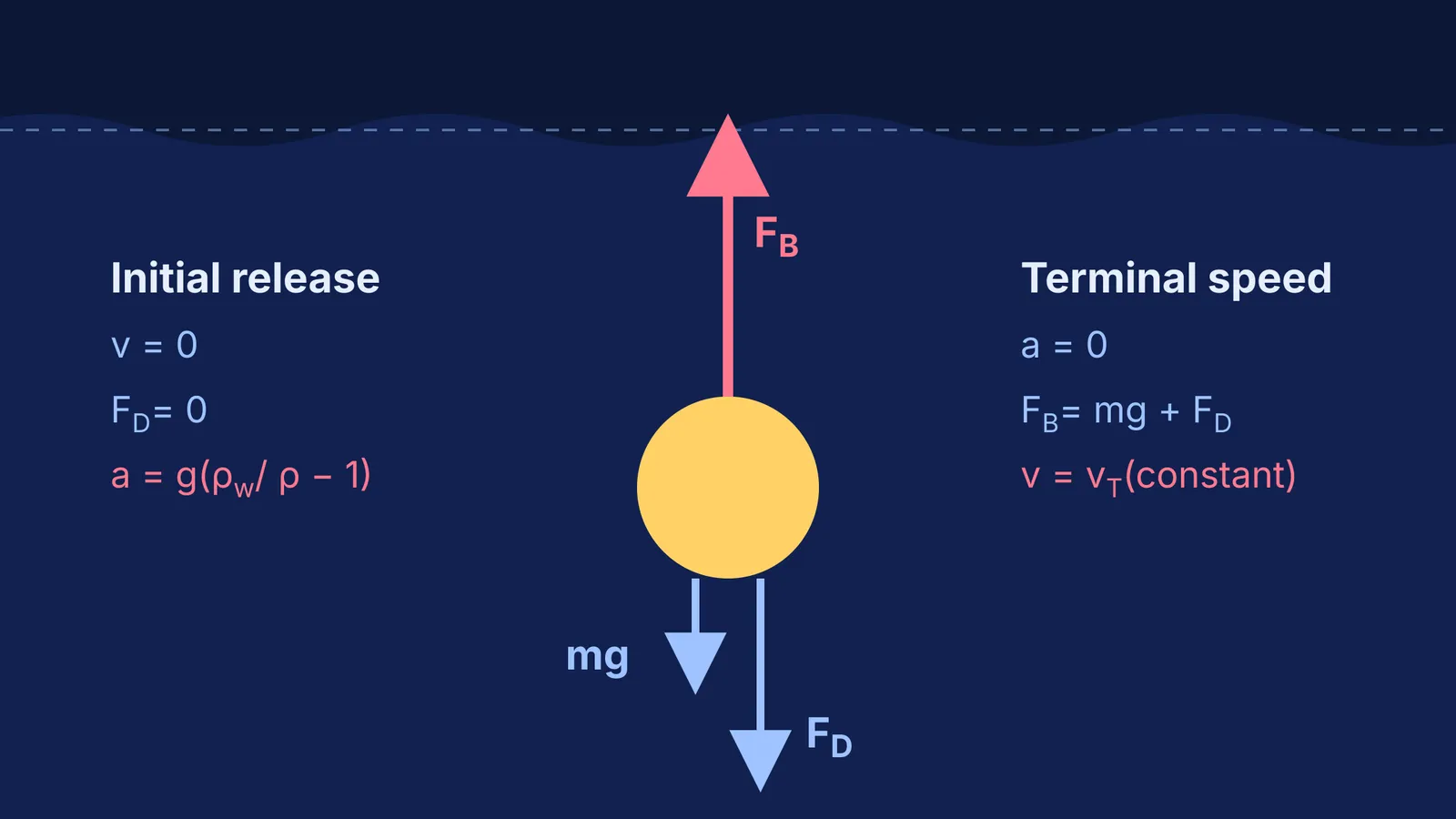
When you release a light ball underwater, buoyancy minus weight creates an initial upward acceleration of a = g(ρ_w/ρ − 1). But as the ball speeds up, drag forces quickly balance this push, capping its rise at a steady terminal velocity.
If you have ever tried to hold a beach ball or a table tennis ball under the surface of a swimming pool, you know it fights back. The moment you let go, it rockets upward. But it does not keep accelerating indefinitely.
What is the acceleration of a ball released under water?
At the exact instant you let go, the ball is not yet moving. Much like finding accelerations the instant a string is cut, you only need to consider the forces acting before any speed builds up. The only forces acting on it are buoyancy pushing up and gravity pulling down.
According to Archimedes' principle, the buoyant force equals the weight of the displaced fluid. The net upward force is the buoyant force minus the ball's weight. Using Newton's second law, we can divide this net force by the ball's mass to find the initial acceleration: a = g(ρ_w/ρ − 1), where ρ_w is the density of water and ρ is the density of the ball.
Let's look at a concrete example. The International Table Tennis Federation (ITTF) sets the mass of an official table tennis ball at 2.7 g and its diameter at 40 mm (ITTF Handbook). This gives it a volume of about 3.35 × 10⁻⁵ m³ and an average density of just 80 kg/m³. Since water has a density of 1000 kg/m³, the initial acceleration formula evaluates to g(1000/80 − 1), which is 11.5g, or roughly 113 m/s².
That means the ball initially accelerates upward with more than 11 times the force of Earth's gravity. If nothing slowed it down, it would be a dangerous projectile by the time it reached the surface.
Why does the ball reach a terminal velocity?
The catch is fluid drag. As soon as the ball starts moving, the water pushes back against it. The faster the ball rises, the harder the water resists.
For macroscopic objects like a table tennis ball, this resistance is known as quadratic drag. The drag force is proportional to the square of the ball's speed, its cross-sectional area, and the density of the fluid. It also depends on the object's shape, captured by a dimensionless drag coefficient. For a sphere, the typical drag coefficient is 0.45 (OpenStax).
Because drag increases with the square of the speed, it builds up extraordinarily fast. Within a fraction of a second, the downward drag force plus the ball's weight perfectly balances the upward buoyant force. At this point, the net force drops to zero. The ball stops accelerating and continues upward at a constant speed, known as its terminal velocity.
How does drag force affect the rising speed?
To find the terminal velocity, you set the net force to zero. The drag equation is F_D = 0.5 × C × ρ_w × A × v², where C is the drag coefficient and A is the cross-sectional area. Equating this to the upward push of buoyancy minus weight gives the balance point.
For our table tennis ball (with dimensions from the ITTF), the net upward force before drag is about 0.30 Newtons. Using the sphere drag coefficient from OpenStax, setting the drag force equal to 0.30 Newtons and solving for velocity gives a terminal speed of just over 1.0 m/s. The ball hits this speed after rising a very short distance. So, despite the massive initial kick, drag quickly tames the motion.
Students often struggle with problems that involve changing forces because standard textbook examples usually feature constant acceleration. If you are dealing with acceleration given as a function of v, integrating it correctly is key to finding the speed at any depth. The Fermi Problem Library has worked problems with a step-by-step solver that explains the reasoning rather than printing an answer. It shows you exactly when to use a constant-acceleration formula and when you must account for a velocity-dependent force like drag.
A step-by-step checklist for underwater motion problems
When you encounter an exam question about an object released in a fluid, follow these steps to avoid common traps:
Check the speeds: Is the question asking about the instant of release (v = 0) or the terminal state (constant v)?
Find the densities: Determine the ratio of the fluid's density to the object's density. This ratio decides whether the object shoots up, sinks, or hovers.
Calculate the net static force: Buoyancy minus weight tells you the maximum possible force driving the motion.
Account for drag: If the object is moving, include the drag force opposing the velocity. Use Stokes' law (linear drag) for microscopic particles and quadratic drag for everyday objects.
Set acceleration to zero for terminal velocity: When asked for the final steady speed, equate the drag force to the net static force and solve for v.
By mapping out the forces before you start computing, you will never be caught out by a changing acceleration again.


