

On this page
When students transition from basic arithmetic to early algebra, they often bring along a fundamental misunderstanding: they view the equals sign (`=`) as a command to calculate an answer. In arithmetic, `4 + 5 = ?` means "do the math." But in algebra, the equals sign is a statement of balance.
A 2014 study published in *The Journal of Problem Solving* (10.7771/1932-6246.1161) found that students' specific errors in algebraic problem solving are persistent and indicative of broader math achievement difficulties. When students view the equals sign as a "calculate" button rather than a point of equilibrium, they learn to solve equations by magically "moving" terms across it—a shortcut known as transposing.
For example, to solve `x + 5 = 12`, students are taught to "move the 5 over and change its sign," giving `x = 12 - 5`. This works fine for simple equations, but as the math grows more complex with brackets and negative coefficients, transposing becomes a minefield of sign errors.
How do you solve equations using the balance method?
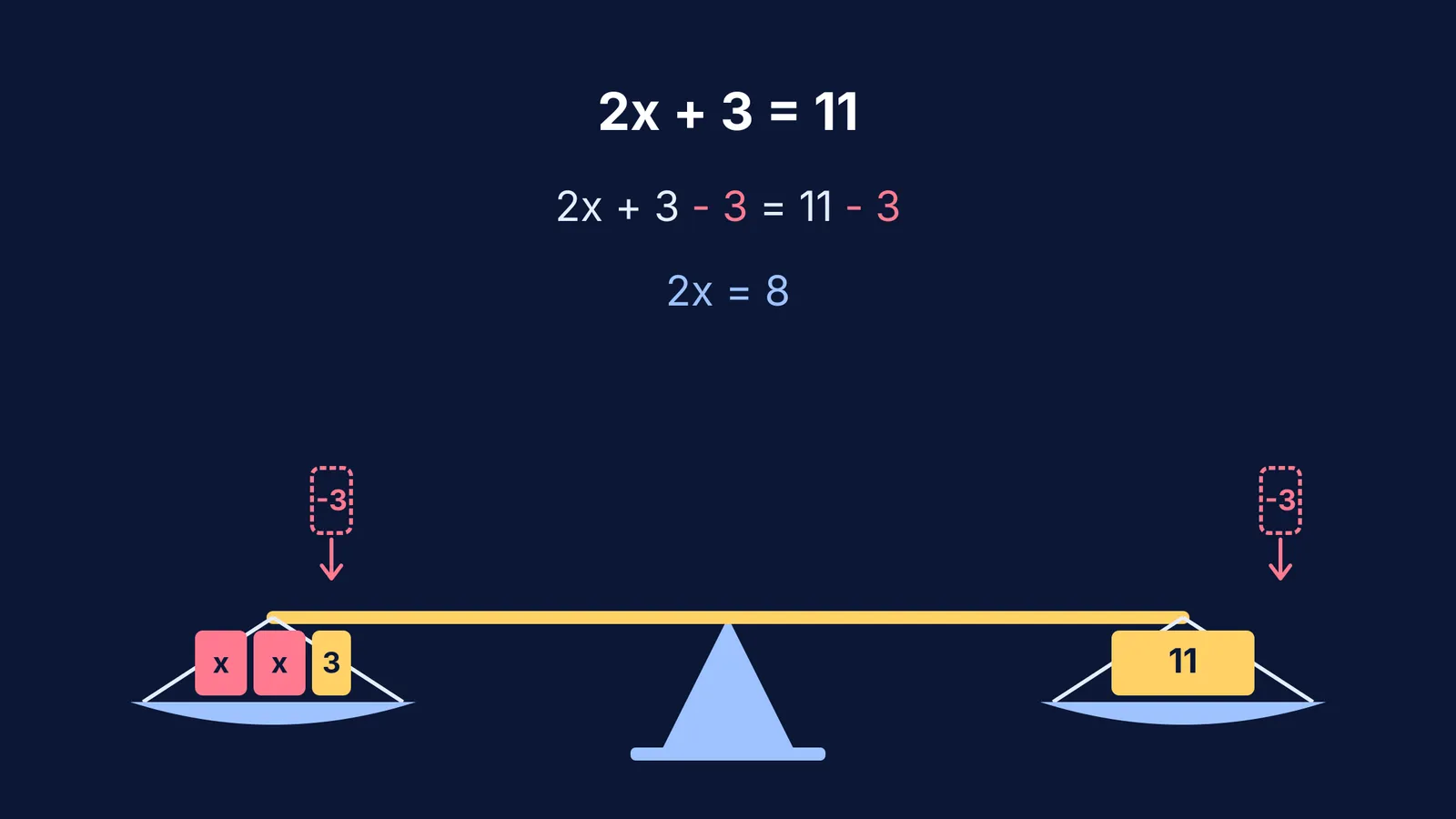
The balance method forces you to treat the equation like a physical weighing scale. To keep the scale level, whatever operation you perform on one side, you must perform on the exact same terms on the other side.
Instead of shifting a number across the equals sign, you apply its inverse operation to both sides simultaneously. To solve `2x + 3 = 11`:
Subtract 3 from the left side: `2x + 3 - 3 = 2x`
Subtract 3 from the right side: `11 - 3 = 8`
The new balanced equation is `2x = 8`.
Divide the left side by 2: `2x / 2 = x`
Divide the right side by 2: `8 / 2 = 4`
The solution is `x = 4`.
This "double writing" takes an extra line of ink, but it anchors the logic. It stops students from losing negative signs or dividing only part of an expression. If you use the Fermi Problem Library to work through an equation, you will find a step-by-step solver that explains the reasoning rather than printing an answer. It models exactly this principle.
Where do sign errors creep in?
The balance method protects against the three most common sign errors students make when solving linear equations:
The detached sign: When a term is negative (like `- 4x`), students often drop the negative sign when they try to transpose it to the other side. By balancing the equation and explicitly dividing both sides by `-4`, the sign stays securely attached to its coefficient.
The additive confusion: Given an equation like `-3x = 12`, students who transpose often see the negative sign and mistakenly add 3 to both sides. The balance method clarifies that `-3` is multiplying `x`, meaning the correct inverse operation is to divide both sides by `-3`.
The partial division: When an equation looks like `2x + 6 = 10`, a common mistake is to divide the `2x` and the `10` by 2, but forget to divide the `6`. The balance rule is explicit: you must perform the operation on the *entire* side.
How can you break the transposing habit?
If you are consistently dropping signs or getting stuck on multi-step equations, you need to rebuild your foundational understanding of equality instead of relying on memorised rules.
Write the operation on both sides. Draw a vertical line down through the equals sign. When you subtract 5 from the left, physically write `- 5` under the left side and `- 5` under the right side.
Circle the terms. Before doing anything, circle each term along with the sign immediately in front of it (for example, circle `-3x` as one unit). This prevents the sign from floating away or being treated as a separate subtraction command.
Check the logic, not just the math. If you are unsure why a step failed, use the Fermi Concept Library to review the underlying algebra. A strong conceptual base stops you from relying on shortcuts that break down under pressure.
Read more about how to handle different types of equations in Quadratic word problems in Class 10: speed, age and area or look into more advanced applications in Equations and inequalities with modulus: the case-split method.


