

On this page
It is one of the most common setups in Class 12 and JEE mathematics: you have two bags of coloured balls, you transfer one ball blindly from the first bag to the second, and then you draw a ball from the second bag.
Because you do not know exactly what was transferred, the composition of the second bag is uncertain. Solving this requires breaking the timeline into two clear events: the hidden transfer (the cause) and the final draw (the effect).
How do you solve a ball transferred from one bag to another probability problem?
The most robust way to solve these problems without getting lost in formulas is to draw a probability tree. This maps out every possible timeline. Let us walk through a standard scenario.
Imagine you are given this situation:
Bag I contains 3 red and 4 black balls, making 7 in total.
Bag II contains 4 red and 5 black balls, making 9 in total.
One ball is transferred from Bag I to Bag II.
Finally, a single ball is drawn from Bag II.
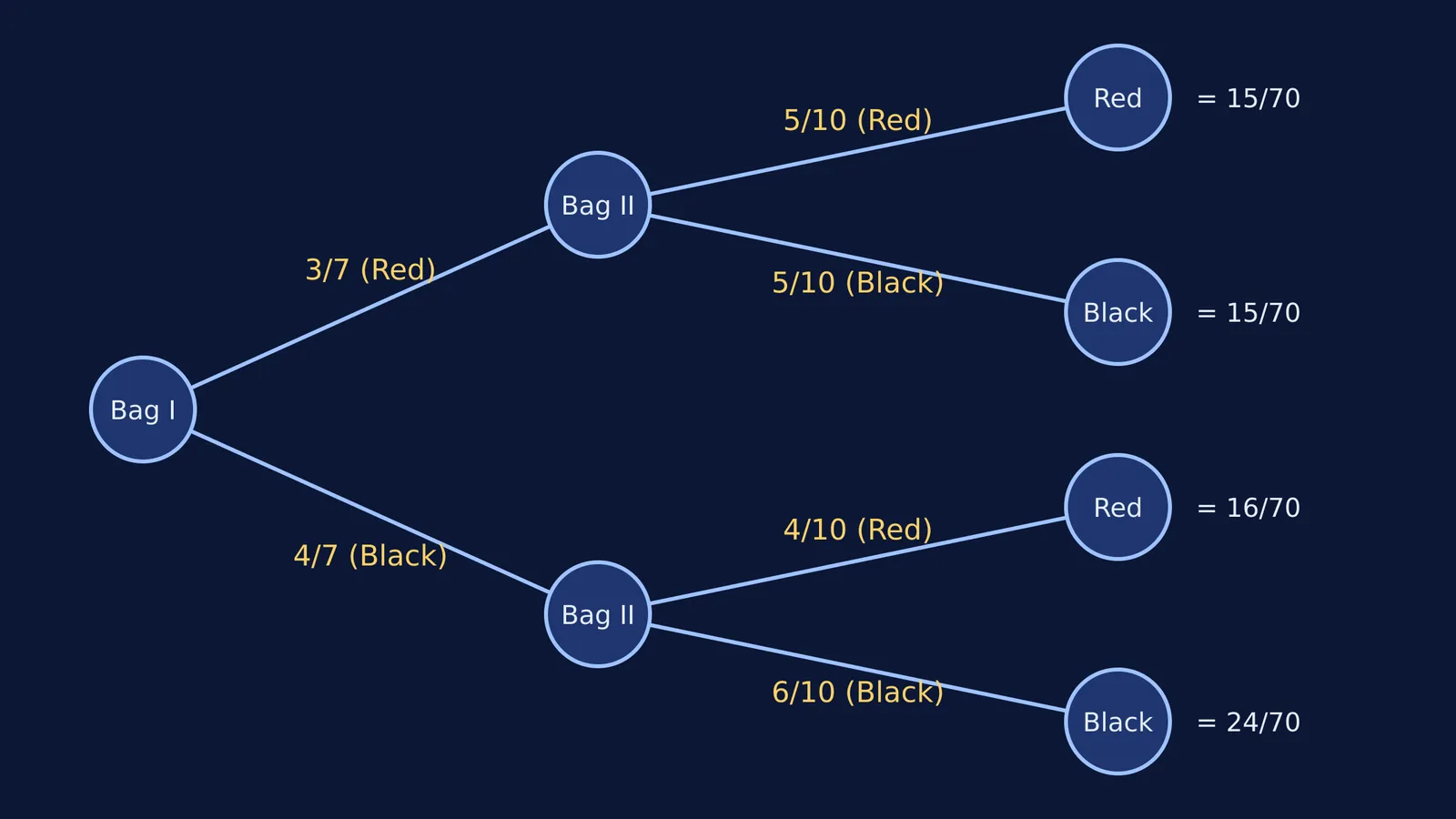
The transfer gives us two mutually exclusive starting paths, which we will call events E₁ and E₂. We calculate the probability of each path based on the initial contents of the first bag.
E₁: The transferred ball is red. The probability P(E₁) = 3/7.
E₂: The transferred ball is black. The probability P(E₂) = 4/7.
Next, we look at the final draw. Let event A be "the ball drawn from Bag II is red". The chance of A happening changes depending on which path we are on. This concept is called conditional probability.
If E₁ happened (a red ball was transferred), Bag II gained a red ball. It now holds 5 red and 5 black balls, bringing its total to 10. The conditional probability of drawing a red ball, written mathematically as P(A|E₁), is therefore 5/10.
If E₂ happened (a black ball was transferred), Bag II gained a black ball instead. It now holds 4 red and 6 black balls, also bringing its total to 10. The conditional probability P(A|E₂) is 4/10.
What is the total probability of drawing a red ball?
To find the overall chance that the final drawn ball is red, we must account for both possible histories. This method relies on the law of total probability.
You calculate this by multiplying the probability of each path by the chance of the final event happening on that path, and then adding them all together. The formula looks like this:
P(A) = P(E₁) × P(A|E₁) + P(E₂) × P(A|E₂)
Plugging in our numbers from the two paths:
P(A) = (3/7 × 5/10) + (4/7 × 4/10)
P(A) = 15/70 + 16/70
P(A) = 31/70
The total probability of drawing a red ball is 31/70. Notice how the tree diagram approach keeps the fractions clear and prevents you from mixing up the denominators.
How do you use Bayes' theorem when the drawn ball is known?
Examiners usually add a final twist to the question. They tell you the result of the final draw, and ask you to calculate the probability of a past event. For example: *If the drawn ball is found to be red, what is the probability that the transferred ball was black?*
You are being asked for the reverse conditional probability, P(E₂|A). This is where Bayes' theorem applies. It flips the condition around.
Bayes' theorem states:
P(E₂|A) = [ P(E₂) × P(A|E₂) ] / P(A)
Look closely at that formula. The numerator is just the probability of the specific path we care about (a black ball was transferred, and then a red ball was drawn). The denominator is the total probability of drawing a red ball across all possible paths, which we just calculated.
P(E₂|A) = (16/70) / (31/70) = 16/31
Given that the final ball is indeed red, there is a 16/31 chance that the transferred ball was black.
Why is conditional logic difficult to grasp?
If you find yourself repeatedly plugging numbers into Bayes' formula without being sure why you chose them, you are not alone. Conditional logic is famously unintuitive for the human brain.
Researchers have found that presenting these problems using natural frequencies makes them much easier to solve. One classic cognitive psychology study found that only 16% of participants could solve a Bayesian problem given as standard probabilities, but 46% succeeded when the numbers were shown as natural counts (10.1037/0033-295X.102.4.684).
By laying the problem out as a timeline of concrete counts rather than abstract variables, you avoid the most common base-rate errors and keep the logic completely transparent.
When you are stuck on probability and need clear reasoning, the Fermi Problem Library has worked problems with a step-by-step solver that explains the reasoning rather than printing an answer.
Read more:


