

On this page
In the CBSE Class 10 Mathematics curriculum, the Statistics and Probability unit carries 11 marks out of 80 in the theory examination CBSE Academic. While statistics questions tend to ask for long tabular calculations, probability questions often test your reasoning with a short puzzle. One of the most common standard-level questions asks you to find an unknown number of balls in a bag.
Instead of giving you all the numbers and asking for the probability, these questions give you a relationship between probabilities—such as drawing a blue ball is double the probability of drawing a red ball—and ask you to find the missing count. By setting up an algebraic equation, you can quickly find the answer.
What does the probability of drawing a ball mean?
The theoretical probability of an event is simply the number of favourable outcomes divided by the total number of possible outcomes. If a bag has 5 red balls and 3 blue balls, there are 8 possible balls you could pull out. The probability of drawing a red ball is 5 / 8.
When you do not know how many balls of a certain colour are in the bag, you cannot write down a single number for the probability. Instead, you write an expression using algebra.
How do you find the number of balls in a bag?
To solve an unknown count problem, you follow four reliable steps:
Define the unknown: let the unknown number of balls be x.
Find the total: write an expression for the total number of balls in the bag, such as 5 + x.
Write the probabilities: write the probability for each colour using your expression for the total.
Set up the equation: use the condition given in the question to link the two probabilities, and solve for x.
If you get stuck trying to translate the words into an equation, the Fermi Problem Library has worked problems with a step-by-step solver that explains the reasoning rather than printing an answer.
How do you solve when blue has double the probability?
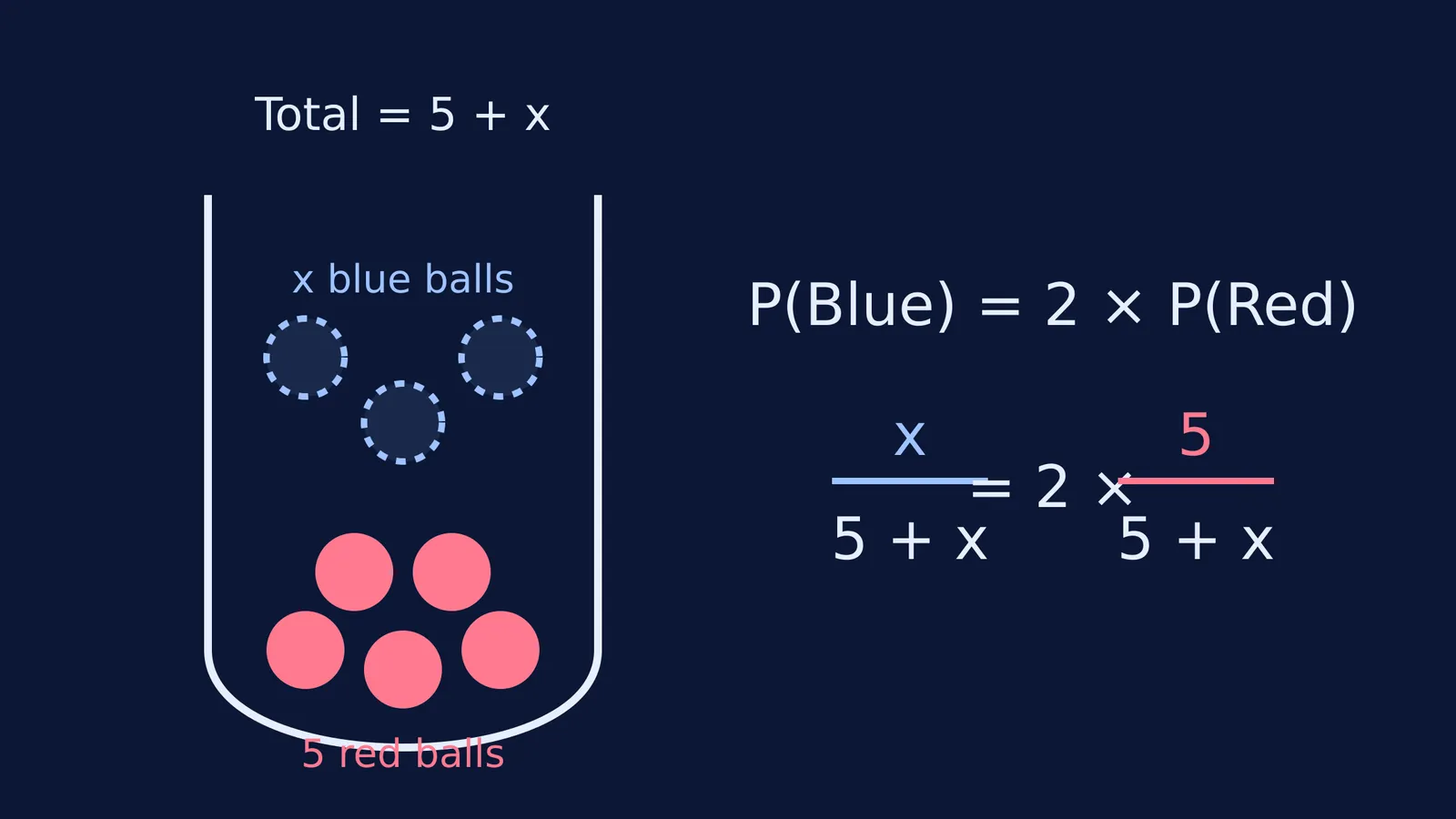
Let us look at a classic exam question: a bag contains 5 red balls and some blue balls. If the probability of drawing a blue ball is double that of a red ball, find the number of blue balls in the bag.
Step 1: Define the unknown and the total Let the number of blue balls be x. The bag contains 5 red balls, so the total number of balls is 5 + x.
Step 2: Write the probability expressions The probability of drawing a red ball is the number of red balls divided by the total: P(Red) = 5 / (5 + x)
The probability of drawing a blue ball is the number of blue balls divided by the total: P(Blue) = x / (5 + x)
Step 3: Set up and solve the equation The question states that the probability of drawing a blue ball is double the probability of drawing a red ball: P(Blue) = 2 × P(Red)
Substitute the expressions you found: x / (5 + x) = 2 × [ 5 / (5 + x) ]
Because both sides are divided by the same total (5 + x), you can multiply both sides by 5 + x to cancel the denominators: x = 2 × 5 x = 10
There are 10 blue balls in the bag.
Why does the sample space change?
Some questions add a twist: they tell you how many balls are in the bag initially, but then state that more balls are added.
For instance: a box contains 12 balls, k of which are black. If 6 more black balls are put in the box, the probability of drawing a black ball is doubled. Find k.
When balls are added, the sample space (the total number of possible outcomes) changes. You must adjust both the numerator and the denominator.
Originally, there are 12 balls. P(Black) = k / 12.
After adding 6 black balls, the new total is 12 + 6 = 18. The new number of black balls is k + 6.
The new probability is (k + 6) / 18.
The equation comes from the phrase "the probability of drawing a black ball is doubled": (k + 6) / 18 = 2(k / 12)
This simplifies to: (k + 6) / 18 = k / 6
Multiplying both sides by 18 gives: k + 6 = 3k 2k = 6 k = 3
If keeping track of changing totals feels overwhelming, Fermi's AI tutor can work out what you already know and build a plan for the session, so you sit down to a clear next step.
Once you know how to link probabilities with algebra, these questions become reliable ways to secure marks. For more on how to handle different ways of drawing items, read our guide on With and without replacement: probability problems compared or see Probability in Class 10: cards, dice and coins worked step by step.


