

On this page
Why is average velocity different from the velocity at the top?
In competitive examinations like JEE Main and NEET-UG, projectile kinematics problems frequently test the distinction between instantaneous velocity and average velocity. When a particle is launched obliquely with initial speed u at an angle θ above the horizontal, its instantaneous velocity at the apex is purely horizontal: u cos θ. Because vertical velocity drops to zero at the highest point, many students assume the average velocity during the climb is either u cos θ or a simple arithmetic mean of initial and peak speeds.
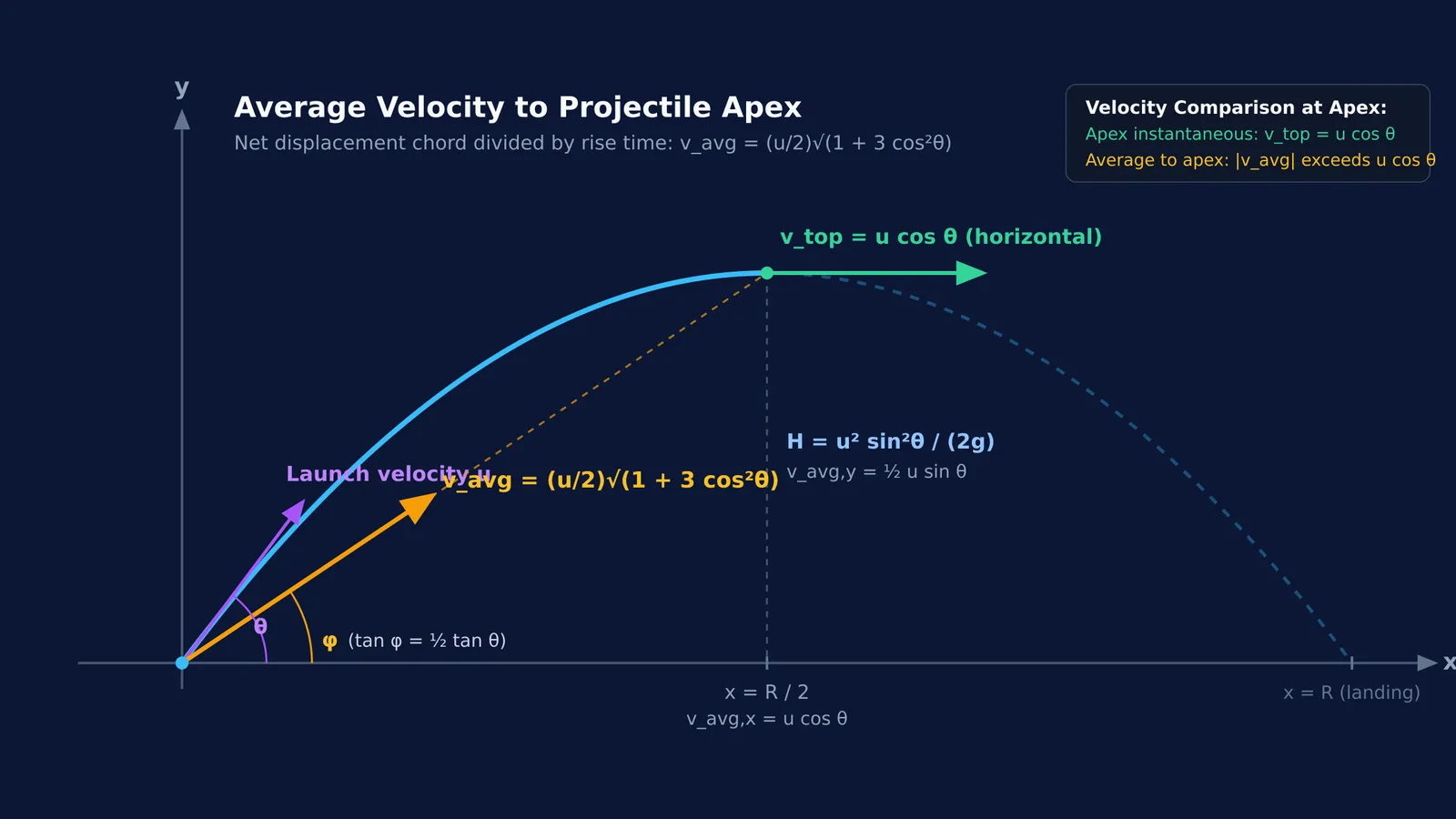
Physics defines average velocity strictly as a vector: net displacement divided by elapsed time. According to OpenStax University Physics Volume 1, analyzing two-dimensional motion requires decomposing displacement and velocity along independent horizontal and vertical axes. During ascent, the particle travels forward by half its horizontal range while climbing to its maximum height. Because the net displacement vector points diagonally upward from the origin to the apex, average velocity must possess both horizontal and vertical components.
How do you derive the horizontal and vertical components?
To determine the average velocity vector v_avg from launch (t = 0) to the peak (t = t_top), we apply kinematic principles from NCERT Class 11 Physics Chapter 4. Under constant downward gravitational acceleration g, the initial velocity vector is u cos θ î + u sin θ ĵ.
The rise time t_top ends when vertical velocity vanishes: v_y = u sin θ − g t_top = 0, giving t_top = (u sin θ) / g.
During this interval, displacement along each axis is:
Horizontal displacement: With zero horizontal acceleration, x_top = (u cos θ) t_top = (u² sin θ cos θ) / g = R / 2, where R is the total range on level ground.
Vertical displacement: The maximum height reached is H = (u² sin²θ) / (2g).
Dividing each coordinate by the rise time t_top gives the average velocity components:
Horizontal component: v_avg,x = x_top / t_top = u cos θ.
Vertical component: v_avg,y = y_top / t_top = [(u² sin²θ) / (2g)] / [(u sin θ) / g] = (u sin θ) / 2.
Because horizontal velocity remains constant throughout flight, its average value equals its instantaneous value. Because vertical acceleration is uniform, the vertical average also matches the arithmetic mean of initial and final vertical velocities: (u sin θ + 0) / 2 = (u sin θ) / 2.
What is the magnitude and direction of the average velocity vector?
Combining both perpendicular components yields the complete average velocity vector: v_avg = (u cos θ) î + [(u sin θ) / 2] ĵ.
To compute the magnitude of average velocity, take the vector norm: |v_avg| = √[(u cos θ)² + ((u sin θ) / 2)²] = √[u² cos²θ + (u² sin²θ) / 4] = (u / 2) √(4 cos²θ + sin²θ).
Applying the trigonometric identity sin²θ = 1 − cos²θ simplifies the expression into standard exam form: |v_avg| = (u / 2) √(1 + 3 cos²θ).
The direction angle φ of the average velocity vector relative to the horizontal is: tan φ = v_avg,y / v_avg,x = [(u sin θ) / 2] / (u cos θ) = (1 / 2) tan θ.
Because average velocity equals the displacement vector divided by the positive scalar t_top, it points along the straight chord connecting the launch point directly to the apex. The slope of this displacement chord is exactly half the slope of the initial launch tangent. You can explore how position vectors trace motion in our guide on motion in a plane from position vectors and verify trajectories with the equation of trajectory of a projectile.
How do you calculate average velocity for 20 m/s at 30 degrees?
Following the standard kinematics framework in OpenStax University Physics Volume 1, consider an object projected across level ground with initial speed u = 20 m/s at an angle θ = 30° above the horizontal, taking g = 10 m/s².
Initial components and rise time:
u_x = 20 × cos 30° = 10√3 ≈ 17.32 m/s. u_y = 20 × sin 30° = 10 m/s. t_top = u_y / g = 10 / 10 = 1.0 s.
Apex displacement:
x_top = u_x × t_top = 17.32 m. y_top = H = u_y² / (2g) = 100 / 20 = 5.0 m.
Average velocity components:
v_avg,x = x_top / t_top = 17.32 / 1.0 = 17.32 m/s. v_avg,y = y_top / t_top = 5.0 / 1.0 = 5.0 m/s.
Magnitude and direction:
|v_avg| = √(17.32² + 5.0²) = √325 = 5√13 ≈ 18.03 m/s. Formula check: (20 / 2) √(1 + 3 cos²30°) = 10 √(1 + 3 × 0.75) = 10 √3.25 = 5√13 ≈ 18.03 m/s. Direction: tan φ = 5.0 / 17.32 = 1 / (2√3) ≈ 0.2887, yielding φ ≈ 16.1°, compared to launch angle θ = 30°.
Notice that the instantaneous speed at the apex is only u cos 30° = 17.32 m/s, which is lower than the magnitude of the average velocity during the ascent (18.03 m/s). For students working through multistep projectile calculations, the Fermi Problem Library provides worked problems with a step-by-step solver that explains the reasoning rather than printing an answer.
Which common mistakes appear in competitive exam problems?
Kinematics multiple-choice questions regularly feature three predictable distractor traps:
Conflating whole flight with half flight: Over the entire trajectory from launch to landing at ground level, vertical displacement is zero, so average velocity is simply u cos θ î. For motion to the highest point, vertical displacement is positive, so the vertical average component is (u sin θ) / 2.
Averaging speeds instead of vectors: Calculating (u + u cos θ) / 2 yields a scalar average that ignores vector directions and produces an incorrect magnitude.
Confusing instantaneous apex velocity with average velocity: The instantaneous speed at the summit is u cos θ, which is the minimum instantaneous speed of the entire flight. The magnitude of average velocity to the top is always strictly greater than u cos θ for any non-zero launch angle.
For problems involving asymmetric boundaries or elevated platforms, review our guide on horizontal projectile from a cliff. To see how vector components evolve along parabolic arcs across different launch angles, the Fermi Simulation Lab provides interactive simulations for ideas that are easier to see than to read.


