

On this page
When you want to find the average of a list of numbers, you add them up and divide by how many there are. But how do you find the average of something that changes constantly, like the temperature over a day? A continuous function has infinitely many values, so you cannot simply add them up and divide.
Instead, we use calculus. By finding the definite integral of the function and dividing it by the length of the interval, we calculate the exact average height of the curve.
What is the average value of a function?
The average value of a continuous function f(x) over the interval [a, b] is defined as 1/(b − a) times the integral of f(x) from a to b (Whitman College Calculus).
In notation, this is written as: Average value = (1/(b − a)) ∫ f(x) dx
The integral calculates the total area under the curve. Dividing by (b − a) is the continuous equivalent of dividing by the number of items. If the function represents your speed over time, its average value is the constant speed required to travel the same total distance in the same time (Whitman College Calculus).
How do you calculate the average value?
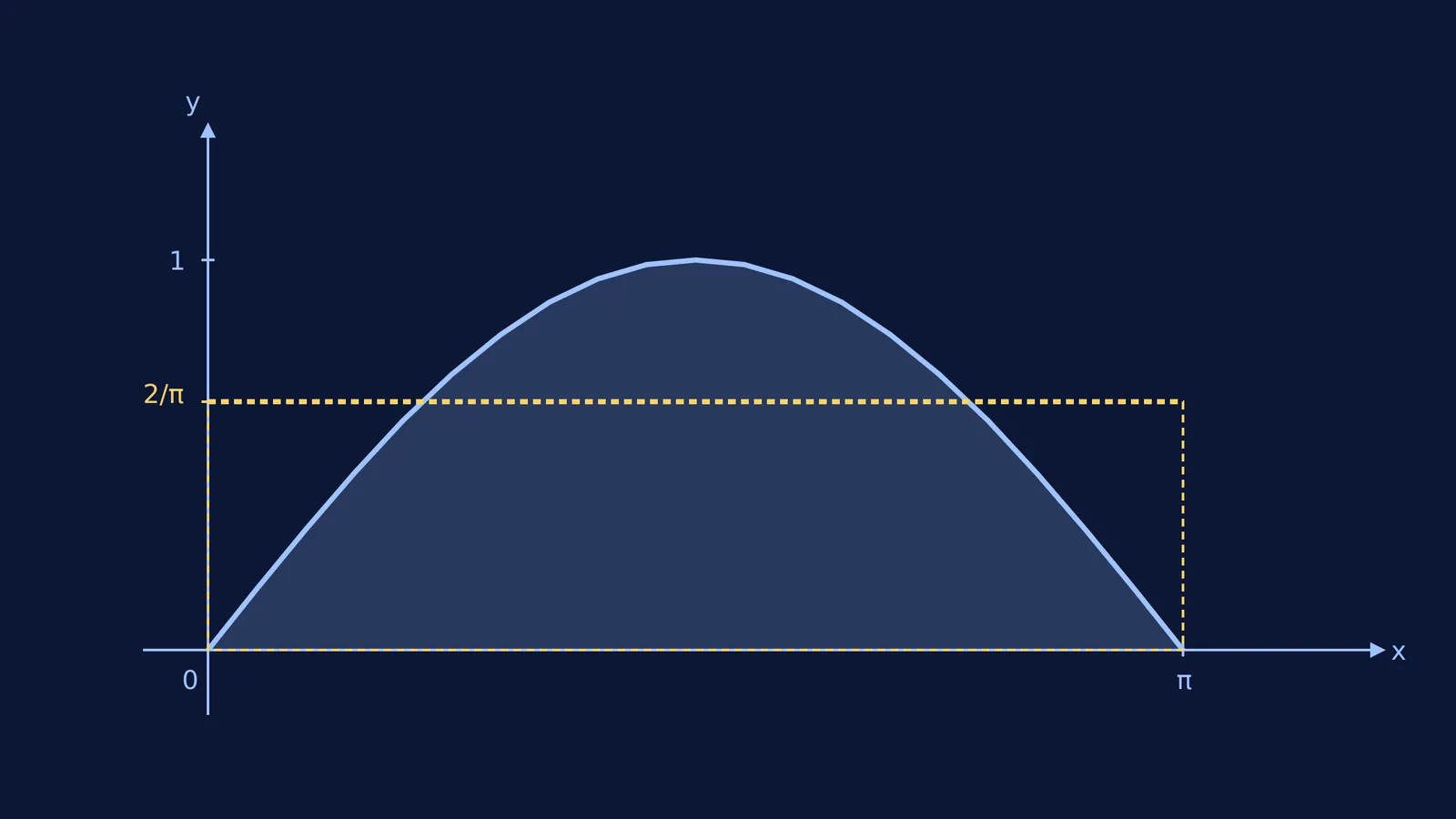
Let us find the average value of f(x) = sin x over the interval [0, π].
Find the length of the interval. The width is π − 0 = π.
Evaluate the definite integral. The area under sin x from 0 to π is needed. The integral of sin x is −cos x.
Evaluating from 0 to π gives: (−cos π) − (−cos 0) = 1 + 1 = 2. The area under one arch is exactly 2.
Divide by the interval length.
Average value = 2 / π.
Since π is approximately 3.1416, the average value is roughly 0.6366. Even though the sine curve peaks at 1, its average height over that half-cycle is just under two-thirds of its maximum.
How do you find the average value of a quadratic function?
Let us calculate the average value of f(x) = 16x² + 5 over the interval [1, 3] (Whitman College Calculus).
Find the interval length. The width is 3 − 1 = 2.
Evaluate the definite integral. Integrating 16x² + 5 from 1 to 3 yields (16/3)x³ + 5x.
At x = 3, this is 144 + 15 = 159. At x = 1, this is 16/3 + 5 = 31/3. Subtracting gives 159 − 31/3 = 446/3 for the total area.
Divide by the interval length.
Average value = (446/3) / 2 = 223/3.
The average height of the curve is exactly 223/3, or approximately 74.3. Drawing a horizontal line at y = 223/3 between x = 1 and x = 3 forms a rectangle with the exact same area as the region under the curve.
If you are dealing with more complicated functions, evaluating the integral is the hardest part. Sometimes finding the area requires using properties of definite integrals to simplify the expression. If your function involves a square root, knowing the standard integrals of √(a² − x²) and √(x² ± a²) will speed up your working.
Why does the formula work?
The formula relies on a geometric idea: the equal-area rectangle.
Imagine the area under f(x) between a and b as a block of ice. If that ice melts into a perfectly flat, rectangular shape within the same width [a, b], the water level represents the average value of the function.
Because no area was added or lost, the rectangle's area equals the area under the original curve. Rearranging Area = width × height gives height = Area / width, matching the definition.
If you are reviewing these foundations for an exam, the Fermi Concept Library contains every concept in physics, chemistry, biology, mathematics and computing, each with its own lesson and its place in the map.
How is average value different from average rate of change?
A common mistake in calculus exams is confusing the average value with the average rate of change. They measure entirely different things.
Average value: The "average height" of the function. It requires an integral.
Average rate of change: How quickly the function is changing on average (the slope of the secant line). It requires only algebra: (f(b) − f(a)) / (b − a).
Always read the question carefully. If asked for average velocity given a velocity graph, you want the average value (integrate). Given a position graph, you want the average rate of change (find the slope).
Calculus problems often combine average values with other rules like the chain rule or substitution. If you get stuck on a homework question, the Fermi Problem Library provides worked problems with a step-by-step solver that explains the reasoning rather than printing an answer.


