

On this page
Calculating an arithmetic mean sounds simple until you face three-digit numbers under timed exam conditions. Adding 782, 795, 804, 788, and 811 directly requires summing five large numbers into a running total of 3980 and dividing by 5 to get 796. This brute-force route invites arithmetic slips because each step forces you to juggle place values and mental carries.
Why does adding large numbers directly slow you down?
When adding multi-digit numbers, your brain relies heavily on working memory to store running totals while managing column carries. A study by Ineke Imbo, André Vandierendonck, and Stijn De Rammelaere in the Quarterly Journal of Experimental Psychology showed that the number and value of carry operations increase error rates and response times by loading the central executive. A review by Diana DeStefano and Jo-Anne LeFevre in the European Journal of Cognitive Psychology confirmed that carries form the primary bottleneck in mental arithmetic.
When data cluster together, direct addition redundantly sums the same shared base. Subtracting a baseline from each observation lets you work with small differences and restore the baseline at the end.
How does the assumed mean method work step by step?
The assumed mean shortcut—known in statistics as changing the origin—relies on an elementary algebraic property. If you select an assumed mean a and calculate each observation's deviation d_i = x_i − a, the true mean x̄ relates to the average deviation d̄ by:
x̄ = a + d̄ = a + (∑ d_i) / n
As shown in our guide on how adding to or scaling data changes the mean and variance, shifting data by a constant preserves the relative distances between values. To use this shortcut:
Choose a pivot: Pick a round number a near the centre of the set, preferably ending in 0 or 5.
Find deviations: Subtract a from each observation x_i to find d_i = x_i − a.
Average deviations: Sum the positive and negative deviations, cancel opposites, and divide by the count n.
Restore the pivot: Add the mean deviation d̄ back to a to find the true mean x̄.
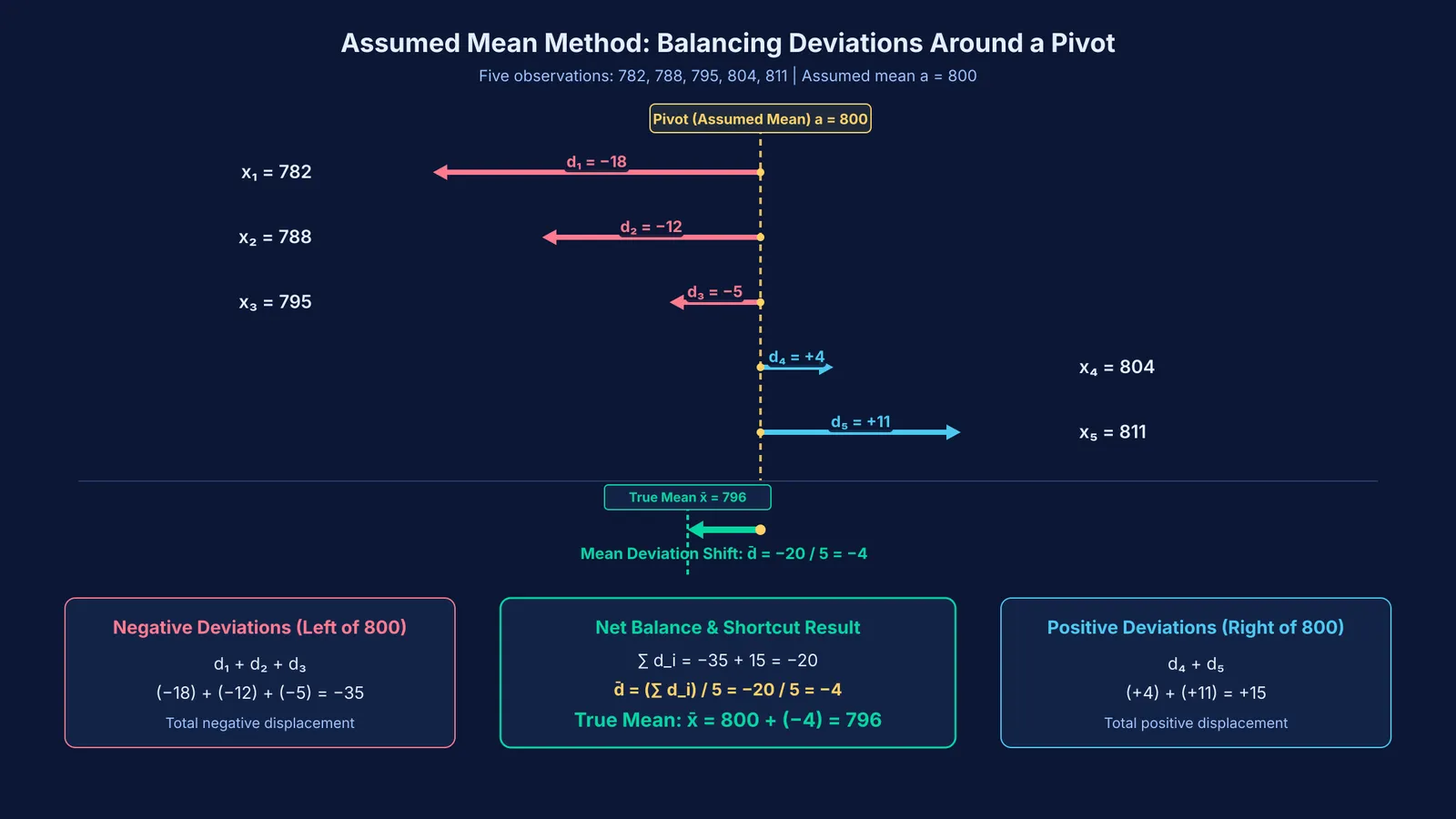
For the observations 782, 795, 804, 788, and 811, choosing 800 as the assumed mean produces deviations of −18, −5, +4, −12, and +11.
Instead of summing four-digit numbers, you cancel small deviations directly. Combining +11 with −18 gives −7. Combining +4 with −12 gives −8. Summing −7, −8, and −5 yields −20. Dividing −20 by 5 gives an average deviation of −4. Adding this to 800 yields the true mean: 800 + (−4) = 796. The arithmetic takes moments and requires no column carries.
Can you use this shortcut for grouped frequency tables?
The shortcut is also a standard tool for tabular data. In the NCERT Class 10 Mathematics curriculum and the CBSE Secondary School Mathematics curriculum, students compute the mean of grouped distributions using:
x̄ = a + (∑ f_i d_i) / (∑ f_i)
Here, x_i is the class mark (the midpoint of each interval), f_i is the class frequency, and d_i = x_i − a is the deviation of each midpoint from a chosen central midpoint a.
When midpoints are large values like 125, 175, 225, 275, and 325, direct products f_i x_i require heavy multi-digit multiplication. Setting a equal to the central midpoint (225) reduces its deviation to 0 and converts other deviations into round multiples of the class width (−100, −50, +50, +100). The f_i d_i products become simple mental multiplications. For procedures across continuous intervals, see our guide on calculating the mean, median, and mode of grouped data in Class 10, as well as our review of mean, variance, and standard deviation problem-solving for competitive exams.
What common mistakes happen when shifting the origin?
While the shortcut eliminates heavy arithmetic, four procedural traps frequently catch students:
Forgetting to add back the pivot: Reporting the mean deviation d̄ as the answer instead of adding it back to a (evaluating a + d̄).
Confusing signs: Deviation is defined as observation minus pivot (x_i − a). An observation of 788 with pivot 800 gives −12, not +12.
Dividing by class count instead of total frequency: In grouped tables, always divide ∑ f_i d_i by total frequency ∑ f_i, never by the number of intervals.
Hesitating over the pivot: Any choice of a yields the exact same final answer, so pick a round number quickly and proceed.
When practicing multi-step calculations under test conditions, small arithmetic slips can obscure conceptual understanding. The Fermi Problem Library provides worked problems with a step-by-step solver that explains the reasoning rather than printing an answer, making it easy to spot calculation errors. To explore how changing origin connects to broader statistical measures, the Fermi Concept Library holds every concept in physics, chemistry, biology, mathematics and computing, each with its own lesson and its place in the map.


