

On this page
When a particle oscillates in simple harmonic motion (SHM), it speeds up as it passes through the centre and slows down at the edges. Students often mix up speed and velocity when dealing with SHM, but over a full cycle, they give two very different answers.
To find the average speed of a particle in SHM over one cycle, we have to look at the total distance it travels and divide it by the time it takes.
How far does a particle travel in one cycle?
In simple harmonic motion, a particle moves back and forth between two extreme positions. The distance from the centre (the equilibrium position) to either extreme is the amplitude, A.
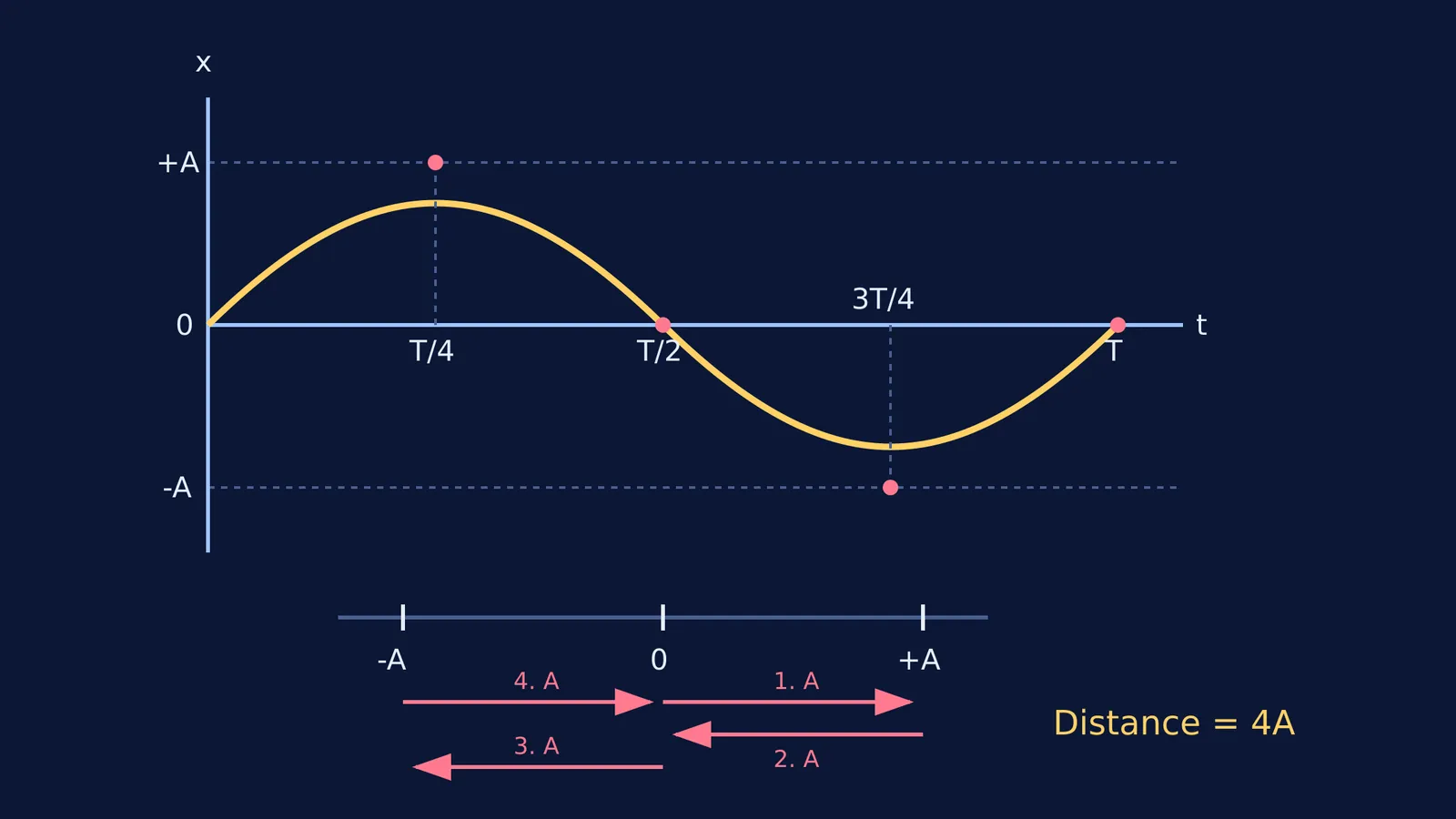
According to OpenStax University Physics, one complete cycle means the particle travels to one extreme, then to the other extreme, and finally returns to its initial position. If we start at the centre (x = 0), the path breaks down into four segments:
From the centre to the positive extreme (+A): distance A.
From the positive extreme back to the centre: distance A.
From the centre to the negative extreme (-A): distance A.
From the negative extreme back to the centre: distance A.
Adding these up, the total distance covered in one full cycle is exactly 4A.
How do you calculate the average speed of a particle in SHM?
Average speed is defined as the total distance travelled divided by the total time taken. The time taken for one full cycle is the period, T.
Using our total distance of 4A, the average speed is simply 4A/T.
We often write SHM equations using the angular frequency, ω. The period of the motion is T = 2π/ω (OpenStax). Substituting this into our formula gives:
Average speed = 4A / (2π/ω) = 2Aω / π
The maximum speed of the particle, which happens as it flies through the centre, is v_max = Aω (OpenStax). This means the average speed over a cycle is exactly 2/π times the maximum speed, or roughly 0.637 v_max.
Why is the average velocity over a cycle zero?
While speed counts every step of the journey, velocity only cares about where you start and where you end up. Average velocity is total displacement divided by total time.
Because a full cycle always brings the particle back to its exact starting point, its net displacement is zero. Therefore, the average velocity of a particle in SHM over one cycle is always exactly zero, no matter the amplitude or the period.
How can Fermi help you master simple harmonic motion?
Questions about speed, velocity, and distance in SHM are common traps in physics exams. If you are struggling to picture the motion or need help with the maths, the Fermi Simulation Lab provides interactive simulations for the ideas that are easier to see than to read, letting you watch the velocity vector change as the particle moves.
When you are ready to tackle exam questions, the Fermi Problem Library offers worked problems with a step-by-step solver that explains the reasoning rather than printing an answer.
For more on oscillatory motion, read about SHM through a tunnel across the Earth, finding the simple pendulum string tension at any angle, or how a seconds pendulum behaves.


