

On this page
The mathematician Carl Friedrich Gauss is said to have discovered a quick way to sum numbers when his teacher asked the class to add 1 to 100. Instead of adding them one by one, he paired them from the outside in: 1 and 100 make 101, 2 and 99 make 101, and so on. In a 2006 investigation, writer Brian Hayes tracked down over 100 versions of this story in eight languages (American Scientist). Whether the exact details are true or not, Gauss's insight transformed a tedious addition task into a single multiplication step.
For students preparing for competitive exams, this trick is more than just a historical anecdote. It remains one of the most useful shortcuts in mathematics. It teaches you to look for the underlying structure of a problem rather than rushing into brute-force calculations. Here is how you can use the pairing logic to find the average of an evenly spaced sequence in seconds.
How to find the average of numbers from 1 to n by pairing?
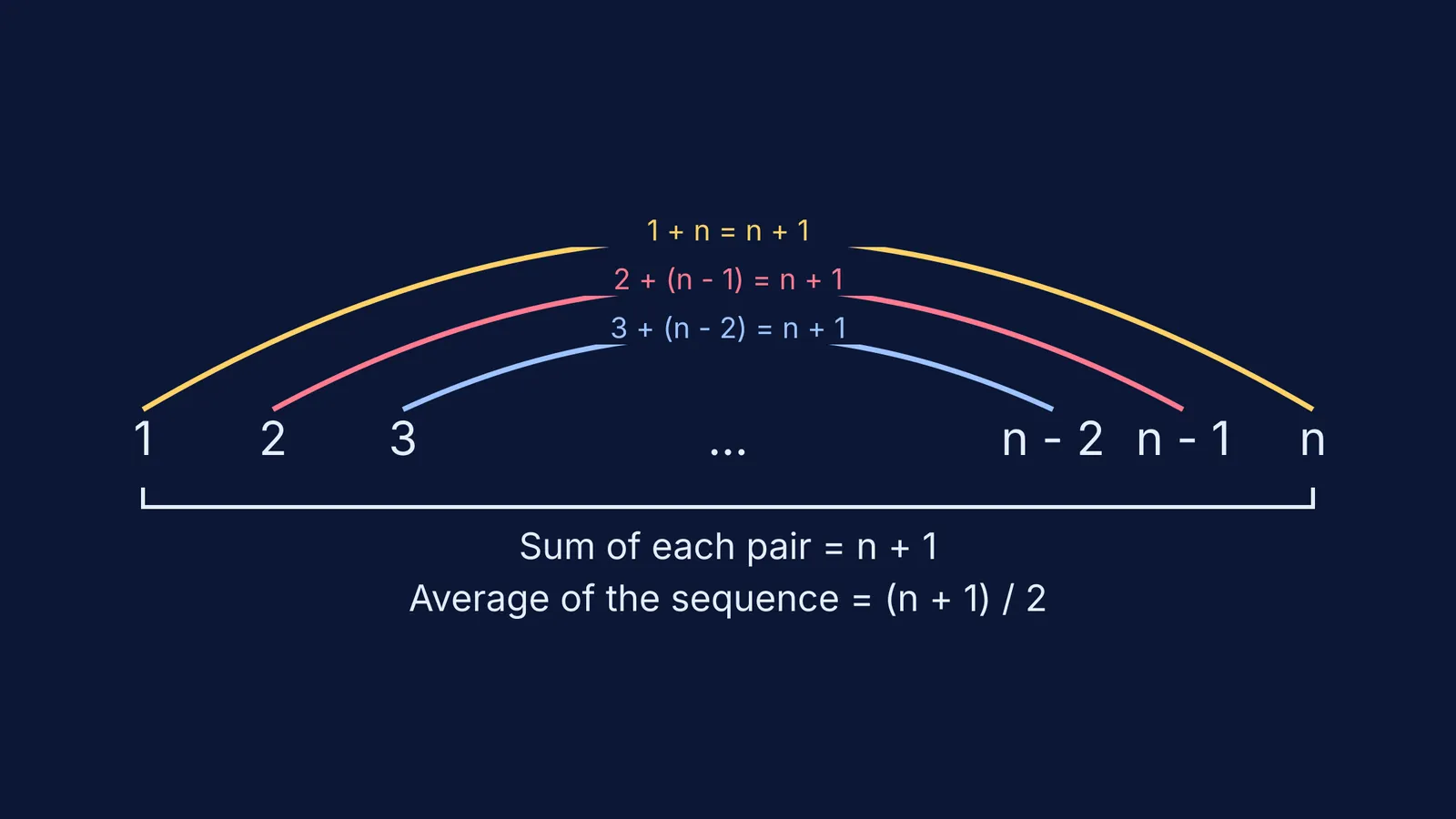
When you want the average of a sequence of numbers that are evenly spaced apart—an arithmetic progression—you do not need the total sum. You just need to look at the pairs.
Take the numbers 1 to n.
Pair the first and the last: 1 and n. Their sum is (n + 1).
Pair the second and the second-to-last: 2 and (n - 1). Their sum is also (n + 1).
Every pair adds up to (n + 1). The average of each pair is exactly half of that sum, which is (n + 1)/2. Since every pair has the same average, the average of the whole set of numbers is simply (n + 1)/2.
This is true whether you have an even or odd number of terms. If you have 9 terms, the middle term is left over, but its value is exactly (9 + 1)/2 = 5, which matches the average of all the pairs.
When you are working through sequences, it helps to focus on the structure rather than just the final number. This is how the Fermi Problem Library approaches mathematics: it gives you worked problems with a step-by-step solver that explains the reasoning rather than printing an answer.
Does the pairing trick work for any sequence?
Yes, as long as the numbers are evenly spaced. This type of sequence is called an arithmetic progression. The difference between consecutive terms is always the same.
Suppose you need to find the average of the sequence: 10, 15, 20, 25, 30, 35, 40.
Instead of adding all seven numbers, you only need to pair the first and the last term:
First term is 10.
Last term is 40.
Their sum is 10 + 40 = 50.
The average of this pair is 50/2 = 25.
You can verify this by checking the next pair inward: 15 and 35 also add up to 50, so their average is 25. The mean of the entire sequence is 25. This shows that for any arithmetic progression, the mean is always simply the average of the first and last terms.
What happens with decreasing sequences?
The pairing method also holds up perfectly when the sequence counts downwards or includes negative numbers, because the constant difference between terms remains.
Consider a sequence like 5, 2, −1, −4, −7. This is an arithmetic progression with a constant difference of −3.
The first term is 5.
The last term is −7.
Their sum is 5 + (−7) = −2.
The average of this pair is −2/2 = −1.
Checking the inner pair, 2 and −4, gives the same sum of −2 and the same average of −1. The middle term itself is −1. So, whether the numbers are growing or shrinking, pairing the outermost terms gives you the correct average immediately.
What is the mean of the first n even numbers?
We can apply the same pairing logic to the first n even numbers: 2, 4, 6, up to 2n.
The first number is 2 and the last number is 2n.
Pair them: 2 + 2n.
The average of this pair is (2 + 2n)/2, which simplifies to (n + 1).
So, the mean of the first n even numbers is exactly (n + 1).
What is the mean of the first n odd numbers?
The first n odd numbers are 1, 3, 5, up to (2n - 1). Let's pair them up in the same way.
The first number is 1 and the last number is (2n - 1).
Pair them: 1 + (2n - 1) = 2n.
The average of this pair is 2n/2, which equals n.
The mean of the first n odd numbers is exactly n. This also tells us that their sum is n × n = n².
A quick checklist for sequences
When you face arithmetic progressions in an exam, remember these shortcuts:
First n natural numbers: Mean is (n + 1)/2.
First n even numbers: Mean is (n + 1).
First n odd numbers: Mean is n.
If you forget the rule, just pair the first and last terms and divide their sum by two. For more on the formulas behind these patterns, you can look at Arithmetic progressions in Class 10: nth term and sum problems or see how to rewrite repeating terms in Sums like 9 + 99 + 999 + …: rewriting them with a GP.
If you struggle to recall formulas under pressure, seeing how they are built can fix them in your memory. The Concept Library explains every concept in physics, chemistry, biology, mathematics and computing, each with its own lesson, showing you why the shortcuts work.


