

On this page
Assertion-Reason (A-R) questions are now a staple of competitive exams like JEE Main and NEET. They test more than just your ability to apply a formula; they test whether you understand the cause-and-effect relationship between two facts.
Modern physics—covering the dual nature of radiation and matter, atoms, and nuclei—is a favourite target for assertion reason questions because the concepts are often counterintuitive. Even at the university level, these ideas cause trouble. A 2025 study published in the *Golden Ratio of Data in Summary* found an average misconception rate of 34.67% among university physics students tested on the photoelectric effect with a rigorous four-tier diagnostic tool.
How to solve assertion reason questions?
The biggest trap in A-R questions is the "true but irrelevant" reason. When you read a statement that you know is a correct physics fact, your brain wants to accept it and move on. You must force yourself to check the logic.
Here is a simple checklist for your next paper:
Evaluate the Assertion independently. (Is it a true physics fact?)
Evaluate the Reason independently. (Is it a true physics fact?)
If one is false, your job is easy.
If both are true, use the "because" test to see if the logic connects.
The photoelectric effect: intensity vs frequency?
Consider this classic pairing from the dual nature of radiation:
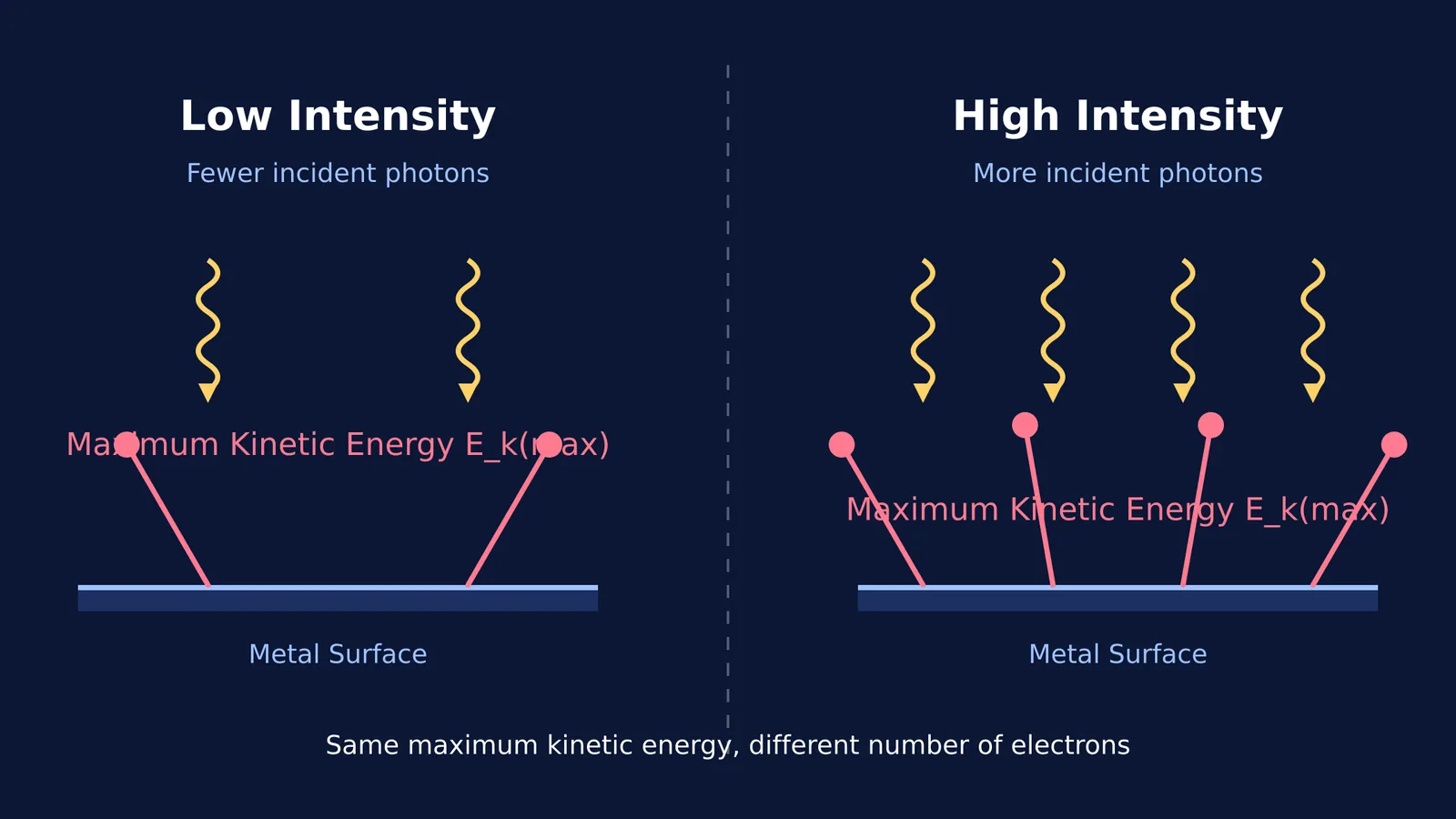
Assertion (A): Increasing the intensity of incident light increases the photoelectric current, but the stopping potential remains unchanged.
Reason (R): Increasing the intensity means more photons strike the metal surface per second, but the energy of each individual photon remains the same.
Both statements are true. Now, apply the "because" test. Read the assertion, add the word "because", and read the reason. Does a higher number of photons per second explain why the stopping potential does not change? Yes. Since stopping potential depends only on the energy of the individual photons (E = hν), keeping that energy constant keeps the stopping potential constant. Both A and R are true, and R is the correct explanation of A.
For more practice with photon calculations, you can read our guide on the Number of photons emitted per second by a lamp or a laser.
Bohr's model: where the logic breaks?
Now look at a tricky example from atomic structure:
Assertion (A): The energy difference between adjacent energy levels in a hydrogen atom decreases as we move to higher orbits.
Reason (R): The radius of the nth orbit is proportional to n².
Let us break it down. Is the assertion true? Yes, the energy gap drops sharply as n increases. Is the reason true? Yes, the radius grows as the square of the principal quantum number.
But does the reason *explain* the assertion? No. The fact that the orbits get wider (r ∝ n²) does not directly explain the specific energy differences. The correct explanation is that the energy of the nth state is proportional to −1/n². This means the gap between E₂ and E₁ is much larger than the gap between E₃ and E₂. Therefore, both A and R are true, but R is *not* the correct explanation of A.
Binding energy: finding the true cause?
Nuclear physics questions often test your understanding of stability and decay.
Assertion (A): Nuclear fission of very heavy nuclei releases energy.
Reason (R): Heavy nuclei have a lower binding energy per nucleon than intermediate nuclei.
Both statements are true. When a heavy nucleus splits, the resulting fragments have a higher binding energy per nucleon, meaning they are more tightly bound. The difference in total binding energy is released as kinetic energy. Here, R is the direct and correct explanation for A. If you want to see how this energy is distributed in a specific case, check out our post on the Recoil of the daughter nucleus in alpha decay: sharing the energy.
How to practise without getting stuck
Finding the exact flaw in your logic is hard when you only have an answer key to check against. Fermi Problem Library has worked problems with a step-by-step solver that explains the reasoning rather than printing an answer.
If you keep picking "Reason is the correct explanation" when it isn't, Fermi's AI tutor can work out what you already know and build a plan for the session. It teaches through the topic—writing on a board, drawing the figure and checking your understanding as it goes—so you sit down to a clear next step.


