

On this page
In plants, the upward movement of water and dissolved minerals from roots to leaves is called the ascent of sap. As you study plant physiology in the ICSE syllabus, you will encounter three main theories explaining this process: root pressure, capillarity, and transpiration pull. But which one actually works in tall trees, and which one does the exam board expect you to rely on?
Does capillarity push water up?
Capillarity is the tendency of a liquid to rise in a narrow tube because of surface tension. The microscopic vessels of a plant's xylem act like these capillary tubes. Water molecules stick to each other (cohesion) and to the hydrophilic cellulose walls of the xylem (adhesion), creeping upward.
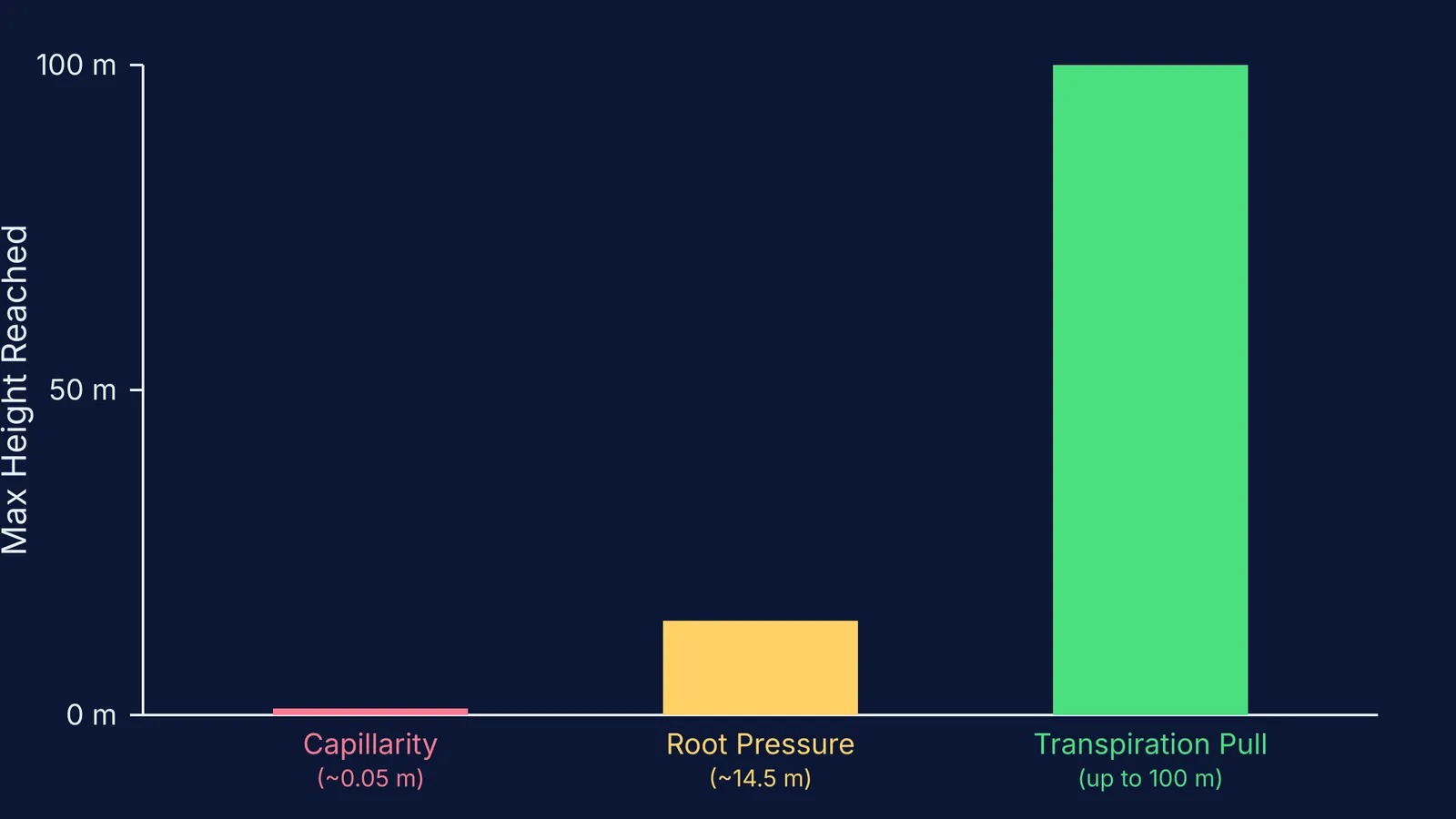
However, capillarity has a strict physical limit. While it helps form the concave menisci that initiate the pull of water in leaves, capillary action alone can only raise water by a few inches in tubes of typical xylem diameters. This might be enough for a tiny seedling, but it cannot explain how water reaches the canopy of a mango tree.
Can root pressure reach the canopy?
Root pressure is a positive hydrostatic pressure that pushes water upward from the base of the plant. It occurs when the water potential of root cells is more negative than the surrounding soil, drawing water into the root via osmosis.
Root pressure varies widely; while some species like *Vitis riparia* can reach 145 kPa (enough to push water a few meters), others have near zero root pressure. While it helps push sap up in the morning and is responsible for *guttation* (the exudation of water drops from leaf margins), it is largely absent during the day when transpiration is highest. Thus, root pressure cannot be the main engine for sap ascent in tall trees.
Why is transpiration pull the accepted theory?
To move water up the height of the tallest trees—up to 100 meters—plants rely on a mechanism that creates a negative suction force from above. The Cohesion-Tension Theory, proposed by Henry Horatio Dixon and John Joly in 1894, remains the most widely accepted explanation and is the primary theory taught in the ICSE biology curriculum.
It works in three continuous steps:
Transpiration: Water evaporates from the mesophyll cells of the leaves. This loss creates a negative pressure or "tension" at the top of the plant.
Cohesion: Because water molecules are polar, they form strong hydrogen bonds with one another. This cohesion ensures the water column does not snap.
Adhesion: Water also adheres to the walls of the xylem vessels, holding the column against gravity.
Together, these forces generate enough tension to lift a solid column of water to the canopy without requiring the plant to spend active energy on a pump.
How do you answer ICSE questions on sap ascent?
When answering questions on the ascent of sap in your ICSE exams, do not treat the three forces as equals. Use this simple checklist to structure your answer:
State the main mechanism: Explicitly name the Transpiration Pull (or Cohesion-Tension theory) as the primary driving force.
Define the supporting forces: Mention that cohesion and adhesion maintain the unbroken water column, while transpiration provides the suction.
Dismiss the minor forces: If asked to compare, point out that root pressure is a minor "push" from below (limited to small heights and morning hours) and capillarity is only a physical aid in narrow tubes.
If you are struggling to picture the invisible forces inside a plant stem, the Fermi Concept Library has every concept in biology, each with its own lesson and its place in the map. You can also explore related botany topics, such as how plants respond to stimuli in our guide to tropic movements in Class 10, or how they scale up in arithmetic vs geometric plant growth.
Understanding *why* a theory fails (like capillarity in a 50-meter tree) is often the key to remembering *why* the winning theory succeeds. Stick to the physics of water, and the biology will make perfect sense.


