

On this page
How do you evaluate the integral of sin x from 0 to π?
Evaluating the definite integral of the sine function between 0 and π is one of the foundational milestones in integral calculus. According to the Fundamental Theorem of Calculus, computing a definite integral requires finding the antiderivative of the integrand and evaluating it at the boundary limits. Because the derivative of cos x with respect to x is −sin x, the antiderivative of sin x is −cos x.
Setting up the integral from lower limit 0 to upper limit π yields:
∫₀^π sin x dx = [−cos x]₀^π = (−cos π) − (−cos 0)
Substituting the exact trigonometric values cos π = −1 and cos 0 = 1 produces:
(−(−1)) − (−1) = 1 + 1 = 2
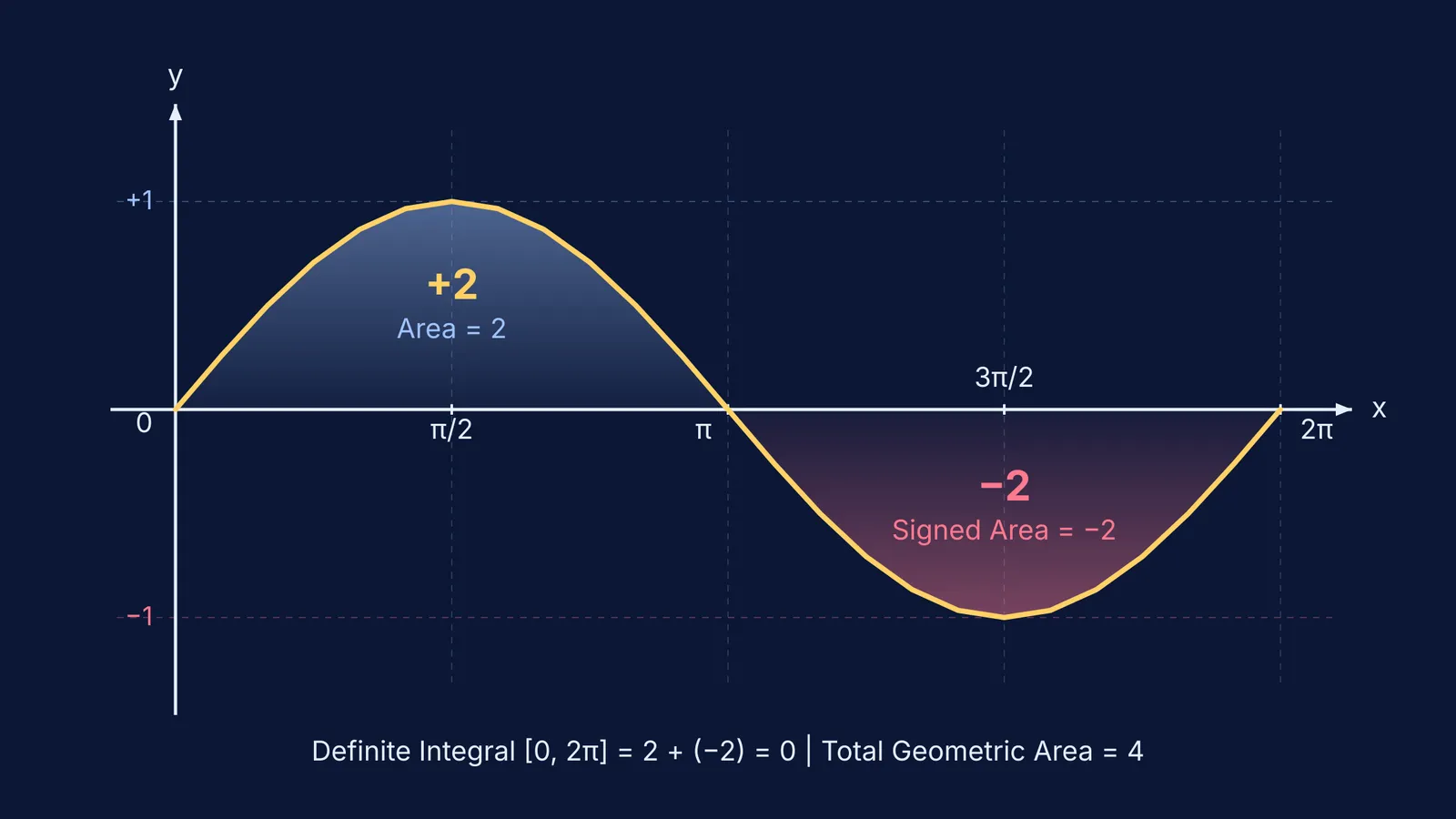
Over the domain [0, π], sin x is non-negative (sin x ≥ 0). Because the curve stays above the horizontal axis, every vertical strip y dx has positive height. Here, the net signed accumulation measured by the definite integral coincides exactly with the geometric area between the curve and the x-axis. As explained in our guide on area under curves, sketching the function first prevents confusion about whether the region sits above or below the baseline.
Why is the definite integral over [0, 2π] zero while the area is 4?
A classic trap in secondary and competitive mathematics involves extending the upper limit to one full period: [0, 2π]. If you apply the Fundamental Theorem of Calculus directly across the entire interval, the algebra gives:
∫₀²π sin x dx = [−cos x]₀²π = (−cos 2π) − (−cos 0) = −1 − (−1) = 0
Yet when you inspect the graph of y = sin x from 0 to 2π, there is an unmistakably visible two-lobed shape. How can a visible geometric figure possess an area of zero?
The paradox dissolves once you distinguish between a definite integral and a geometric area. A definite integral evaluates net signed area. By the additivity property of integrals, the full interval splits at the root x = π:
∫₀²π sin x dx = ∫₀^π sin x dx + ∫_π²π sin x dx
Computing the second sub-interval reveals why cancellation occurs:
∫_π²π sin x dx = [−cos x]_π²π = (−cos 2π) − (−cos π) = −1 − (−(−1)) = −1 − 1 = −2
Adding both halves gives 2 + (−2) = 0. Because the second arch lies below the horizontal axis where sin x ≤ 0, its Riemann sum contributes negative values.
To find the true geometric area, regions cannot have negative values. You must integrate the absolute value |sin x|, as detailed in our guide on definite integrals with modulus and floor:
Total Area = ∫₀²π |sin x| dx = ∫₀^π sin x dx + ∫_π²π (−sin x) dx = 2 + 2 = 4 square units
In Chapter 8 ("Application of Integrals") of the NCERT Class 12 Mathematics Part II textbook, official guidelines instruct students to divide regions into separate integrals wherever a curve crosses the x-axis, taking the absolute value of any sub-interval below the axis: Area = ∫₀^π y dx + |∫_π²π y dx| = 2 + |−2| = 4 square units.
Why do calculus students confuse signed area with geometric area?
In mathematics education research, this confusion is widely documented. In a study of 157 university calculus students published in the *International Journal of Mathematical Education in Science and Technology* (DOI: 10.1080/0020739X.2014.1001454), researcher Steven R. Jones found that students rely overwhelmingly on the shorthand phrase "area under a curve" without recognising that definite integrals calculate accumulated products rather than literal surface areas. When asked to interpret an integral that evaluated to zero, students frequently doubted their own algebra because their mental picture demanded a positive geometric quantity.
When working through integration problems where signs change across bounds, the Fermi Problem Library provides a step-by-step solver that explains the reasoning rather than just printing an answer. For reviewing fundamental theorems and related calculus definitions, the Fermi Concept Library maps every concept in physics, chemistry, biology, mathematics and computing, each with its own lesson and its place in the map.
How does this distinction appear in physics and alternating current?
The difference between signed integrals and positive magnitudes is not just an abstract mathematical distinction; it governs basic electrical physics. According to the NCERT Class 12 Physics Part I textbook (Chapter 7, "Alternating Current"), an alternating current source delivers a sinusoidal current described by i(t) = I₀ sin(ωt), where I₀ is the peak amplitude and ω is the angular frequency.
Over one complete cycle of period T = 2π/ω, the average current is zero:
I_avg = (1/T) ∫₀ᵀ I₀ sin(ωt) dt = 0
Because charges oscillate back and forth symmetrically, the net electric charge transferred through any cross-section over a full period equals zero. However, over a single positive half-cycle from 0 to T/2 (equivalent to integrating from 0 to π), the average current is:
I_avg(half cycle) = (2/T) ∫₀^{T/2} I₀ sin(ωt) dt = (2/π) I₀ ≈ 0.637 I₀
This numerator factor of 2 comes directly from ∫₀^π sin θ dθ = 2. Furthermore, electrical heating depends on Joule dissipation, proportional to i²(t) = I₀² sin²(ωt). Because sin²(ωt) remains non-negative across both half-cycles, power accumulates positively, yielding the root-mean-square current I_rms = I₀ / √2 ≈ 0.707 I₀. As shown in our guide on integrating over n periods, periodic symmetry lets you evaluate continuous signals across many cycles from a single fundamental loop.
What is the 3-step checklist for area questions in exams?
Under the CBSE Senior Secondary Curriculum and competitive assessments like JEE Main, sign errors on area questions are among the most avoidable point deductions. Use this 3-step checklist whenever an exam asks for "area bounded by a curve":
Solve for the x-intercepts: Set f(x) = 0 across the entire interval [a, b]. Identify every point where the curve crosses the axis. For sin x on [0, 2π], the roots are 0, π, and 2π.
Determine the sign of each piece: Test a value inside each sub-interval to see if the curve is above the axis (f(x) ≥ 0) or below the axis (f(x) ≤ 0).
Apply absolute values to negative regions: Never compute a single continuous antiderivative across crossing points. Write the total area as the sum of separate integrals: ∫_a^c f(x) dx + |∫_c^b f(x) dx|.
Following this procedure guarantees that opposing lobes do not cancel out, ensuring your final numerical answer reflects the true geometric area.


