

On this page
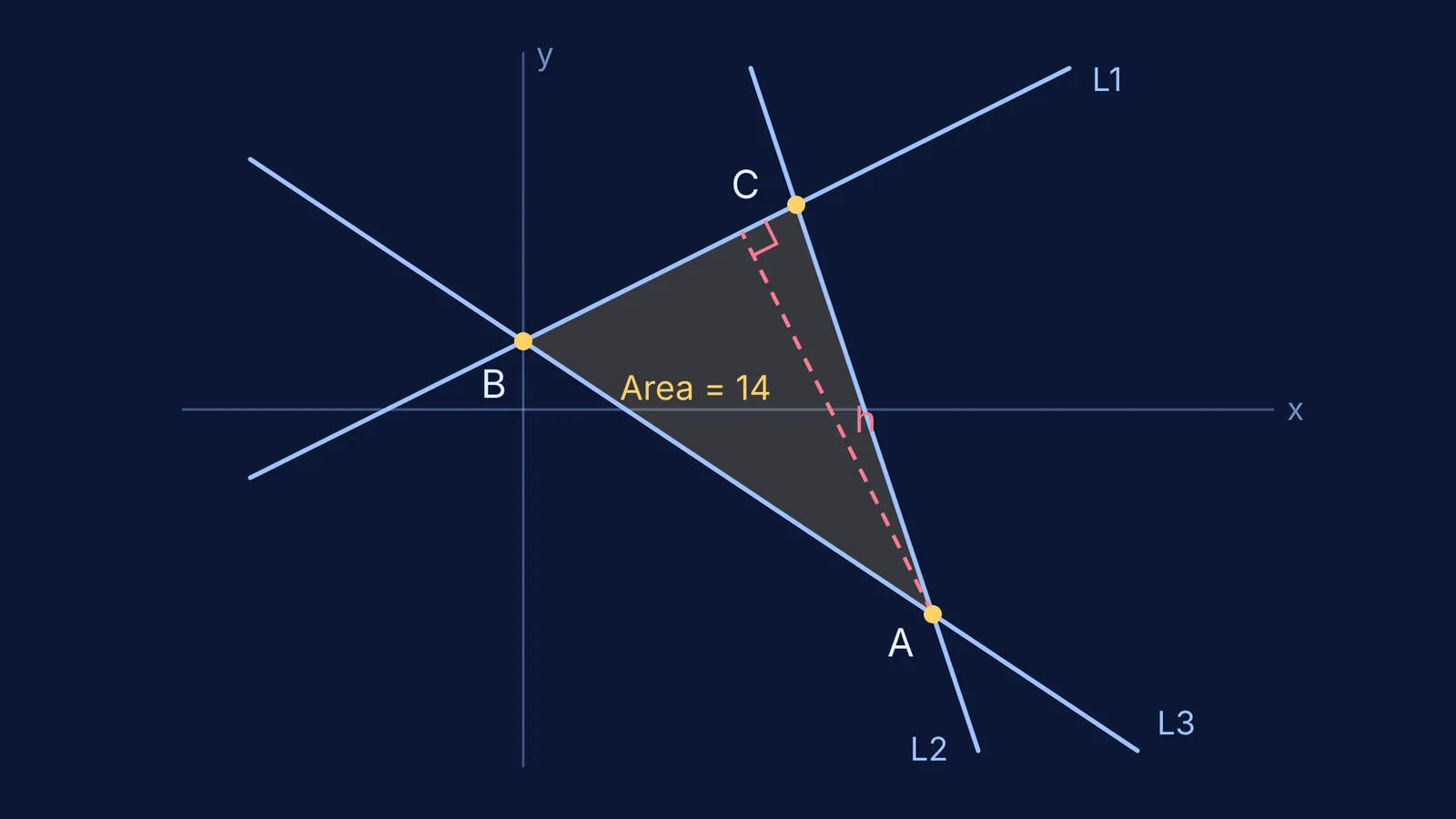
Three straight lines that are not parallel and do not pass through one point cut out a triangle. Board papers and entrance tests such as JEE Main can ask for its area in two ways: as a question where you show full working, or as a quick objective question where speed matters. You need a method you can trust, a fast one, and a quick check. We use the same three lines throughout:
L1: x − 2y + 2 = 0
L2: 3x + y − 15 = 0
L3: 2x + 3y − 3 = 0
How do you find the vertices of a triangle from three lines?
Each vertex is where two lines cross, so solve the equations in pairs. Name each vertex after the line it is not on; this helps with the check later.
L1 and L2 give C. From L1, x = 2y − 2. Put this into L2: 3(2y − 2) + y = 15, so 7y = 21, y = 3, x = 4. C is (4, 3).
L1 and L3 give B. Again x = 2y − 2, so 2(2y − 2) + 3y = 3, 7y = 7, y = 1, x = 0. B is (0, 1).
L2 and L3 give A. From L2, y = 15 − 3x, so 2x + 45 − 9x = 3, x = 6, y = −3. A is (6, −3).
Check each vertex in both its lines before going on.
The area of a triangle with vertices (x1, y1), (x2, y2), (x3, y3) is ½|x1(y2 − y3) + x2(y3 − y1) + x3(y1 − y2)|, half the determinant with rows (x, y, 1), also called the shoelace formula.
With A(6, −3), B(0, 1), C(4, 3): 6(1 − 3) + 0(3 + 3) + 4(−3 − 1) = −28. The area is 14 square units. Our post on the area of a triangle using a determinant explains this formula in more detail.
Is there a formula for the area directly from the line equations?
Yes. George Salmon derives it in Article 39 of A Treatise on Conic Sections by putting the three vertices into the vertex formula and simplifying. For lines aᵢx + bᵢy + cᵢ = 0, the result is:
Area = Δ² / (2|C1 · C2 · C3|)
Δ is the 3 × 3 determinant of all the coefficients, with rows (a1, b1, c1), (a2, b2, c2), (a3, b3, c3).
C1 = a2b3 − a3b2, C2 = a3b1 − a1b3 and C3 = a1b2 − a2b1. Each is built from the x and y coefficients of the other two lines.
For our lines, Δ = 1(−3 + 45) + 2(−9 + 30) + 2(9 − 2) = 98. The minors are C1 = 7, C2 = −7 and C3 = 7. So the area is 98² / (2 × 343) = 9604 / 686 = 14, with no vertices needed. Each minor is also the denominator you get solving that pair by Cramer's rule, which is why 7 kept turning up above.
Δ = 0 is the test for three concurrent lines, which has its own post.
How can you check the area using one side and its height?
A different formula catches mistakes that repeating a method would not. Side BC lies on L1. Its height is the distance from the opposite vertex A to L1.
The distance from (x0, y0) to ax + by + c = 0 is |ax0 + by0 + c| / √(a² + b²) (distance from a point to a line).
Height from A(6, −3) to L1: |6 + 6 + 2| / √5 = 14 / √5.
Length of BC, from (0, 1) to (4, 3): √(16 + 4) = 2√5.
Area = ½ × 2√5 × 14 / √5 = 14.
The √5 cancels, so the check is quick by hand. Naming vertices after the line they are not on pays off: the vertex opposite L1 is A.
Which method should you use in an exam?
Board question with full working: solve pairs, then use the vertex formula. Examiners can follow every step.
Objective or numerical answer: use Δ² / (2|C1C2C3|). Find the minors first, since a zero one means no triangle.
When you have a minute spare: run the side-and-height check.
If two methods disagree, look for a sign error in c (writing ax + by = c instead of ax + by + c = 0) or a vertex paired with the wrong line. Our guide to straight lines in coordinate geometry covers line equations.
If you cannot see where your working went wrong, the Fermi Problem Library has worked problems with a step-by-step solver that explains the reasoning rather than printing an answer.
Next step: take three lines from your textbook exercise and find the area all three ways. When all three agree, you have the method.


