

On this page
Many students get bogged down in algebra when asked to find the area of the triangle formed by z, iz, and z + iz. However, sketching these three points on the Argand plane reveals a simple geometric shape that takes seconds to solve.
Here is how to find the area of the triangle formed by z, iz and z + iz using geometry, and why it forms exactly half of a square.
How does multiplying by i change a complex number?
Every complex number z = x + iy can be plotted as a point (x, y) or a vector from the origin (0, 0) on the Argand plane.
When you multiply z by the imaginary unit i, you get iz = -y + ix. Geometrically, this operation rotates the original vector by 90° counterclockwise around the origin, without changing its length. The distance from the origin to z is its modulus |z|, so the length of the new vector iz is also |z|.
We can also see this in polar form. A complex number z has an angle θ and a length r. The number i has an angle of 90° (π/2 radians) and a length of 1. When you multiply two complex numbers, you multiply their lengths and add their angles. Therefore, multiplying by i simply adds 90° to the original angle, rotating it in the complex plane.
The Norwegian-Danish surveyor Caspar Wessel first published this geometric interpretation of complex numbers as points and vectors in 1799.
If you want to read more about how vectors behave on the plane, the Fermi Concept Library covers every concept in mathematics and physics, each with its own lesson.
Why do z, iz and z + iz form a square?
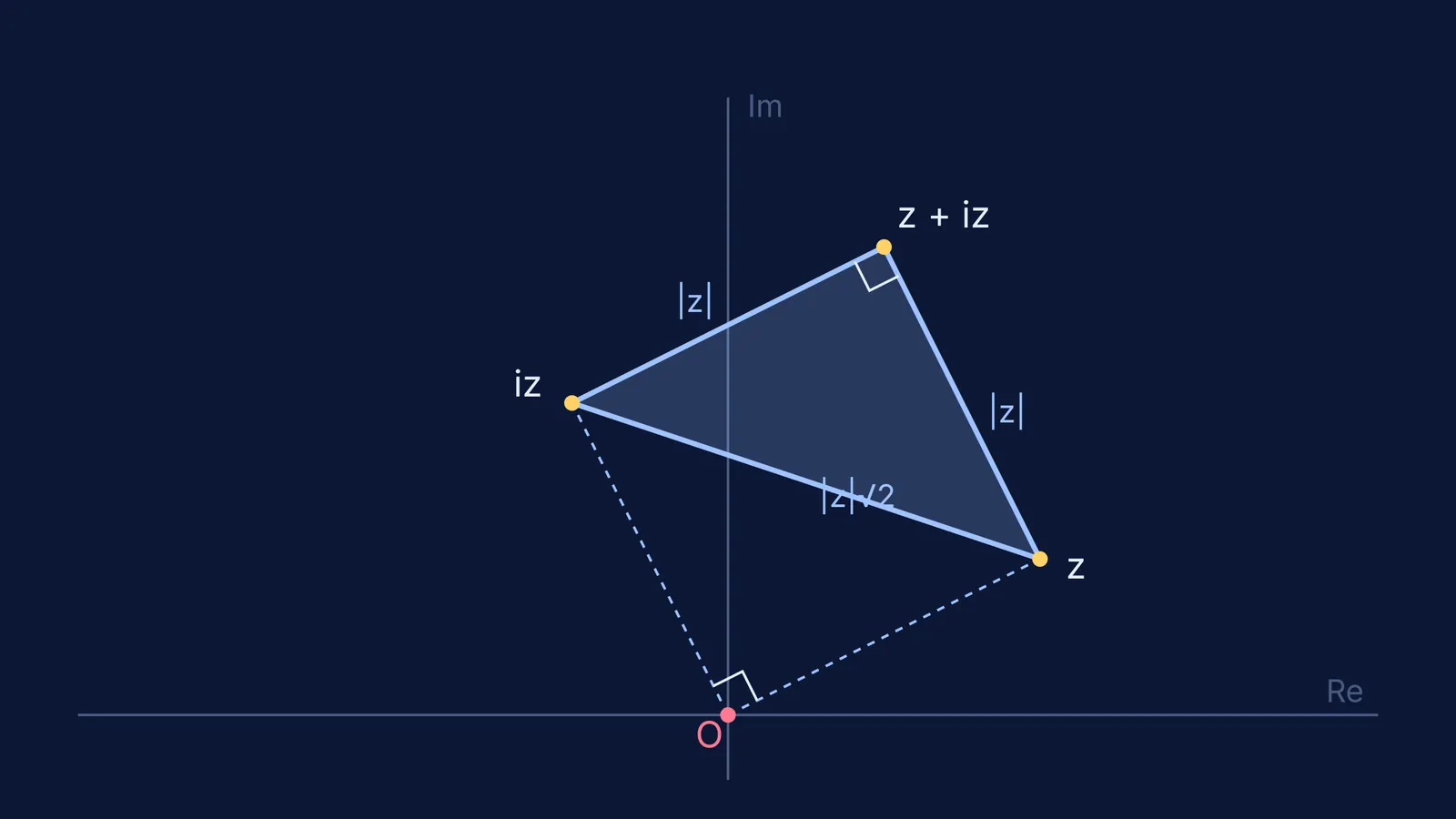
If you plot z and iz as vectors from the origin, they meet at a right angle. When you add two vectors, z + iz, the result is the diagonal of the parallelogram formed by them.
Because z and iz are perpendicular and have the exact same length |z|, their parallelogram is a perfect square. The four corners of this square are the origin (0, 0), z, z + iz, and iz. This geometric insight is the key to solving the problem without lengthy calculations.
What is the area of the triangle formed by z, iz and z + iz?
The problem asks for the area of the triangle whose vertices are z, iz, and z + iz.
Looking at the square we just built, these three points make up exactly one half of it. The triangle has its right angle at the vertex z + iz. Its two legs are the sides of the square:
The leg from z + iz to z has length |iz| = |z|.
The leg from z + iz to iz has length |z|.
The area of any right-angled triangle is ½ × base × height. Since both the base and the height are equal to |z|, the area of the triangle is ½|z|².
Solving the triangle algebraically
If you prefer to verify this with algebra, you can use the distance formula to find the lengths of the three sides of the triangle:
Distance between z and z + iz: |(z + iz) - z| = |iz| = |z|
Distance between iz and z + iz: |(z + iz) - iz| = |z|
Distance between z and iz: |z - iz| = |z(1 - i)| = |z|√2
If you square these side lengths, you can see that |z|² + |z|² = (|z|√2)². By Pythagoras' theorem, this confirms the triangle is a right-angled isosceles triangle with legs of length |z|. The area is ½ × |z| × |z| = ½|z|².
Finding the area with determinants
For those studying coordinate geometry, another common method to find the area of a triangle with vertices (x₁, y₁), (x₂, y₂) and (x₃, y₃) is using a determinant formula. The area is given by half the absolute value of the determinant of a 3×3 matrix containing the coordinates.
Let z = x + iy. The coordinates of our three vertices in the Argand plane are:
z → (x, y)
iz → (-y, x)
z + iz → (x - y, x + y)
If we set up the determinant, the calculation looks like this: Area = ½ | x₁(y₂ - y₃) + x₂(y₃ - y₁) + x₃(y₁ - y₂) |
x₁ = x, y₁ = y
x₂ = -y, y₂ = x
x₃ = x - y, y₃ = x + y
Area = ½ | x(x - (x + y)) + (-y)((x + y) - y) + (x - y)(y - x) | Area = ½ | x(-y) - y(x) - (x - y)² | Area = ½ | -xy - xy - x² + 2xy - y² | Area = ½ | -x² - y² | Area = ½(x² + y²)
Since the modulus squared of a complex number is |z|² = x² + y², the area calculated via determinants is precisely ½|z|². While the algebra confirms the answer perfectly, the geometric method using the square skips all these steps entirely, saving valuable time during an exam.
If you are stuck on similar problems, such as finding arg z in each quadrant: the principal value rules, or using z z̄ = |z|² to simplify complex number problems, the step-by-step solver in the Fermi Problem Library explains the reasoning behind each algebraic step rather than just printing an answer.


