

On this page
When paving a path around a circular garden or finding the amount of metal in a washer, you are looking at an annulus. In school mathematics, this usually shows up as the area of a circular path between two concentric circles.
What is the area of a circular ring between two circles?
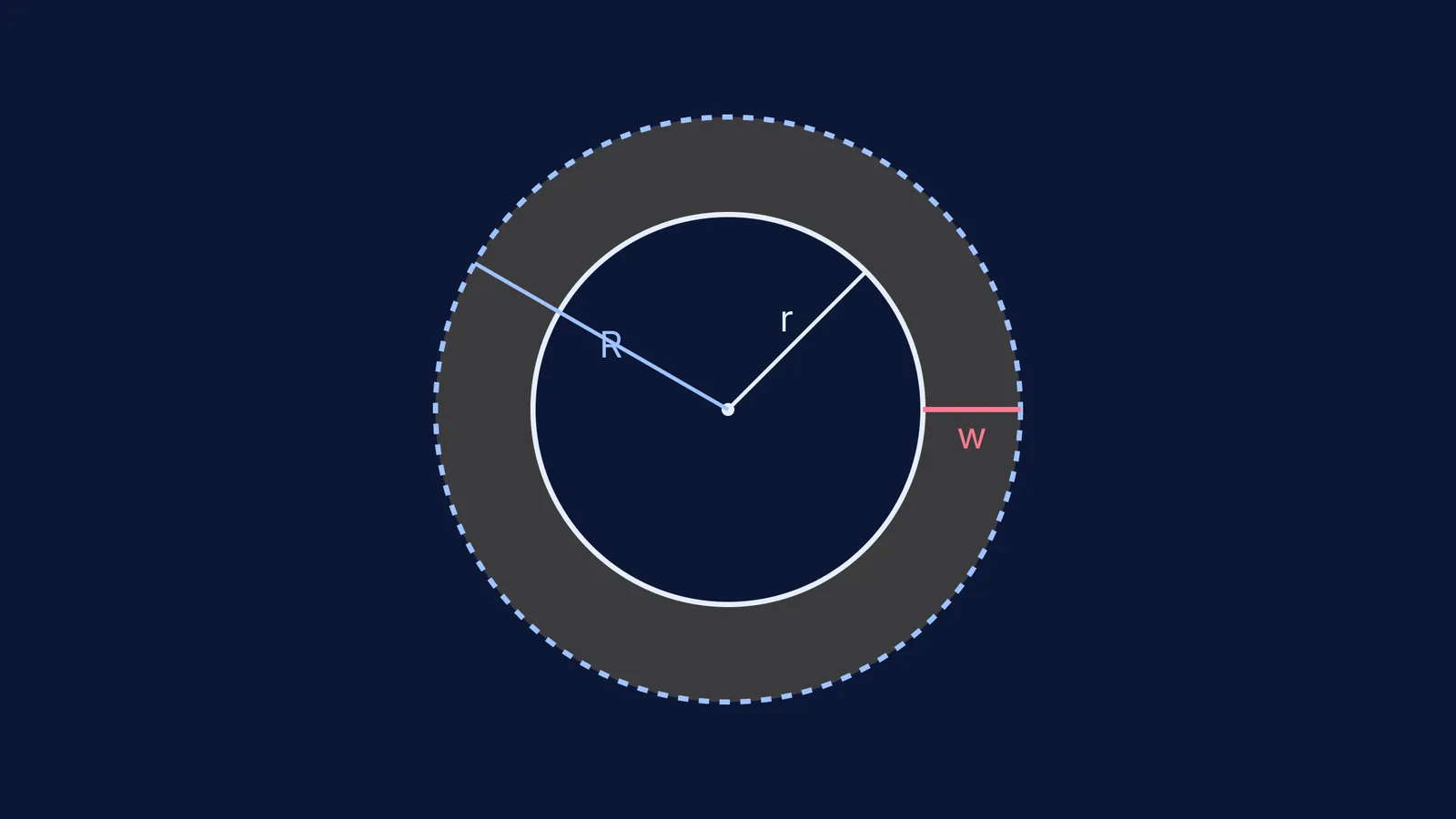
A circular ring is a large circle with a smaller circle cut out of the middle. To find its area, subtract the inner circle's area from the outer circle's area.
If the outer radius is R and the inner radius is r, the formula for the area of a ring is π(R² - r²) (Physics Wallah).
The path's width is the difference between the radii: R - r. A common mistake is treating the width as the radius itself, or squaring the difference as (R - r)². Instead, you must square the radii separately before subtracting.
If you are brushing up on circle concepts, the Fermi Concept Library breaks down everything from basic definitions to circle theorems and arcs.
How do you factorise the formula for easier arithmetic?
Calculating R² and r² is tedious with large numbers or decimals. You can use the algebraic identity a² - b² = (a - b)(a + b) to rewrite it.
The factorised area formula is π(R - r)(R + r) (Physics Wallah).
This version is much faster to compute by hand. The term (R - r) is the ring's width, and (R + r) is the sum of the radii. Turning squares into simple addition and subtraction reduces arithmetic errors.
Does the path run inside or outside the circle?
A common trap in exams is how the path is described. You must read carefully to know if the given radius is the inside or outside of the ring.
If a path is built outside a circle, the given radius is your inner radius (r). Add the path width to find the outer radius (R).
However, if a path is inside a circular field's boundary, the given radius is the outer radius (R). To find the inner radius (r), subtract the path's width. For example, if a circular field has a 20 m radius and a 2 m path is laid inside it, R is 20 m, and r is 18 m. Plugging wrong numbers into the formula is a frustrating way to lose marks, so always draw a sketch first.
Example: What is the area of the garden path?
Let's look at a Class 10 area problem. Suppose a circular park has a 21 m radius. A path 7 m wide runs around the outside. What is the path's area?
First, identify your two radii:
The inner radius r is the park itself: 21 m.
The outer radius R includes the park and the path: 21 + 7 = 28 m.
Now, apply the factorised formula: Area = π(R - r)(R + r) Area = (22/7) × (28 - 21) × (28 + 21)
Notice how simple the arithmetic becomes: Area = (22/7) × 7 × 49
The 7s cancel out immediately, leaving: Area = 22 × 49 = 1078 m²
If you used the un-factorised formula, you would calculate 28² (784) and 21² (441), subtract them to get 343, then multiply by 22/7. Factorising skips this heavy lifting.
How do you find the width when you know the area?
Sometimes a question provides the area of the circular ring and asks you to work backwards to find its width. This is where the factorised formula shines.
Imagine the area of an annulus is 88 cm², and the sum of its inner and outer radii is 14 cm. You need to find the ring's width.
Instead of setting up a complex quadratic equation with R², you can use the factorised version: Area = π(R - r)(R + r)
You already know the area is 88, the sum (R + r) is 14, and π is 22/7. Substitute these directly: 88 = (22/7) × (R - r) × 14
Simplify the right side by dividing 14 by 7: 88 = 22 × (R - r) × 2 88 = 44 × (R - r)
Divide both sides by 44: R - r = 2
Since R - r is the width of the ring, your answer is 2 cm. What could have been a messy calculation involving complex equations becomes a simple division problem.
When working through multi-step mathematics like this, Fermi's AI tutor helps you build a solid method. If you make a mistake, it notices where you are stuck and explains the reasoning rather than just printing the final answer.


