

On this page
When you integrate a function, you are reversing the process of differentiation. However, differentiation destroys information. The derivative of x², x² + 5 and x² − 42 is always 2x. If you only know that f'(x) = 2x, you cannot tell which original function you started with.
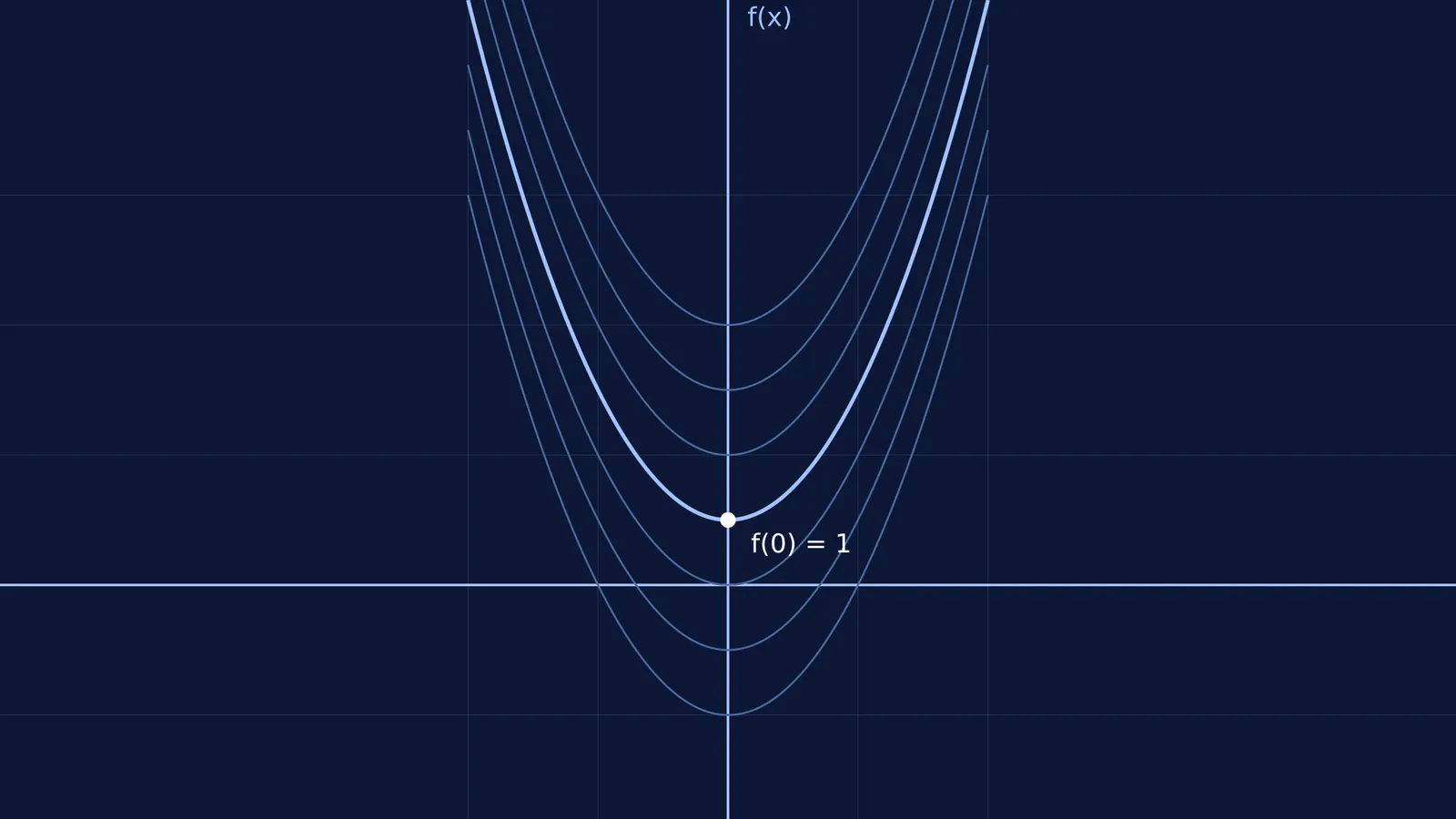
That is why integrating f'(x) gives you f(x) + C. The C is the constant of integration, and it means your answer is not a single curve, but an infinite family of parallel curves. To find the specific curve, you need one more piece of information: a point that the curve passes through, often given as an initial value like f(0).
If you are stuck on problems where the constant keeps getting away from you, the Fermi Problem Library has worked problems with a step-by-step solver that explains the reasoning rather than printing an answer.
How do you find f(x) from f'(x)?
To recover the original function from its derivative, you follow a simple two-step framework.
Find the indefinite integral: Integrate f'(x) with respect to x. Always add the constant of integration, C, at the end.
Substitute the known point: Plug the given x and y values into your new equation. Solve the resulting equation for C, and rewrite your function with this specific number.
What is the process for polynomial curves?
Problem: Find f(x) if f'(x) = 3x² − 4x + 2 and f(0) = 7.
Step 1: Integrate f'(x) We find the antiderivative of each term. ∫ (3x² − 4x + 2) dx = 3(x³/3) − 4(x²/2) + 2x + C = x³ − 2x² + 2x + C
So, f(x) = x³ − 2x² + 2x + C. This represents all possible curves with that derivative.
Step 2: Use f(0) to find C We are told that f(0) = 7. We substitute x = 0 and set the whole expression equal to 7. f(0) = (0)³ − 2(0)² + 2(0) + C = 7 0 − 0 + 0 + C = 7 C = 7
Now, replace C in the general equation with 7. f(x) = x³ − 2x² + 2x + 7.
This same principle applies when you use integration by parts or the substitution method. While definite integrals allow you to bypass C entirely, it is strictly required for indefinite integrals.
What if the given point is not at zero?
You do not always get f(0). You might be given f(1), f(π/2) or any other point on the curve. The method is exactly the same.
Problem: The slope of a curve at any point is given by dy/dx = cos x + sin x. The curve passes through the point (π, 3). Find the equation of the curve.
First, integrate the slope to find y. y = ∫ (cos x + sin x) dx y = sin x − cos x + C
Next, substitute the given point x = π and y = 3. 3 = sin(π) − cos(π) + C
We know that sin(π) = 0 and cos(π) = -1. 3 = 0 − (-1) + C 3 = 1 + C C = 2
The exact equation of the curve is y = sin x − cos x + 2.
How do you find position from velocity?
In physics, this exact mathematical rule connects velocity to position. Velocity, v(t), is the derivative of position, x(t). To find where an object is at any time, you integrate its velocity function. The constant of integration becomes the initial position, often written as x₀.
Problem: A particle moves with a velocity v(t) = 6t m/s. If its starting position at t = 0 is 4 m, find its position function x(t).
Since v(t) = x'(t), we integrate to find position. x(t) = ∫ 6t dt x(t) = 3t² + C
The problem states that at t = 0, x = 4. x(0) = 3(0)² + C = 4 C = 4
The position function is x(t) = 3t² + 4.
This process of finding the constant of integration is also how you derive the motion in a plane from r(t) vectors, and how you find an object's velocity given a variable acceleration as a function of v. Whenever you move a step up the chain of derivatives, you must anchor your formula with a known data point.
What if you start with the second derivative?
Sometimes, you are given f''(x) and need to find f(x). Because you are two steps removed from the original function, you have to integrate twice. This creates two separate constants of integration, so you need two initial conditions to solve the problem.
Problem: Find f(x) given that f''(x) = 12x, with the initial conditions f'(0) = 5 and f(0) = -2.
Step 1: Integrate to find f'(x) f'(x) = ∫ 12x dx f'(x) = 6x² + C₁
Use the condition f'(0) = 5 to find C₁: f'(0) = 6(0)² + C₁ = 5 C₁ = 5
So, f'(x) = 6x² + 5.
Step 2: Integrate again to find f(x) f(x) = ∫ (6x² + 5) dx f(x) = 2x³ + 5x + C₂
Use the condition f(0) = -2 to find C₂: f(0) = 2(0)³ + 5(0) + C₂ = -2 C₂ = -2
The final function is f(x) = 2x³ + 5x − 2.
In mechanics, this is exactly what you do when you start with a constant acceleration and integrate twice to find a falling object's position over time. The rules for second-order derivatives require care to ensure each constant is applied correctly. If you struggle with keeping these nested steps organised, Fermi's AI tutor teaches rather than answers: it holds a line of reasoning across a session, notices where you are stuck, and decides whether to explain, ask or show.


