

On this page
Aluminium sits above zinc and iron in the reactivity series, so you would expect it to corrode faster than iron. Yet aluminium window frames and pressure cookers last for years. The answer is an oxide layer too thin to see, and anodising makes it thicker.
Why doesn't aluminium corrode even though it is reactive?
Start with the numbers. In the LibreTexts table of standard reduction potentials, the Al³⁺/Al couple is −1.676 V, compared with −0.7618 V for zinc and −0.44 V for iron. The more negative the value, the more readily the metal gives up electrons, so aluminium really is the more reactive metal.
The product of that reaction is what protects it. The Royal Society of Chemistry's periodic table notes that aluminium "forms a microscopically thin oxide layer, protecting its surface from further corrosion." Aluminium oxide does not dissolve in water (Chemguide), so once the film forms, water and air are kept away from the fresh metal below. Iron is different: its rust does not seal the surface, so corrosion keeps going, as our post on why iron rusts and how to stop it explains.
There is a catch: aluminium oxide is amphoteric, so it reacts with hot dilute hydrochloric acid and with hot, concentrated sodium hydroxide (Chemguide).
What is anodising?
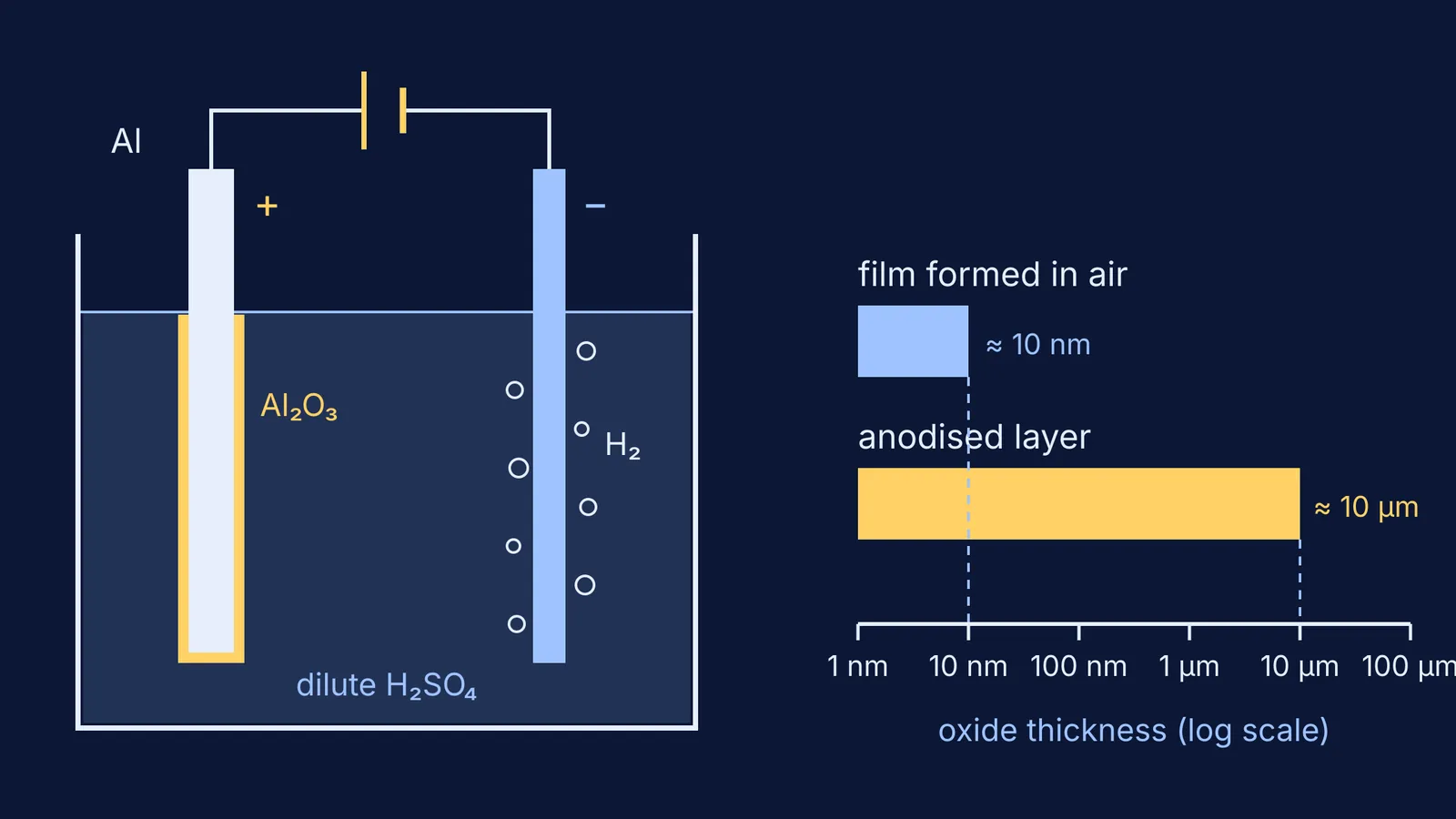
Anodising thickens aluminium's natural oxide layer by electrolysis: the clean aluminium object is made the anode in a cell containing dilute sulfuric acid. The RSC's classroom demonstration of anodising uses sulfuric acid of about 2 M at 5–10 V and runs the current for about 20 minutes. Here is what happens at each electrode:
At the anode, aluminium is oxidised to aluminium oxide: 2Al + 6OH⁻ → Al₂O₃ + 3H₂O + 6e⁻.
At the cathode, hydrogen ions are reduced: 6H⁺ + 6e⁻ → 3H₂, so bubbles appear there.
The RSC also gives the scale. Untreated aluminium has an oxide layer about 10⁻⁸ m thick, and anodising thickens it to about 10⁻⁵ m (RSC). That is roughly a thousand times thicker. The same page warns that the hydrogen given off is highly flammable, so this is a demonstration for a teacher's lab, not your kitchen.
How is anodised aluminium dyed and sealed?
The anodised layer is not a solid sheet. A 2020 review of the sealing step in Coatings describes it as a nano-porous oxide. Those pores are what make dyeing possible. In the RSC demonstration, the freshly anodised piece sits in hot dye for about 10–15 minutes, then goes into boiling water for another 10 minutes to seal the dye in.
Sealing is chemistry too. The Coatings review explains that hot water, often at 95 °C or above, hydrates the porous oxide into a crystalline hydrate called boehmite, which fills the pores. This keeps the finish looking good and improves corrosion resistance. The review reports hot-water sealing rates of about 2 minutes per micrometre of coating, and calls sealing arguably the second most energy-hungry step in anodising.
Worked example: how much oxide can a current make?
Anodising is a neat way to practise Faraday's laws. Suppose 0.5 A flows for 20 minutes and every electron goes into making oxide.
Charge: Q = It = 0.5 A × 1200 s = 600 C.
Moles of electrons: 600 ÷ 96,485 ≈ 0.00622 mol. The Faraday constant is 96,485.332 C/mol (NIST CODATA).
Electrons per formula unit: the anode equation shows 6 electrons for each Al₂O₃.
Moles of oxide: 0.00622 ÷ 6 ≈ 0.00104 mol.
Mass: 0.00104 mol × 101.96 g/mol (2 × 26.98 + 3 × 16.00) ≈ 0.106 g.
Treat that as an upper limit, because the question assumed all the charge forms oxide. For more on electrons per mole of product, see our guide to electrolysis and Faraday's laws. To practise more, the Fermi Problem Library has worked problems with a step-by-step solver that explains the reasoning rather than printing an answer.
What do exam questions on anodising usually test?
Check you can answer each of these without notes:
Which electrode is the aluminium object? The anode, which is where the name comes from.
What is the electrolyte? Dilute sulfuric acid.
What forms where? Aluminium oxide on the anode, hydrogen gas at the cathode.
Why can it be dyed? The anodised layer is porous; sealing in hot water then closes the pores.
Why doesn't reactive aluminium corrode? Its oxide seals the surface, unlike rust on iron.
How is it different from galvanising? Galvanising coats iron with zinc; anodising grows the metal's own oxide. Our Class 10 guide to metals and the reactivity series covers the other methods.
If electrode potentials or oxidation still feel shaky, the Fermi Concept Library gives every concept in chemistry its own lesson and its place in the map, so you can revise oxidation, electrolysis and corrosion as connected ideas.


