

On this page
Calculus is the most heavily weighted unit in the CBSE Class 12 Mathematics curriculum, carrying 35 out of the 80 theory marks. Definite and indefinite integrals make up a substantial part of that total.
A common pattern in board exams and competitive tests involves fractions with sine or cosine terms in the denominator. When the angles in the numerator and denominator don't match, substitution rarely works directly. Instead, you need the angle-shift trick: writing one angle as a combination of the others to force a cancellation.
How to find the integral of sin x by sin x - a?
This is a classic introductory problem from Chapter 7 of the NCERT Class 12 textbook. You are asked to integrate:
∫ [sin x / sin(x − a)] dx
The denominator has an awkward (x − a) inside the sine function. The trick is to rewrite the numerator's angle to match it, by subtracting and adding a:
x = (x − a) + a
Now, substitute this back into the numerator:
∫ [sin((x − a) + a) / sin(x − a)] dx
Expand the numerator using the compound angle identity sin(A + B) = sin A cos B + cos A sin B:
sin((x − a) + a) = sin(x − a) cos a + cos(x − a) sin a
Divide both terms by the denominator, sin(x − a):
∫ [ (sin(x − a) cos a) / sin(x − a) + (cos(x − a) sin a) / sin(x − a) ] dx = ∫ [ cos a + cot(x − a) sin a ] dx
Because a is a constant, cos a and sin a are just numbers. The integral of a constant is the constant times x, and the integral of cot u is ln|sin u|.
Answer = x cos a + (sin a) ln|sin(x − a)| + C
How do you integrate 1 / (sin(x-a) sin(x-b))?
What if the numerator is 1, and the denominator has a product of two sine functions with different angles?
∫ 1 / (sin(x − a) sin(x − b)) dx
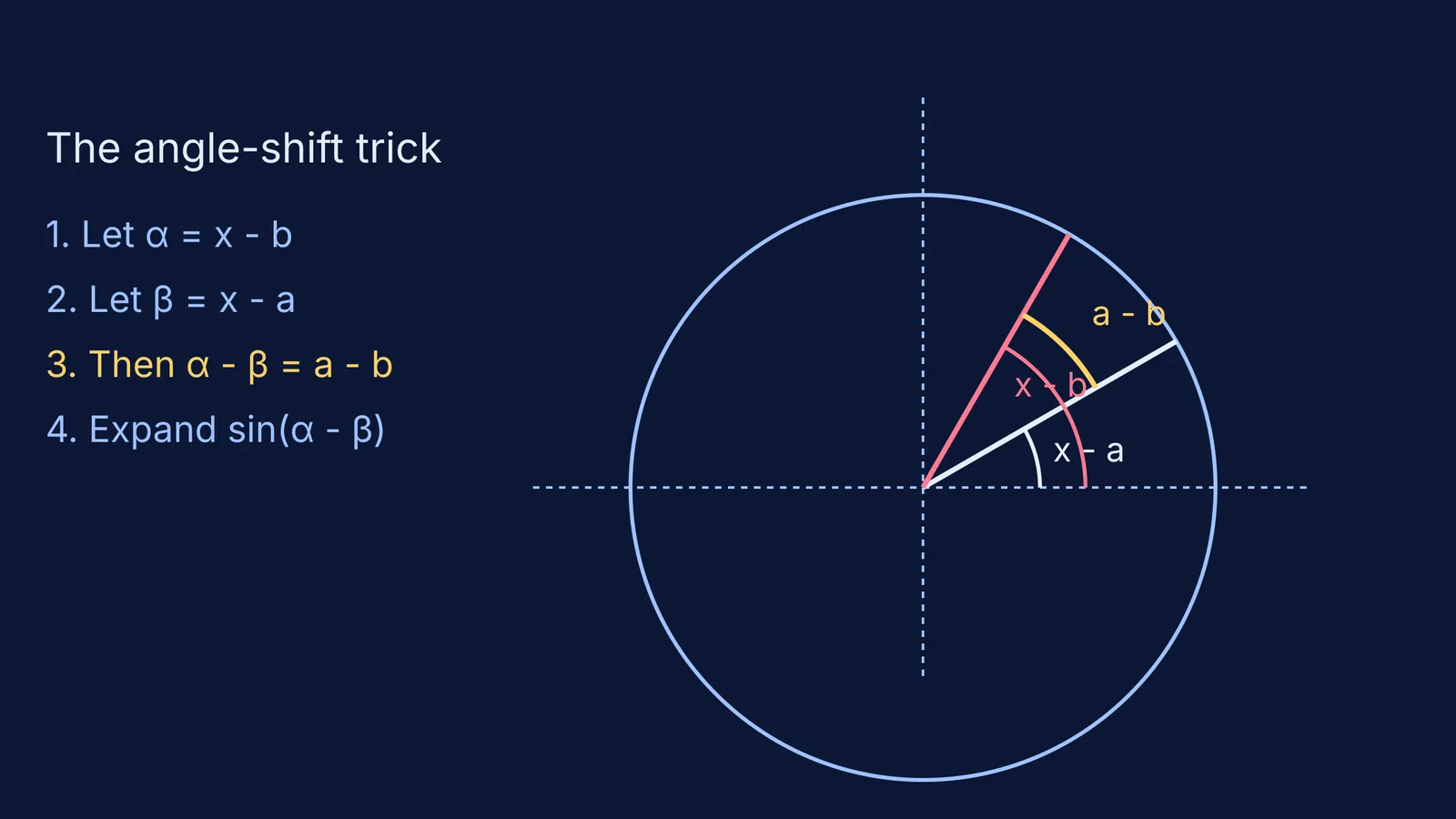
Here, there is no sine term on top to expand. The angle-shift trick still works, but you have to introduce the term yourself. You multiply the numerator and the denominator by a constant: sin(a − b).
∫ [ 1 / sin(a − b) ] × [ sin(a − b) / (sin(x − a) sin(x − b)) ] dx
Next, rewrite the constant angle (a − b) as the difference between the two angles in the denominator:
a − b = (x − b) − (x − a)
Geometrically, (x − a) and (x − b) are two angles on the unit circle rotating by the same amount x. The angle between them is always their difference, (a − b), which remains constant. By writing sin(a − b) as sin((x − b) − (x − a)), you map this fixed geometric gap back into algebraic terms you can divide.
[ 1 / sin(a − b) ] ∫ [ sin((x − b) − (x − a)) / (sin(x − a) sin(x − b)) ] dx
Expand the numerator using sin(A − B) = sin A cos B − cos A sin B:
sin((x − b) − (x − a)) = sin(x − b) cos(x − a) − cos(x − b) sin(x − a)
Divide each term by the denominator sin(x − a) sin(x − b). The first term simplifies to cot(x − a) because the sin(x − b) terms cancel. The second term simplifies to cot(x − b).
[ 1 / sin(a − b) ] ∫ [ cot(x − a) − cot(x − b) ] dx = [ 1 / sin(a − b) ] [ ln|sin(x − a)| − ln|sin(x − b)| ] + C
Using the logarithm rule ln m − ln n = ln(m / n), you get the final result:
Answer = [ 1 / sin(a − b) ] ln | sin(x − a) / sin(x − b) | + C
What if the denominator is cos(x-a) cos(x-b)?
The exact same technique applies when both terms in the denominator are cosines. You still multiply the numerator and denominator by sin(a − b).
When you expand sin((x − b) − (x − a)) and divide by cos(x − a) cos(x − b), the sine terms on top and cosine terms on the bottom will cancel to give tangents instead of cotangents:
tan(x − b) − tan(x − a)
The integral of tan u is −ln|cos u|, which leads to a similar logarithmic result.
If the denominator is mixed — one sine and one cosine, like sin(x − a) cos(x − b) — you must multiply and divide by cos(a − b) instead. This ensures the terms split neatly into tangents and cotangents without leaving un-integrable fractions behind.
How do you spot the right integration trick?
In calculus, half the battle is spotting the pattern before you start writing. If you struggle to decide between multiplying by a constant, u-substitution, or trigonometric identities, the Fermi Problem Library has worked problems with a step-by-step solver that explains the reasoning rather than printing an answer.
When you get stuck on a difficult integral, Fermi's AI tutor works out what you already know and builds a plan for the session. It teaches through the problem — writing on a board and checking your understanding as it goes — so you learn to recognise the angle-shift trick the next time it appears on a paper.


